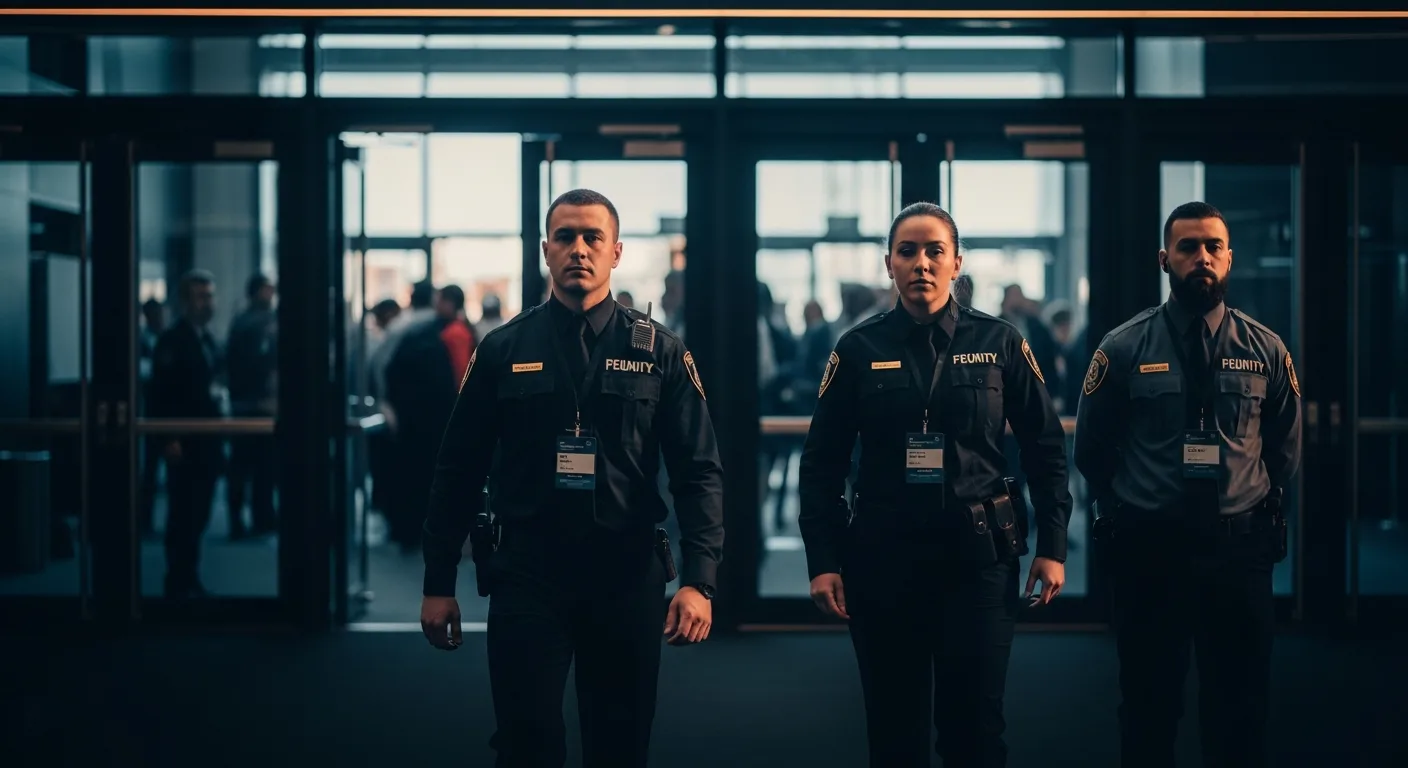
Armed guards aren't automatically 'better' — they cost more, carry more liability, and are the wrong call for most sites. Here's how to match the guard to the real threat, with national cost figures, a state-by-state firearm-permit table, and the insurance gaps to watch.
When people picture "better" security, they often picture a firearm. But armed and unarmed guards solve different problems, and choosing armed coverage where the threat doesn't call for it simply raises your cost and your liability without a matching gain in safety. The right question isn't "armed or unarmed?" — it's "what threat am I actually defending against?" This guide gives you a clear framework, national cost data, a scoreable threat-assessment tool, a state-by-state look at what armed guards must be licensed to carry, and the insurance traps that catch buyers off guard.
Quick answer: Most commercial sites — reception, retail, residential, general deterrence — are well served by trained unarmed guards, which run roughly $22–$35 an hour in 2026. Choose armed guards — roughly $30–$48 an hour — when a credible, documented threat carries severe or lethal consequences, or when you're protecting cash and high-value liquid assets. Armed typically costs about 40% more, requires a separate state firearm permit, and raises your liability and insurance exposure. Let a genuine threat assessment (not a gut feeling) make the call.
Key differences at a glance
| Unarmed guard | Armed guard | |
|---|---|---|
| Typical bill rate (2026) | ~$22–$35/hr | ~$30–$48/hr (high-cost metros run higher — see below) |
| Best for | Reception, access control, retail, residential/HOA, patrols, deterrence | Cash handling, banks/jewelry, dispensaries, high-value assets, elevated threat |
| Force capability | Observe, deter, report; reasonable/citizen's-arrest force only | Can meet a lethal or violent threat |
| Credential | State guard registration (or agency-vetted) | Guard registration + separate state firearm permit |
| Liability insurance | Lower | Higher — often 2–3× the insurance cost |
What the cost difference really is
Unarmed coverage runs roughly $22–$35 an hour nationally and armed roughly $30–$48 an hour — a premium of about 40%, driven by firearms training, permitting, and much higher insurance. That premium is the honest national picture; earlier rules of thumb that pegged armed at $70–$100+ an hour were quoting high-cost-metro or high-risk-detail rates as if they were the national norm.
Where you are matters. In a high-cost coastal market such as Los Angeles / Orange County, an unarmed post can push toward the top of the national band (roughly $35–$40 an hour) and armed posts carry a metro premium on top of the national figure. Dense Midwestern markets like Chicago sit between the national midpoint and the coastal high end. Treat those metro numbers as an explicitly regional adder — not the national rate.
Treat every one of these ranges as directional, not a quote. The actual number turns on shift length, the number of posts, the officer's certifications, overnight or holiday differentials, and how targeted your site is. Remember, too, that these are client bill rates, not the guard's wage — the underlying guard wage is generally $16–$25 an hour, marked up roughly 1.5–2.5× for overhead, insurance, and margin. See our full security cost guide for how the rate is built and how it varies by state.
The threat-assessment scorecard
The whole armed-vs-unarmed decision should turn on a documented threat assessment — but "do a threat assessment" is useless advice without a method. Here is one. Score your site on each factor, add the points, and read the band. It is a decision aid, not legal advice, but it forces the conversation onto evidence instead of unease.
| Factor | What raises your score | Points |
|---|---|---|
| Asset value & liquidity | Cash, jewelry, precious metals, pharmaceuticals, firearms, or easily-fenced high-value inventory on site | 0–3 |
| History of violent incidents | Robbery, assault, or weapons incidents on or immediately adjacent to the site in the last 24 months | 0–3 |
| Cash handling | Regular cash on premises or cash-in-transit exposure | 0–2 |
| Likelihood of armed offenders | Local crime pattern, business type, or past events suggest offenders may arrive armed | 0–3 |
| Isolation / response time | Law-enforcement response time over ~10 minutes; remote, rural, or after-hours site | 0–2 |
| Direct threats to people | Specific, credible threats against employees, executives, or residents (stalking, terminations, disputes) | 0–3 |
| Regulatory / contractual mandate | A regulator, insurer, or client contract requires armed coverage | 0–2 (or auto-arm) |
| Target profile | Symbolic, controversial, or high-visibility site more likely to attract a determined attacker | 0–2 |
Read your total (max 20):
- 0–5 — Unarmed is sufficient. A trained, visible officer delivers the deterrence and documentation you need. Arming here adds cost and liability with no proportionate gain.
- 6–10 — Consider armed, or a hybrid. Look at armed coverage for specific shifts (cash pickups, overnight, isolated hours) or an armed supervisor over an unarmed team, rather than arming every post.
- 11+ — Armed is warranted. A credible, potentially lethal threat is present. Pair the armed program with a written use-of-force policy and verified insurance (see the checklist below).
Tip: Any single "auto-arm" trigger — a regulatory mandate, an active credible threat against a specific person, or documented armed-robbery history at the exact site — can justify armed coverage on its own, regardless of the total. Use the score to catch the borderline cases, not to override an obvious one.
When you need an armed guard
Armed coverage is warranted where a successful attack would carry severe or lethal consequences, or where high-value liquid assets attract determined, potentially violent offenders. Common cases:
- Cash-in-transit and cash handling.
- Banks, jewelry stores, and high-value inventory.
- Cannabis dispensaries (largely cash businesses).
- Executive protection and high-risk individuals.
- Sites with a credible or documented elevated threat.
A firearm materially changes the operation's risk profile from an insurer's standpoint, so an armed decision should follow a genuine threat assessment — not a general sense of unease.
When unarmed is enough
For most commercial sites, a trained unarmed officer delivers the deterrence you need at significantly lower cost and lower liability. The officer's value there is being seen, documenting activity, controlling access, and calling in the right response — not using force. These profiles almost always sit in the unarmed band:
- Corporate reception & lobby. Low-traffic, badge-controlled, daytime. The job is access control and a professional first impression.
- Retail & shopping-center deterrence. Visible presence deters shoplifting and loitering; the officer observes and reports, and calls police for anything beyond that. Firing to protect merchandise is unlawful in most states regardless.
- Residential / HOA & multifamily patrol. Gate control, roving patrol, parking and noise enforcement, incident documentation.
- Construction & equipment yards (fenced, low-value or insured assets). Overnight deterrence and access logging; theft here is a property-loss problem, not a lethal-threat problem.
- Offices, warehouses, and campuses without cash or elevated threat. General presence, after-hours access, and alarm response back-stopped by police.
When to escalate to armed. Revisit the unarmed decision if any of these appear:
- Cash or high-value liquid assets start living on site, or you take on cash-in-transit.
- An armed robbery, weapons incident, or credible threat occurs on or next to the property.
- Your insurer, a regulator, or a client contract requires armed coverage.
- Law-enforcement response times are long enough that "call and wait" is not a real plan.
- A specific, credible threat is made against a person on site.
Adding firearms where the threat doesn't justify them raises cost and legal exposure without a proportionate security gain — which is exactly why the scorecard above exists.
What the armed premium actually costs: a worked comparison
Abstract percentages hide the real number. Here is one continuously staffed 24/7 post — a single position covered around the clock, which takes 8,760 officer-hours a year — priced at canonical 2026 bill rates.
| 24/7 post (8,760 hrs/yr) | Unarmed | Armed |
|---|---|---|
| Bill rate | $22–$35/hr | $30–$48/hr |
| Per month (~730 hrs) | ~$16,000–$25,600 | ~$22,000–$35,000 |
| Per year | ~$193,000–$307,000 | ~$263,000–$420,000 |
| Representative midpoint | ~$245,000/yr | ~$342,000/yr |
The true annual gap for a single 24/7 post is roughly $70,000–$115,000 a year (about $95,000 at the midpoints). That is the visible cost of arming — and for a genuine lethal threat, it is money well spent.
Now price the tail
The cost that never appears on the quote is the liability tail. Suppose an armed guard uses their firearm — and assume it was justified. A civil claim still follows, and it names the guard, the security firm, and often you. Defense costs alone routinely reach six figures; if the firm's assault-and-battery or firearms endorsement is sublimited (commonly $50,000–$100,000) and defense costs erode that limit, everything above it is exposed.
Put rough numbers on it. Call the annual probability of a discharge-with-claim at a genuinely elevated post something under 1% — say 0.5–1% per post-year — and the uninsured exposure when a sublimit is exhausted somewhere in the $500,000–$1,000,000+ range. The expected annual cost is small — roughly $3,000–$8,000 a year — because most years nothing happens. But the distribution is the point: it is mostly zero with a rare six- or seven-figure hit. A single uninsured $500k–$1M tail event equals 5 to 10+ years of the entire armed rate premium, absorbed in one incident.
None of this means never arm — against a real lethal threat, the alternative is worse. It means the deterrence value of a firearm has to be weighed against a low-probability, high-severity tail that can dwarf years of the rate difference. That is precisely why the decision should follow the documented threat assessment above and a hard look at the provider's actual coverage limits — not a gut sense that "armed is safer."
Liability and insurance: the hidden cost of armed
This is where the armed decision gets expensive in ways that aren't on the quote. Several traps:
- Standard policies exclude the core risk. Commercial general-liability (CGL) policies are built on an accidental "occurrence" trigger and commonly exclude assault & battery and firearms/use-of-force — precisely the armed guard's core exposure. Armed operations need a specific firearms-liability and assault-and-battery endorsement, or a claim can be denied outright.
- Endorsements are often sublimited. Assault-and-battery coverage is frequently capped (illustratively $50,000–$100,000) and defense costs can erode that sublimit — so "we have A&B coverage" isn't the end of the question; the limit is.
- Armed insurance costs 2–3× unarmed. A firearm on site raises premiums across the board.
- You share the liability. As the client, you can face exposure through respondeat superior (vicarious liability for a guard's acts within the scope of duty) and negligent hiring (for failing to vet the provider). Your own property insurer may also add a surcharge for armed personnel on site.
Provider-verification / COI checklist for armed programs
Don't assume an armed company's general-liability policy covers a shooting. Before you sign, get a certificate of insurance (COI) and confirm each of the following in writing:
- Named endorsements are present. Look for an explicit assault & battery endorsement and a firearms / use-of-force (or "armed operations") endorsement — by name, not just a general-liability line.
- Read the sublimit, not just the policy limit. A $1M general limit can sit over a $50,000–$100,000 A&B sublimit. The sublimit is your real ceiling for the exact risk you care about.
- Confirm whether defense costs erode the limit. "Defense inside the limits" (eroding / "wasting" limits) means legal fees eat your coverage before any payout. Prefer defense outside the limits.
- Get named as an additional insured. Confirm your organization is added — ideally with a waiver of subrogation — so the provider's policy responds for you, not just for them.
- Check limits and carrier rating. Adequate per-occurrence and aggregate limits, and an A-rated (admitted or reputable surplus-lines) carrier, not an unrated captive.
Red flags on a certificate: no armed/firearms endorsement listed; an A&B sublimit far below the headline limit; "defense within limits"; a policy that expires mid-contract; your name absent from the additional-insured line; or a carrier you can't verify. Any one of these leaves you exposed. See security contracts and insurance for the full contract walkthrough.
Use of force and the legal standard
A firearm doesn't come with police powers. A private security officer — armed or not — is a private citizen in the eyes of the law, without the qualified immunity or the arrest authority a sworn officer carries. That distinction shapes everything about when force is lawful.
The general standard is objective reasonableness and proportionality: force has to match a genuine, imminent threat, and it ends the moment the threat does. Deadly force — which is what a firearm represents — is lawful only against an imminent threat of death or serious bodily harm to the officer or another person, and almost never to protect property alone. A guard who fires to stop a fleeing shoplifter or to defend merchandise is, in most states, exposed to criminal charges and a civil suit regardless of the badge on the uniform.
Duty to retreat vs. stand your ground, by state
The specifics vary by state and matter a great deal. A majority of states follow stand-your-ground rules (no duty to retreat where you're lawfully present); a minority — concentrated in the Northeast and mid-Atlantic — impose a duty to retreat in public before deadly force, if it can be done safely. Every state keeps some form of castle doctrine (no duty to retreat in your own home). Here's where the largest security markets fall:
| State | Public-deadly-force regime (2026) |
|---|---|
| Texas | Stand your ground |
| Florida | Stand your ground |
| Georgia | Stand your ground |
| North Carolina | Stand your ground |
| Pennsylvania | Stand your ground (with conditions) |
| Arizona | Stand your ground |
| Tennessee | Stand your ground |
| Virginia | No statutory duty to retreat (case law) — functionally stand your ground |
| Washington | No statutory duty to retreat (case law); reasonableness of retreat can be weighed |
| Illinois | No statutory duty to retreat; retreat may factor into "necessity" |
| California | No broad duty to retreat, but prosecutors may argue retreat was possible |
| New York | Duty to retreat in public (castle doctrine at home) |
| New Jersey | Duty to retreat in public (castle doctrine at home) |
| Maryland | Duty to retreat in public (castle doctrine at home) |
Private-person ("citizen's") arrest authority is narrow and differs by jurisdiction — often limited to felonies or breaches of the peace committed in the officer's presence, with the guard personally liable for a wrongful detention or an unlawful use of force. Even displaying a weapon can amount to brandishing or menacing when the threat doesn't justify it.
This is exactly why a professional armed program treats the firearm as a last resort governed by a written use-of-force policy, documents every escalation, and drills de-escalation hardest of all — because the legal exposure of getting it wrong lands on the guard, the company, and, through vicarious liability, potentially on you. Self-defense law changes and is highly fact-specific; confirm the current rule with counsel or the state board for your jurisdiction rather than relying on this summary.
Armed licensing by state
Every state that licenses armed security requires a separate firearm credential on top of the guard registration, and the requirements vary a lot — from about 8 hours of firearms training in Washington to 45–47 hours in Texas and New York. Two things surprise buyers most: minimum age is 21 in most states but 18 in several (Arizona, Pennsylvania, Texas, Virginia), and only some states restrict guards to open ("exposed") carry. Requalification cadence matters too — a permit issued years ago means nothing if the officer hasn't re-shot on schedule. Here's the landscape for the largest markets, with each state linked to its full license guide.
| State | Armed credential | Firearm training | Min. age | Requalification | Carry / caliber |
|---|---|---|---|---|---|
| California | BSIS Exposed Firearm Permit | ~14 hrs (8 class + 6 range) | 21 | Range requal 4× per 2-yr permit | Exposed, on-duty only; qualify per weapon/caliber carried |
| Texas | Commissioned ("Level III") | ~45 hrs | 18 | Annual continuing/requal | On-duty; qualify with weapon carried |
| Florida | Class "G" firearm license | 28 hrs + 4 hr annual | 21 | Annual (4-hr requal) | Concealed allowed on duty; qualify per firearm |
| New York | Special Armed Guard reg. (+ pistol license) | 47 hrs + 8 hr annual | 21 | Annual (8-hr) | On-duty; qualify with the specific handgun |
| Illinois | Firearm Control Card (+ FOID) | 28-hr firearm course | 21 | Annual requal | On-duty; qualify per weapon |
| Pennsylvania | Act 235 certification | 40 hrs | 18 | Certification valid 5 yrs; periodic requal | On-duty; qualify per weapon |
| Georgia | Weapons permit + armed registration | ~40 hrs (24 class + 15 range) | 21 | Annual requal | Exposed or concealed; qualify per weapon |
| North Carolina | Armed firearm registration permit | 20 hrs armed | 21 | Annual requal | On-duty (open); qualify per weapon |
| Virginia | Firearms endorsement (DCJS) | 24 hrs handgun | 18 | Annual in-service qual | On-duty; qualify per weapon/caliber |
| Arizona | Armed guard registration | 16 hrs + 8 hr annual | 18 | Annual (8-hr) | On-duty (employer-authorized) |
| Washington | Armed license + CJTC Firearms Certificate | ≥8 hrs | 21 | Periodic recert per CJTC | On-duty; qualify per weapon |
| New Jersey | SORA + Permit to Carry (employer-sponsored) | SORA 24 hrs + carry qual | 21 | Semiannual qual (per NJ carry rules) | Employer-tied, concealed |
| Maryland | Wear & Carry Permit | 16 hrs (50-round qual) | 21 | Renewal qual per permit cycle | Concealed allowed; qualify per weapon |
| Tennessee | Armed guard registration | 16 hrs | 21 | Annual requal | On-duty; qualify per weapon |
Most states do not dictate a specific caliber; instead the officer must qualify on the record with the exact firearm and caliber they carry on duty — a subtle point that matters when a provider swaps an officer's weapon. Firearm-training hours change and vary widely by state, and third-party sites often publish outdated or conflated figures. Requalification intervals in particular drift as boards update rules. Always confirm the current requirement — and that each officer's requal is current — with the state board before relying on a specific number.
Training the guard card, too
Armed status is layered on top of the base guard credential, which also varies by state. California requires a 40-hour guard card (8-hour Power to Arrest plus 32 hours of skills training) before an officer can even apply for the Exposed Firearm Permit; Illinois requires a PERC before the Firearm Control Card; Florida requires a Class "D" before the Class "G." When you vet an armed provider, confirm both credentials for every officer, plus the firearm permit — and that each is unexpired and requal is current.
Buyer's bottom line: Run the scorecard first. If you land in the armed band, treat the COI checklist and the state licensing rows as your due-diligence list before you sign — the firearm is the easy part; the coverage limits and current credentials are what actually protect you.
Frequently asked questions
How much more do armed guards cost than unarmed in 2026?+
When do I actually need armed guards instead of unarmed?+
Does a security company's general-liability policy cover an armed guard's shooting?+
Can an armed security guard use their firearm to protect property?+
What licensing does an armed guard need, and how does it vary by state?+
Share this guide