Cargo theft losses surged to an estimated $725 million in 2025, and criminals have shifted back to physically stealing loaded trailers. Here's how to protect a warehouse or distribution center, and what a real program costs.
Warehouses, distribution centers, and trailer yards sit at the center of a theft wave. Verisk's CargoNet estimated US cargo-theft losses at about $455 million in 2024, surging roughly 60% to nearly $725 million in 2025, with the average theft now worth $273,990 — up 36% in a single year. As freight platforms added anti-fraud tooling, criminals shifted back to the oldest method: physically stealing loaded, unattended trailers from yards and truck stops. That puts physical security — access control, patrol, cameras, and yard management — back at the center of protecting high-value inventory. This guide covers what industrial security actually includes, how the dock, yard, and gate get exploited, the internal-theft controls most programs miss, how bill rates and monthly program pricing work, and how to vet a firm that genuinely knows logistics.
Quick answer: Protect a warehouse with layered security: gate and dock access control, license-plate recognition (LPR) at entrances, CCTV with AI analytics, and guards or mobile patrol at access points and across the yard. Guard labor runs about $22–$35/hr unarmed; full facility programs are quoted as a monthly or annual program that blends guards with technology — a 24/7 staffed gate post runs roughly $16,000–$25,600/mo, supplemental yard patrol $600–$2,500/mo, and a CCTV install $1,000–$5,000 plus monitoring. The biggest current threat is theft of unattended loaded trailers and fraudulent "fictitious" pickups — so your yard and your gate process matter as much as the building. Get free quotes from licensed industrial firms to compare programs.
The scale of the problem
Cargo and freight theft is at record levels, and it is increasingly organized. CargoNet recorded 3,594 supply-chain crime events across the US and Canada in 2025 — essentially flat versus 2024 — but confirmed cargo-theft incidents rose 18% and total losses jumped 60%. In other words, the same number of crews are stealing far more valuable loads. CargoNet and the National Insurance Crime Bureau (NICB) describe two dominant modes.
Straight theft is the physical grab — a criminal takes an unattended loaded trailer from a yard, drop lot, or truck stop and drives it away. Strategic theft is fraud-based — identity theft, fictitious pickups, and double-brokering scams in which the load is handed over legitimately to a thief posing as the carrier. Both are frequently run by organized theft rings that surveil facilities, target specific high-value commodities, use fencing networks to move goods within hours, and rotate across regions to stay ahead of local law enforcement.
Three patterns matter for how you secure a facility. First, the shift back to physical trailer theft means your yard — not just your building — is a primary target. Second, fraudulent pickups and internal shrinkage remain significant, so access control and a visual audit trail are essential. Third, theft concentrates in major logistics corridors. California remained the most-hit state in 2025 with 1,218 incidents, though activity is dispersing — Los Angeles County actually fell 11% while Kern County jumped 82% and San Joaquin County 44%, and New Jersey (+50%), Indiana (+30%), and Pennsylvania (+24%) all climbed. Facilities in and around Los Angeles — the ports, the Inland Empire distribution belt — and Chicago's intermodal rail hubs still face elevated risk, but the map is widening. If your site sits on a busy freight lane, assume you are being watched and priced by someone.
Is your commodity a target? A risk self-assessment
Organized crews are selective — they steal what moves fast and prices well. Locate your own inventory in CargoNet's 2025 data before you decide how much to spend. The higher your commodity sits on this list, the more your program should lean on hardened yard controls and after-hours coverage rather than daytime presence alone.
| Commodity | 2025 trend | What crews want | Risk posture |
|---|---|---|---|
| Food & beverage | +47% (708 thefts — the #1 targeted category) | Meat, seafood, tree nuts; no serial numbers, sold within hours, untraceable | Highest — treat every loaded reefer in the yard as a live target |
| Metals & copper | +77% | Copper products driven by commodity prices; melted or scrapped to erase origin | High — physical trailer/lot theft risk |
| Enterprise electronics | Rising (consumer TVs/PCs falling) | RAM modules, storage drives, servers, crypto-mining rigs — high $/lb | High and growing — CargoNet's 2026 outlook names RAM and storage specifically |
| Vehicle parts | Sustained | Engines, tires, motor oil, components bound for assembly plants | Elevated in manufacturing corridors |
If your dominant SKU appears above, the single cheapest risk reduction is closing the after-hours yard gap — that is where a loaded, unattended trailer becomes a $273,990 average loss. Budget for the yard first, the building second.
Threats and the controls that stop them
Effective industrial security is not one product — it is a set of controls matched to specific threats. The table below maps common warehouse threats to the layer that actually mitigates each one. Most losses happen where a single layer is missing.
| Threat | How it happens | Primary control |
|---|---|---|
| Trailer / straight theft | Unattended loaded trailer taken from yard or drop lot after hours | Gate access control + LPR, yard patrol, kingpin & landing-gear locks, camera coverage of parking |
| Fictitious pickup (strategic theft) | Thief poses as the assigned carrier with plausible paperwork and drives the load out the gate | Guard-enforced driver/BOL/DOT verification at the gate, photo capture, appointment reconciliation |
| Perimeter breach | Fence cut, after-hours intrusion into yard or building | Perimeter fencing, intrusion detection, AI camera analytics with voice-down, patrol response |
| Internal / employee theft | Diversion from pick areas, dock, or high-value cage; falsified paperwork; collusion | Access control on sensitive zones, camera audit trail over docks/exits, separation of duties, cycle-count reconciliation |
| Gate / receiving fraud | Short shipments, collusion, unlogged vehicle movements | LPR logging, guard-supervised check-in, ISO 17712 seal verification against the manifest |
| Tailgating / unauthorized entry | Vehicle or person follows an authorized entry through the gate or dock | Credentialed access, anti-tailgating gates, staffed entry points, CCTV |
Dock, yard, and gate security
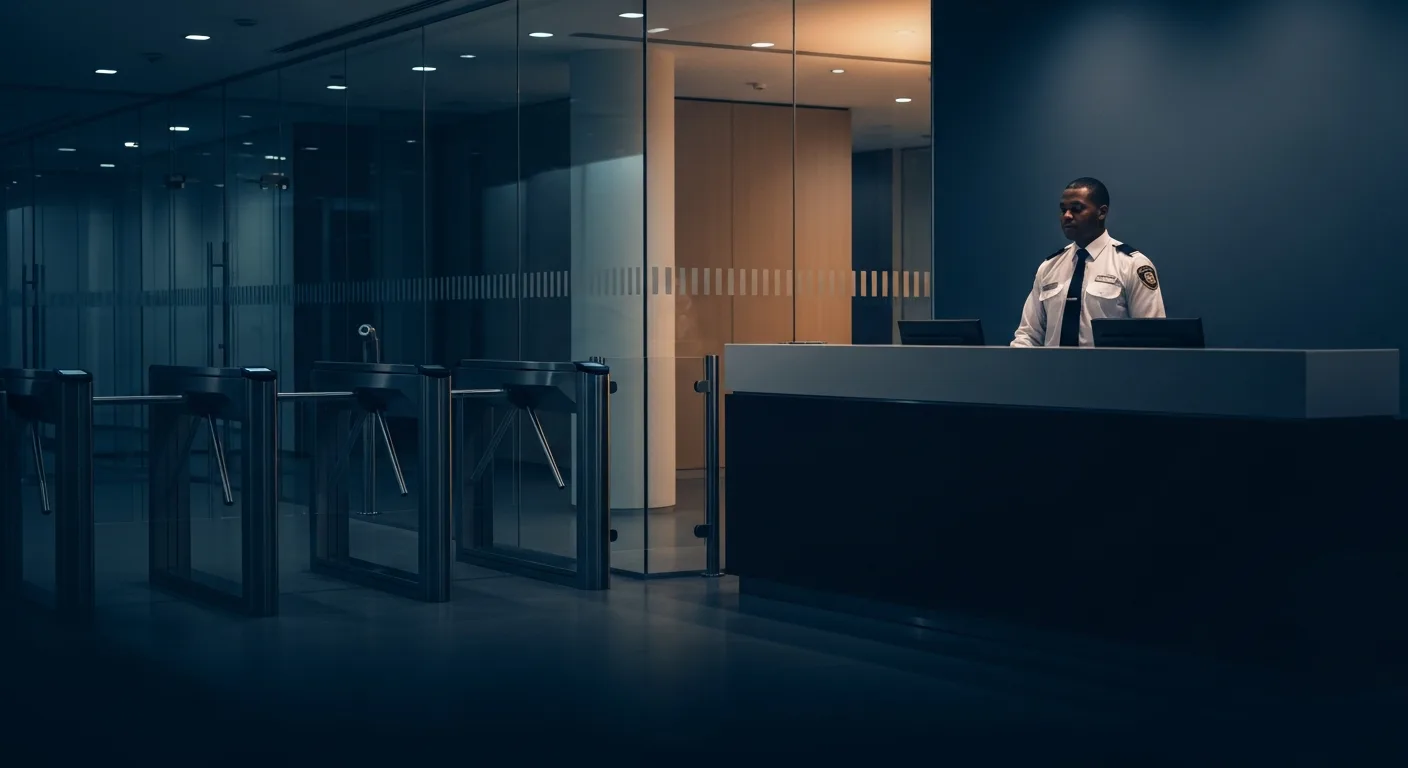
For a distribution center, the gate is the single most important control point, because that is where nearly every high-value load and every stranger legitimately enters and exits. A well-run gate turns an open flow of trucks into a documented, verified process. Driver check-in should confirm the pickup against the appointment schedule and the bill of lading (BOL), verify the driver's ID against the dispatch information, and check the carrier and the truck's USDOT number before anything moves. LPR at the entrance logs every vehicle and trailer in and out, creating a searchable record that is invaluable both for stopping theft in progress and for reconstructing what happened after one.
Seal verification: name the standard, not just the habit
Seal verification is a discipline in its own right — and "check the seal" is not a spec a buyer can enforce. The standard that C-TPAT and cargo insurers actually require is ISO 17712, which grades seals as Indicative ("I"), Security ("S"), or High Security ("H"). Only the "H" high-security bolt seal — a steel bolt-and-body that needs bolt cutters to remove — meets C-TPAT, and it must be lab-tested by an ISO/IEC 17025-accredited lab within the prior 24 months and stamped "H." When you write your SOP and your guard contract, require ISO 17712 "H" seals by name; a look-alike plastic seal is not compliant and is trivial to defeat.
Every inbound trailer should have its seal number checked against the shipping paperwork and the seal physically inspected using CBP's VVTT method: View the seal and locking mechanism, Verify the number against the manifest, Tug to confirm it is affixed, and Twist/Turn to confirm it does not unscrew. A common trick is to break a seal, remove product, and reseal with a look-alike, so any discrepancy triggers a hold and a report rather than a routine unload. On the outbound side, "H" seals are applied and recorded before the trailer leaves the dock, closing the chain of custody.
Harden the yard: trailer lock cost guide
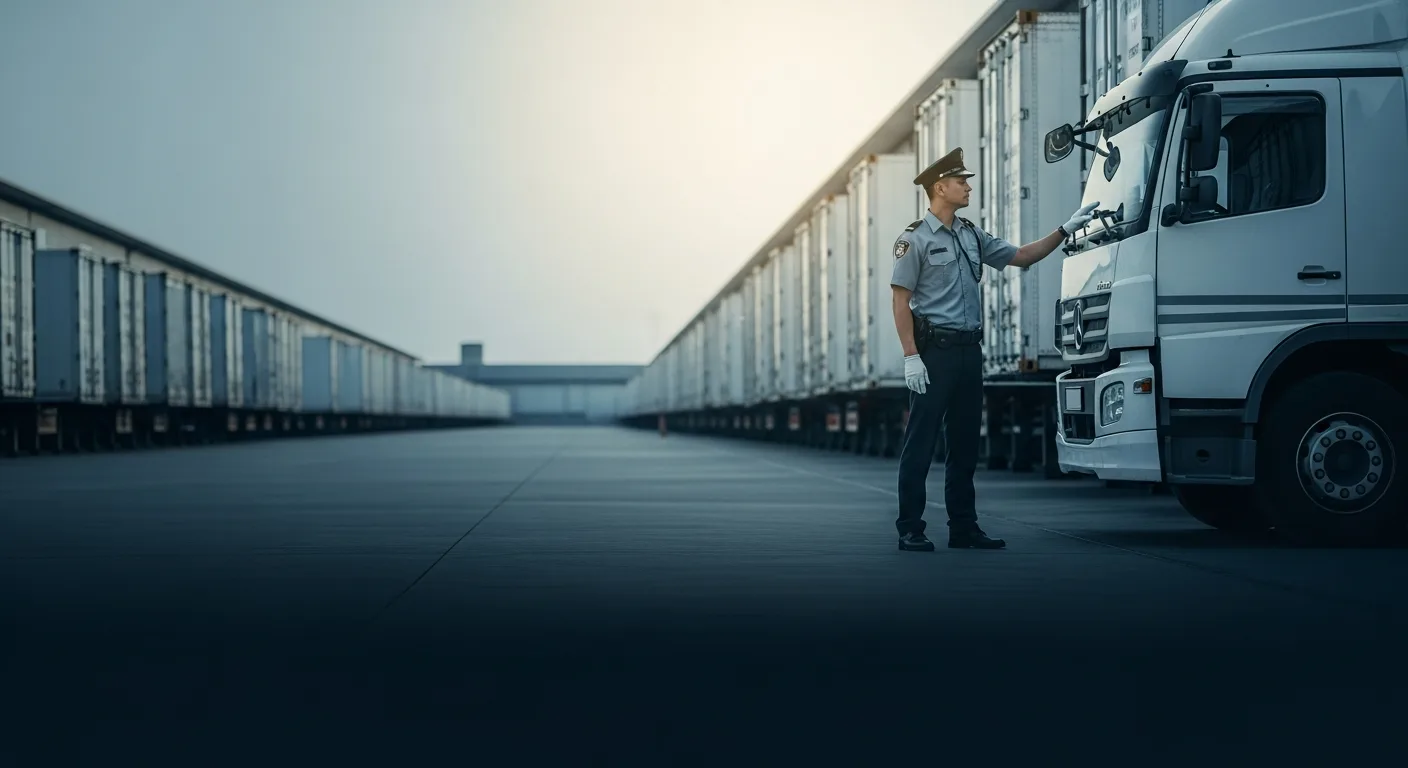
The yard and drop lot deserve the same attention as the building. With thieves back to stealing whole trailers, a lot full of loaded, unattended equipment is a target-rich environment. Physical locks raise the effort and time a thief needs — and time is what deters organized crews working against a schedule. The table below shows typical 2026 hardware price bands and which threat each lock blocks; these are one-time equipment costs, not recurring guard fees.
| Device | Typical 2026 price | What it blocks |
|---|---|---|
| Kingpin lock | ~$100–$400 | Prevents an unauthorized tractor from coupling to a parked loaded trailer — the core defense against "hook and go" theft |
| Glad-hand (air-brake) lock | ~$30–$150 | Blocks the air-brake connections so a thief cannot release the trailer brakes to tow it |
| Landing-gear lock | ~$150–$500 | Stops the landing gear from being cranked up, keeping the trailer physically pinned in place |
| ISO 17712 "H" bolt seals | ~$1–$3 each | Tamper-evident chain-of-custody on the trailer doors (consumable, per load) |
Layer these with trailer-lot patrol, camera coverage of parking areas, and LPR at exits. Some sites add a yard management system (YMS) that tracks which trailer sits in which slot, so a missing unit is flagged in minutes, not at the next shift change.
The gate scam that steals a whole trailer
The most expensive warehouse loss often walks in the front gate with paperwork. In a fictitious pickup, a criminal poses as a legitimate carrier — real-looking load numbers, a plausible driver, sometimes a spoofed broker email — and simply drives away with a full trailer, legally handed over by a gate that never verified. It is a leading form of modern cargo theft precisely because it exploits process, not fences, and CargoNet expects "theft by deception" crews to grow in 2026 by misdirecting loads tendered to legitimate carriers. A trained officer defeats it with a checklist most yards skip. Print this, laminate it, and put it in the gate house.
Gate driver-verification checklist (copy this into your SOP):
- Appointment vs. BOL — the pickup must match a scheduled appointment and the bill of lading. No appointment, no load.
- Driver ID vs. dispatch — the driver's name and ID must match the dispatch/broker information on file.
- Carrier + USDOT check — confirm the carrier and the truck's USDOT number; verify the motor carrier is the one actually tendered the load.
- Photograph the driver, the truck, and the license plate at check-in.
- Hold on any mismatch — if anything fails to reconcile, the trailer does not move until a supervisor clears it.
The technology creates the record; the guard applying the verification is what actually stops the theft.
Perimeter, access control, CCTV, and guard integration
No single layer secures a large facility — the goal is defense in depth, where each layer buys time and information for the next. A mature program stacks four layers:
- Perimeter — fencing, gates, lighting, and intrusion detection that define the boundary and slow anyone crossing it. Good lighting and clear sightlines are cheap force multipliers.
- Access control — keycard, PIN, biometric, or mobile credentials governing who enters the building, the dock, the yard, and sensitive zones like high-value cages. Every access event is logged and, ideally, tied to a camera view.
- CCTV with AI analytics — cameras that do more than record. Modern analytics detect intrusion, loitering, and line-crossing in real time, cut false alarms, and can trigger strobes or a live voice-down to repel an intruder after hours. See our video surveillance and CCTV guide and the video surveillance service overview.
- Guards and patrol — officers at gates and docks for access control and verification, plus interior and perimeter patrol of large facilities and yards. People handle the judgment calls technology cannot.
The layers are only as good as their integration. Access control tied to CCTV gives every entry a visual audit trail. Camera analytics tied to a guard or a remote monitoring center turns a detection into a response. LPR tied to the gate process turns a plate read into a verification step. The programs that fail are usually the ones that bought good hardware but never connected it to a human who acts on the alert. When you evaluate a provider, the integration story matters more than any single camera or credential brand.
Internal theft and shrinkage: the controls most programs miss
Not every loss comes over the fence. Internal theft, collusion, and process failures account for a meaningful share of warehouse shrinkage, and they are invisible to a program focused only on outside intruders. The National Retail Federation's annual security survey has consistently attributed a large portion of shrink to internal theft and process/administrative error alongside external theft. In a distribution center the exposure is concentrated in a few places — the pick line, the high-value cage, the dock, and the paperwork — and the fix is procedural as much as technological.
Controls that actually reduce shrink
- High-value cage protocols — segregate top-target SKUs (electronics, copper, high-theft food) behind access-controlled walls with a named, logged custodian. Two-person rule for pulls above a dollar threshold.
- Cycle-count reconciliation — frequent partial counts of high-value bins, reconciled against the WMS, catch quiet diversion long before an annual physical inventory would. A count variance is your earliest internal-theft signal.
- Badge-to-camera pairing — tie every access-control event to a camera view so the system can answer "who was at this dock door / cage / exit at this timestamp," not just "a door opened."
- Separation of duties — the person who picks the order should not be the person who verifies, seals, and releases it. Collusion needs a broken segregation of duties to work; enforcing it is free.
- Exit inspections and package checks — a consistent, non-discriminatory policy for employee and driver egress, posted and applied to everyone, deters casual diversion.
- Anonymous tip line — most internal cases surface through a coworker report; give staff a confidential channel and act on it.
None of these require new hardware you don't already have. They require a provider and an operations team willing to enforce process every shift — which is exactly what separates a facility that shrinks 0.2% from one that shrinks 2%.
What a warehouse security program costs in 2026
Buyers ask for an hourly rate, but a facility is protected by a program — a blend of staffed posts, patrol, and technology quoted monthly or annually. Guard labor is the anchor: unarmed officers bill $22–$35/hr (the officer's own wage is typically $16–$25/hr; the rest covers insurance, supervision, payroll taxes, and margin). From there, the pieces stack. All figures below are 2026 planning estimates, not firm quotes — see our full quote comparison and the pricing pillar for how rates are built.
| Program component | Typical 2026 cost | What it buys |
|---|---|---|
| Unarmed guard, single 12h post | ~$8,000–$12,800/mo | One staffed gate or dock position during operating hours |
| 24/7 staffed gate post | ~$16,000–$25,600/mo | 2–4 officers rotating to cover the post around the clock |
| Supplemental mobile patrol | $600–$2,500 / property / mo | Scheduled or random yard/perimeter sweeps, documented checkpoints |
| CCTV install | $1,000–$5,000 (4–10 cameras) | System hardware + install; roughly $150–$500 per camera |
| Camera / alarm monitoring | $30–$200 / mo per camera | Remote analytics + live voice-down and dispatch |
Worked example: a mid-size distribution center
Picture a mid-size DC that wants a verified gate during operating hours, after-hours yard coverage, and remote eyes on the lot overnight — the cost-efficient blend for a site that is busy by day and full of loaded trailers by night:
- Staffed gate post, 12h/day (driver + seal verification during receiving hours): ~$8,000–$12,800/mo
- After-hours mobile yard patrol (the 3 a.m. theft window): ~$1,200–$2,500/mo
- AI camera remote monitoring, 8-camera yard/perimeter package: ~$400–$1,600/mo in monitoring, plus a one-time install of ~$2,000–$5,000
That lands the recurring program around $9,600–$16,900/mo, or roughly $115,000–$203,000/year, plus a few thousand dollars of one-time camera install and the yard-lock hardware above. Against a $273,990 average theft, a single prevented loss pays for the entire program — which is the argument you take to your CFO. A site that needs a truly 24/7 staffed gate (2–4 officers) should budget the ~$16,000–$25,600/mo post rate on top.
The two most common budgeting mistakes are overspending on quiet daytime hours and underspending on the yard at 3 a.m. Match headcount to the clock: staffed posts when trucks flow, remote monitoring plus light patrol when the building is empty but the trailers are not.
Coverage models for a large site
Because a large footprint is expensive to cover with guards alone, the design question is which coverage model fits which part of the site and which hours. Three models get blended:
- Static post — an officer fixed at the gate or dock. Best where verification and access control happen continuously, such as an active receiving gate during operating hours.
- Mobile patrol — an officer covering the yard, perimeter, and interior on a route, often with documented patrol checkpoints. Best for large areas where continuous presence everywhere is impractical. Our mobile patrol guide explains how patrols are verified.
- Remote video monitoring — cameras with analytics watched from an off-site center that can issue voice-downs and dispatch a response. Best for after-hours deterrence across a big footprint at a fraction of the labor cost.
The right mix follows the clock. Daytime, with trucks flowing and staff on site, usually calls for staffed gate and dock posts plus roving patrol. Nights and weekends, when the building is empty but the yard is full of loaded trailers, often shift toward remote video monitoring plus a smaller patrol presence — the highest-risk theft window, but not one that requires the same headcount as an operating shift.
How to vet a firm that genuinely knows logistics
Any licensed guard company will bid on a warehouse. Far fewer actually understand cargo. The difference shows up the first time a fictitious-pickup crew tests your gate — so vet for logistics fluency, not just a state license and a price. Use this checklist when you compare providers:
- TAPA FSR facility certification or experience — the Transported Asset Protection Association's Facility Security Requirements is the industry benchmark for warehouse/distribution security. A firm that has run TAPA FSR-certified sites knows the standard your cargo insurer respects.
- C-TPAT familiarity — ask how they support Customs-Trade Partnership Against Terrorism compliance, including seal handling and driver verification. If C-TPAT is a blank stare, keep looking.
- ISO 17712 seal handling — they should already require "H" high-security bolt seals by name and train officers on VVTT verification. This is table stakes for cargo, not a premium add-on.
- Documented fictitious-pickup / driver-verification SOPs — ask to see the actual written procedure their officers follow at the gate. "We check IDs" is not an SOP; a step-by-step reconcile-and-hold protocol is.
- Yard-management-system experience — have their officers worked alongside a YMS, LPR, and a WMS? Cargo security is a systems-integration job, not a clipboard job.
- Distribution-center references — ask for two or three current DC or 3PL clients you can call. A firm that protects logistics sites can produce logistics references; a firm that protects office lobbies cannot.
A provider that clears this checklist is buying you the thing hardware cannot: a team that recognizes the scam before the trailer leaves the gate. When you're ready to compare, request quotes from licensed industrial firms and score them against these six points, not against price alone.
Frequently asked questions
How much does warehouse security cost per month in 2026?+
What is the biggest cargo-theft threat to warehouses right now?+
What seal standard should a warehouse require on trailers?+
Is my commodity a likely target for cargo thieves?+
How do I vet a security firm that actually understands logistics?+
Share this guide