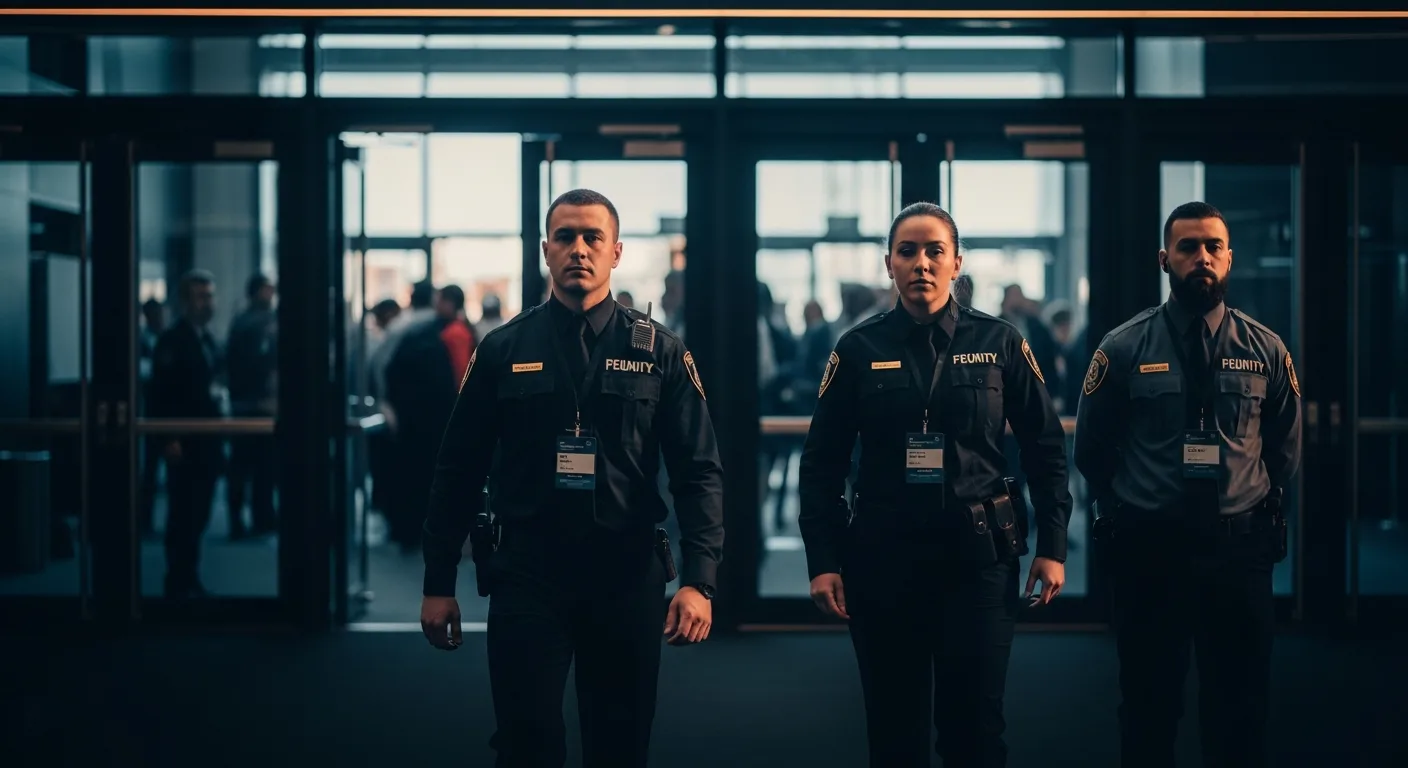
Executive protection ranges from a single agent for a day to a round-the-clock detail costing $500,000+ a year. Here's what drives the price, what a real program includes, the credentials that matter, the demand surge since late 2024, and how to hire the right firm.
Executive protection (EP) sits at the specialized, high-end tier of private security — and its pricing reflects that. A single agent for a day is one thing; round-the-clock protection for a high-profile principal is a different budget entirely. Demand has surged since late 2024, and with it, a lot of confusion about what EP actually is and what it should cost. This guide explains the components of a real EP program, what it costs in 2026, the qualifications that separate genuine EP from a bodyguard with a suit, when it's warranted, and how to hire a firm the right way — with a sample budget, a threat-assessment breakdown, the exact questions to ask, and a state-by-state licensing reference.
Qualified EP agents typically run $75–$150 an hour, or roughly $1,200–$2,500 per agent per day. Armed and high-threat work costs more, and international travel adds 30–50%. An ongoing single-agent program runs about $15,000–$35,000 a month; a true 24/7 detail on one principal can require 24–36 agents in rotation and exceed $500,000 a year. The recommended first step — a threat assessment (about $2,500–$25,000) — costs far less and right-sizes everything else.
Executive protection vs. a bodyguard with a suit
The phrase people picture — a large, visible "bodyguard" standing beside a principal — is the opposite of what good executive protection looks like. Real EP is a program: it prevents incidents through planning, intelligence, and positioning long before anyone needs to physically intervene. A standing guard reacts; a protection detail is built so the reaction is rarely needed. This distinction is the single most useful thing a buyer can understand, because it explains both the price and the value.
| Capability | Program-based executive protection | A standing "bodyguard" |
|---|---|---|
| Advance work | Site surveys, route and contingency planning, exit mapping before every movement | None — shows up where the principal is |
| Protective intelligence | Ongoing threat monitoring, open-source and dark-web research, digital-exposure tracking | None |
| Profile | Deliberately low-profile; blends into the routine | Visible presence, often the point |
| Driving | Trained secure/evasive driver; arrivals and departures managed as the highest-risk phase | Rides along or drives untrained |
| Medical | Tactical-medical trained (TECC/TCCC, Stop-the-Bleed) | Basic first aid at best |
| Structure | Detail leader, close protection, advance, driver, analyst — sized to the assessed risk | One person covering everything |
| Failure mode | Incidents avoided; the detail is boring by design | Reacts under pressure, can escalate or draw attention |
A poorly trained "muscle" hire can create liability and draw attention rather than reduce risk. When you pay for EP, you are buying the layers a bodyguard doesn't have — advance work and intelligence — not just a body at the door.
What executive protection includes
EP is an integrated program built to prevent incidents before they happen, not a single guard at a door. A full program spans:
- Advance work — the backbone of EP: site surveys, route and contingency planning, exit mapping, and coordination with venues and local authorities before the principal ever arrives.
- Protective intelligence — an analytical function that researches and assesses threats (including open-source and dark-web monitoring) to catch risks before they materialize.
- Secure transportation — trained security drivers, motorcades, evasive-driving capability, and armored vehicles where warranted. Vehicle arrivals and departures are consistently the highest-risk phase of any detail.
- Residential security — home and family hardening, alarms, safe rooms, access protocols, and on-site presence.
- Travel and medical — international advance logistics, vetted local partners, medevac arrangements, and agents trained in tactical medicine.
- Technical and cyber — technical surveillance countermeasures ("bug sweeps"), doxxing detection, and removal of the principal's exposed personal data. This layer is substantial enough that it gets its own section below, because digital threats often precede physical ones.
Well-run programs are deliberately low-profile: the protective layer operates underneath the principal's normal routine.
What it costs
Rates vary enormously, and most published numbers come from EP firms — treat everything as a range, not a quote. The main cost driver is coverage depth; a single agent for an appearance is a fraction of a 24/7, travel-and-residence program.
| Engagement | Typical cost (2026, illustrative) |
|---|---|
| Single agent, hourly | ~$75–$150/hr (armed adds roughly 30–50%) |
| Single agent, day rate | ~$1,200–$2,500/day (basic tiers can start ~$600) |
| Two-agent detail, day rate | ~$3,000–$5,000/day |
| 24/7 single-agent coverage | ~$1,500–$3,000/day |
| Ongoing single-agent program | ~$15,000–$35,000/month |
| Multi-agent, high-threat detail | $10,000+/day |
| Full-time 24/7 program (one principal) | $500,000+/year (24–36 agents in rotation) |
| Threat / risk assessment (first step) | ~$2,500–$25,000 ($100–$250/hr) |
| International / high-threat premium | +30–50% |
True 24/7 protection requires 24–36 agents in rotation across travel, residence, and advance work — which is why a single-principal round-the-clock detail runs into the mid–six figures annually, and founder-scale programs can reach into the millions. Armed coverage adds roughly 30–50% over unarmed, and agency markup (versus hiring an individual) commonly adds 25–75% for scheduling, insurance, and compliance. For how EP fits into the wider market, see our guide to what security costs.
A sample EP budget, itemized
Abstract ranges are hard to shop. Here is a concrete, illustrative build for a common engagement: a three-day out-of-state conference detail — a two-agent team (a detail leader and a close-protection agent), 12-hour coverage days, one advance day, flying domestically with the principal, standard (non-armored) secure transport. Every figure is a 2026 estimate to test against real quotes, never a firm price.
| Line item | Basis | Est. cost |
|---|---|---|
| Base agent labor | 2 agents × 12 hrs × 3 days = 72 hrs @ ~$70/hr (individual base rate) | ~$5,040 |
| Advance work | 1 agent × 8 hrs the day prior (site + route survey) @ ~$70/hr | ~$560 |
| Overtime buffer | ~6 hrs late-event coverage @ 1.5× | ~$630 |
| Agency markup (~35%) | firm liability insurance, workers' comp, screening, scheduling | ~$2,180 |
| Subtotal — labor (firm-billed ≈ $90–$100/hr effective) | ~$8,410 | |
| Airfare | 2 round-trip, booked with the principal's schedule | ~$900 |
| Lodging | 2 rooms × 3 nights @ ~$220 | ~$1,320 |
| Per diem / meals | 2 agents × 4 days (incl. travel) @ ~$75 | ~$600 |
| Secure ground transport | trained security driver + SUV, 3 days @ ~$800 | ~$2,400 |
| Subtotal — expenses (pass-through) | ~$5,220 | |
| Program total (unarmed, standard transport) | ~$13,600 | |
| Add: armored vehicle, if the assessment warrants | +$500–$1,500/day | +$1,500–$4,500 |
| Add: armed coverage premium | +30–50% on labor | +$2,500–$4,200 |
Notice how the labor line and the pass-through expenses land close to each other — on any travel detail, expenses can rival the labor, which is exactly why an "expenses TBD" proposal is a blank check. The agency markup isn't padding: it is what converts an individual for hire into an insured, workers'-comp-covered, licensed engagement.
The cost structure behind the day rate
A day rate is only the headline number. Understanding what sits underneath it is how you compare proposals honestly and avoid surprises on the invoice. EP pricing is built from several stacked components — and every one is market-dependent, so treat the figures as ranges to test against real quotes, not fixed prices.
- Agent hourly and day rates. The base labor cost. A day rate typically assumes a set block (often 8 or 12 hours); anything beyond it bills as overtime, frequently at 1.5x. Many firms enforce a daily minimum (commonly 4–8 hours), so a two-hour airport meet-and-greet can still bill a half or full day.
- Retainers. Ongoing programs are often structured as a monthly retainer that reserves a bench of vetted agents and covers standby, planning, and intelligence work — with deployed hours billed on top. Retainers buy availability and continuity, not just bodies.
- Per diem and travel expenses. On travel details you pay agents' airfare, lodging, meals, and ground transport in addition to their time. On multi-day or international trips these pass-through costs can rival the labor line, which is why "expenses TBD" in a proposal is a blank check.
- Vehicles and transportation. Secure transport is usually a separate line — a standard SUV with a trained security driver is one price; an armored vehicle, a follow car, or a full motorcade is considerably more, and armored assets often carry their own daily or rental charge.
- Overtime and surge. Long event days, delayed flights, and last-minute movements push hours past the base block. A serious proposal spells out the overtime rate and how surge staffing is priced before you need it.
- Agency markup and insurance. Hiring through a licensed firm rather than an individual adds 25–75% — that margin funds the firm's liability insurance, workers' comp, background screening, scheduling, and compliance. It is not padding; it is what makes the engagement insured and lawful.
Coverage hours: 8-hour, 12-hour, and 24/7
Coverage depth is the single biggest lever on cost, and it usually comes in three shapes. An 8-hour engagement covers a workday, an appearance, or a specific movement — the most common and most affordable pattern. A 12-hour shift extends through evenings and events and is where many corporate travel details land. 24/7 coverage is a different order of magnitude: protecting one principal around the clock, safely and legally, means multiple agents per post working in rotation with time for rest, so the same principal can require 24–36 agents across close protection, residence, and advance work. Each step up doesn't just add hours — it multiplies the headcount and the annual budget.
Armed vs. unarmed protection
Whether the detail is armed is both a risk decision and a cost decision. Unarmed agents rely on awareness, positioning, advance work, and evacuation to keep a principal out of trouble, and for many low- to moderate-threat executives that is the appropriate posture. Armed protection is warranted when the assessment identifies a credible, elevated threat — and it costs roughly 30–50% more because of the added licensing, firearms training, insurance, and liability it carries. Armed work also demands the correct permits in every jurisdiction (see our armed vs. unarmed guide and our overview of armed security services). The right answer flows from the threat assessment, not from a preference for the more visible option — and a good firm will tell you when unarmed coverage genuinely suffices.
What a threat assessment includes
The assessment is the article's recommended first step for a reason: it is the one purchase that sizes every other purchase. Formally a threat, vulnerability, and risk assessment (TVRA), it converts a vague sense of danger into a written specification a firm can execute against — and a budget you can defend. Skipping it is how buyers both over-spend (an armed detail for a low-threat profile) and under-spend (one untrained guard against a real threat).
| What the assessor examines (inputs) | What you receive (deliverables) |
|---|---|
| Public exposure and profile — media presence, controversy, activism, public schedule | A written risk rating (e.g., low / moderate / elevated / high) |
| Prior threats and concerning communications directed at the principal | The specific threats and vulnerabilities identified, ranked by likelihood and impact |
| Digital footprint — home address on data-broker sites, social media, doxxing exposure | A recommended protective posture: unarmed vs. armed, covert vs. overt |
| Travel patterns and upcoming itinerary, including international legs | A coverage-hour spec — which movements need 8, 12, or 24/7, and how many agents |
| Residence and family exposure — school runs, events, social media | Residential and digital hardening recommendations |
| Business context — layoffs, litigation, controversial decisions, regulatory scrutiny | A phased, right-sized budget tied to the assessed risk |
A focused single-principal assessment typically takes about one to three weeks; complex multi-residence, family, or international scope takes longer. Cost runs roughly $2,500–$25,000 depending on scope, with assessors often billing $100–$250/hr — a fraction of a standing detail, and the document that keeps you from buying the wrong one.
A threat, vulnerability, and risk assessment (roughly $2,500–$25,000) is the recommended, cost-effective first step. It sizes the actual risk and, for public companies, helps document the "bona fide business-oriented security concern" and "overall security program" that affect how security benefits are treated for tax purposes and support SEC perquisite disclosure. These are fact-specific questions — consult qualified tax and securities counsel.
When you need executive protection
EP is warranted when there is a specific, documented threat or an elevated risk profile — not general anxiety. Common triggers include executives with a public profile, credible or targeted threats, high-net-worth individuals, sensitive or international travel, contentious litigation or layoffs, and large public appearances.
Corporate demand rose sharply after the December 2024 targeted killing of a health-insurance CEO — an incident that also pushed many health systems to reexamine their own hospital and healthcare security; security firms reported EP-assessment requests more than doubling, and executive security jumped to become one of the most-considered executive benefits. Proxy-disclosure data reflects the shift — roughly a third of S&P 500 companies now report an executive-security perk, up sharply from prior years — though analysts caution that some of the post-2024 spike may be transient as budgets normalize.
Digital protection, TSCM, and data removal
If the article argues one thing repeatedly, it's that online threats frequently precede physical ones — a leaked home address is what lets a fixated individual show up at the door. That makes the technical-and-cyber layer one of the highest-leverage, lowest-cost parts of a program, and it deserves more than a bullet.
- Technical surveillance countermeasures (TSCM). Electronic "bug sweeps" of offices, residences, vehicles, and meeting rooms before sensitive events — detecting hidden cameras, audio bugs, GPS trackers, and rogue wireless devices. Usually project-priced; a single-site sweep sits at the lower end of the consulting range and scales with square footage and frequency.
- Data-broker removal. Scrubbing the principal's and family's home address, phone numbers, and personal details from people-search and data-broker sites, then suppressing re-listings on an ongoing basis — typically a modest monthly retainer, and one of the cheapest risk reductions available.
- Doxxing detection and monitoring. Watching for the principal's information being weaponized, tracking concerning communications, and flagging escalation on social platforms and fringe forums so intelligence can act before it becomes physical.
- Executive and family cyber hygiene. Breach and credential monitoring, social-media exposure review, and simple operational-security guidance for the household — often where a determined adversary finds the soft target.
A program that invests here can prevent a situation from ever requiring a full detail, which is why serious firms treat digital protection as core rather than an add-on. Ask any provider how it gathers and acts on this information — a firm that only offers bodies at a door is missing the layer that prevents incidents.
Levels of protection
EP isn't one product — it scales to the threat, and matching the level to the risk is how you avoid both over- and under-spending.
- Low-profile / covert. A single agent or small team operating discreetly, often unarmed, blending into the principal's routine. Common for executives who want protection without signaling it. The lowest cost and the most common engagement.
- Standard corporate EP. One to a few agents with advance work and secure transportation for travel, appearances, and daily movements, scaling up around higher-risk events. This is where most corporate programs live.
- High-threat / high-profile. A full detail — multiple armed agents, advance teams, secure and sometimes armored transport, residential coverage, and protective intelligence running continuously. Reserved for credible threats, very high public profile, or hostile environments, and priced accordingly.
A good firm will recommend the lowest level that genuinely covers the assessed risk, not the most expensive one they can sell.
Questions to ask before you hire
The intro promised "how to hire the right way," and this is the deliverable: a checklist you can hand a prospective firm. A credible provider answers all of it in writing without flinching.
- Will you conduct a threat and risk assessment before quoting a team and a price? What does it cover, cost, and produce?
- Which state licenses do you and every deployed agent hold in each jurisdiction we'll operate in — and can you show them?
- Can you provide a certificate of insurance (COI) naming us as additional insured, covering general and professional liability and workers' comp on every agent? For armed work, a firearms/use-of-force endorsement?
- What are the specific agents' backgrounds, training, and medical certifications — and exactly who will be on our detail?
- What is the written overtime rate, the daily minimum, and how is surge staffing priced before we need it?
- How are travel expenses billed — capped, receipted, or "TBD"?
- Do you provide protective intelligence and advance work, or only standing agents?
- Will all deployed personnel sign an NDA? Can you share references and your client-retention record?
- Quotes a team and a price before any assessment or site survey.
- No state license for a jurisdiction it operates in — or treats a business license as a security license.
- No certificate of insurance, or no workers' comp on its agents (you inherit the liability).
- Vague "expenses TBD" with no cap or receipts.
- No written overtime or surge-staffing rate.
- No protective-intelligence or advance capability — just bodies at a door.
- Won't sign a confidentiality/NDA, or sells the highest tier for a low-threat profile.
State licensing at a glance
Requirements are jurisdiction-specific, and a detail that crosses state lines must be licensed in each one. Verify credentials in every market a detail operates in — including major hubs like Los Angeles and Chicago — and confirm them yourself with the issuing agency (see our license-verification guide). The table below covers the states this guide touches most.
| State | Unarmed credential | Armed add-on | Agency / company license |
|---|---|---|---|
| California | BSIS Security Guard registration ("guard card") | BSIS Exposed Firearm Permit (+ annual requal) | Private Patrol Operator (PPO), via BSIS |
| Illinois | PERC (Permanent Employee Registration Card), via IDFPR | FOID card + 20-hour Firearm Control Card training | Private security agency license, via IDFPR |
| New York | Security Guard registration (DOS/DCJS): 8-hr pre-assignment + 16-hr OJT | County pistol permit + 47-hr firearms course → Special Armed Guard Registration | Watch, Guard & Patrol Agency license |
| Texas | Level II non-commissioned officer, via DPS Private Security | Level III Commissioned Security Officer (45-hr + MMPI); EP agents also need Level IV Personal Protection Officer | Security company license, via DPS |
| Florida | Class D Security Officer (FDACS, 40-hr, Ch. 493) | Class G Statewide Firearm License (28-hr, annual requal) | Class B Security Agency license, via FDACS |
Two EP-specific notes: in Texas, a bodyguard is legally a "Personal Protection Officer," which requires the Level III commission plus the Level IV course — not just a guard card. In New York, county pistol permits (especially in NYC) can take 6–18 months, so armed coverage there is a planning item, not a same-week option.
Qualifications to look for
Screen for agents who exceed state licensing minimums, not just meet them. Strong candidates and firms bring:
- Relevant background — law enforcement, military, or federal protective experience.
- Formal EP training from a recognized academy, covering advance work, threat assessment, surveillance detection, and protective operations.
- Industry credentials — ASIS certifications (CPP, PSP, PCI) signal recognized risk-management competence at the firm level.
- Tactical-medical certification (TECC/TCCC plus CPR/AED and Stop-the-Bleed), above the basic first-aid floor.
- Protective/evasive driving training.
- Correct state licensing for every jurisdiction a detail operates in — see the state table above and verify each credential yourself.
How to read an EP proposal, line by line
Executive-protection proposals are where vague sells for a premium. A serious proposal is specific; a padded one hides behind "a team." Here's how to decode one:
- Agents and credentials — not just "two agents," but their background (law-enforcement, military, federal-protective), training, and licensing. If the proposal won't name credentials, you're buying uniforms, not protection.
- Roles and coverage pattern — which agents cover close protection, advance, and driving, and exactly what hours and days. "24/7 coverage" should reconcile to a real rotation, since one principal around the clock needs 24–36 agents.
- Advance work — a dedicated line, not an afterthought. No advance line means no site surveys or route planning, which is the part that actually prevents incidents.
- Secure transportation — vehicles, trained security drivers, and whether armored transport is included or extra.
- Rate basis and expenses — hourly vs. day rate, minimums, and how travel, lodging, and per diem are billed. "Expenses TBD" is a blank check.
- Agency markup and insurance — a legitimate firm carries the liability; confirm the certificate of insurance and, for armed work, a firearms endorsement.
A proposal that quotes a team and a number without first doing a threat or site assessment is selling a product, not protection. The assessment is what right-sizes everything else — a firm that skips it either doesn't do real EP or is happy to over-sell you a detail you may not need.
How to hire an EP firm
A serious engagement starts with an assessment, not a price. A credible firm conducts a site survey or risk assessment before quoting — a cookie-cutter proposal with no survey is a red flag. From there:
- Verify active state licensure in every jurisdiction of operation (in California, confirm the PPO via BSIS; in Illinois, the agency license via IDFPR; and so on). A general business license is not a security license.
- Demand a certificate of insurance naming your organization as additional insured, covering general and professional liability plus workers' comp — and, for armed protection, a firearms/use-of-force endorsement.
- Vet the people, not just the brand — how the firm background-checks and screens its own agents, agent credentials, references, and client retention.
- Insist on clear contract terms — scope of work, use-of-force policy, indemnification, minimums, a written overtime/surge rate, an expense cap, and a confidentiality/NDA covering all deployed personnel, since discretion is part of the service.
The protective intelligence layer
The most cost-effective protection often happens before an agent is ever deployed. Protective intelligence is the analytical work of identifying and assessing threats early — monitoring for direct threats and concerning communications, open-source and dark-web research, and tracking the principal's digital exposure. Increasingly this includes digital protection: detecting doxxing, scrubbing the principal's home address and personal data from broker sites, and watching social media for escalation, because online threats frequently precede physical ones. A program that invests here can often prevent a situation from requiring a full detail at all, which is why serious firms treat intelligence as core rather than an add-on.
Who's on a protection detail
Understanding the roles helps you read a proposal and its price. A full detail can include a detail leader who runs the operation and stays closest to the principal; close-protection agents forming the protective ring; an advance agent who works sites and routes ahead of every movement; a security driver trained in evasive and secure driving; and, for larger programs, residential and command-center staff. A low-threat engagement might be a single agent covering several of these functions; a high-threat one staffs each separately and around the clock — which is exactly why costs scale from one agent to a 24–36-person rotation. When a quote lists "a team," ask which roles it covers and why the assessment calls for them.
Controlling the cost of executive protection
Because EP scales so steeply, the discipline is buying exactly what the risk requires — no more, no less. A few ways to keep spend proportionate: start with a threat assessment and let it size the program rather than defaulting to a large detail; tier the coverage so heavy protection attaches to genuinely high-risk movements (major appearances, sensitive travel) while day-to-day life runs lighter or covertly; lean on intelligence and hardening (residential security, digital cleanup) that reduce the need for standing agents; and reassess periodically as the threat picture changes so you scale down when you can, not just up. A trustworthy provider actively helps you do this; one that pushes the maximum program regardless of the assessment is optimizing its invoice, not your safety.
In-house vs. outsourced protection
Organizations that need ongoing EP eventually face a build-or-buy decision. An outsourced program through a licensed firm is faster to stand up, spreads liability and insurance to the provider, scales up and down with need, and taps a deep bench of vetted agents — the right choice for most companies and for anything short of continuous, high-threat coverage. An in-house team offers maximum control, continuity, and intimacy with the principal's routine, but it's expensive and complex: you take on hiring, training, licensing, insurance, scheduling, and management, and you need enough sustained demand to justify it. A common middle path is a small in-house core supplemented by an outsourced firm for travel, surges, and specialized needs. Whichever model, the licensing, insurance, and vetting standards in this guide apply — an in-house team still needs the same credentials as a firm you'd hire.
Looking for vetted providers? Get free quotes from licensed security companies that offer executive protection, browse executive protection services, and read how to hire a security guard company before you engage anyone.
Frequently asked questions
How much does executive protection cost per day?+
What does an executive protection agent cost per hour?+
How much does a 24/7 protection detail cost?+
What does a threat assessment cost, and what does it include?+
What's the difference between executive protection and a bodyguard?+
Share this guide
Sources
- California BSIS — Firearms Permit Fact Sheet
- Illinois IDFPR — Security Professions
- New York DOS — Security Guard Training Requirements
- New York DCJS — Security Guard Training
- Texas DPS — Private Security Training and Continuing Education
- Florida FDACS — Class D Security Officer License Requirements
- Florida FDACS — Class G Statewide Firearm License Requirements
- ASIS International — Enterprise EP Spending Spiked in 2024
- Harvard Law Forum — Executive Security: The Perk to Watch
- Morgan Lewis — SEC Disclosure & Taxation of Executive Security Benefits