You don't always need a guard standing on site 24/7. Mobile patrol delivers visible deterrence and periodic checks for a fraction of the cost — here's how it works, what it costs, and when it's the right call.
A stationed guard is the most visible form of security, but it's also the most expensive — and for many properties, it's more coverage than the risk actually requires. Mobile patrol (also called roving patrol) is the middle path: a marked security vehicle that checks your property on a mix of scheduled and randomized rounds, delivering real deterrence and periodic verification without paying for a body on site every minute of the day. Because one officer's time is shared across a route of client sites, patrol typically costs a small fraction of a dedicated post. This guide explains exactly how it works, what services come bundled into a patrol contract, what it costs and why, how it stacks up against a static guard and remote video guarding, which properties it fits best — and, most importantly, how to make sure the patrols you're paying for are actually happening.
Quick answer. Mobile patrol is billed per visit (roughly $15–$30 per check), as a monthly package (typically $600–$2,500 per property per month — the low end for light 1–2 checks a night, the high end for multiple checks plus alarm response), or as a dedicated roving unit (roughly $30–$45/hr). Because labor is amortized across many sites on one route, patrol runs roughly 60–80% cheaper than a dedicated 24/7 static guard (which runs about $16,000–$25,600/month). It's the right tool for after-hours deterrence, large or multi-building properties, vacant sites, and open-and-close routines — but it leaves gaps between passes, so the provider's GPS/NFC checkpoint verification is what separates a real service from an invoice.
How mobile patrol actually works
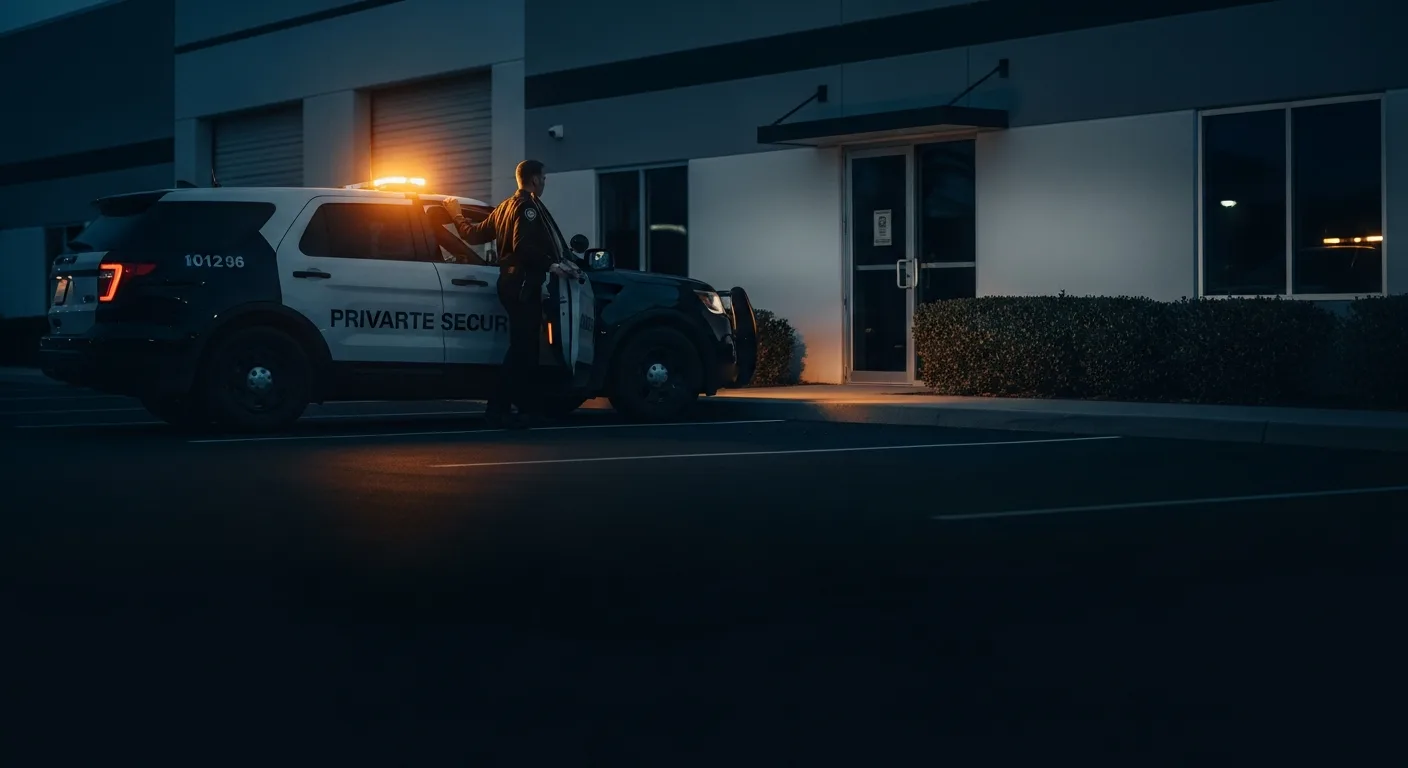
Mobile patrol replaces a fixed post with intermittent, deliberately unpredictable visits. A uniformed officer in a marked vehicle — sometimes on bike or on foot for dense downtown blocks — works a route of client properties across a shift, stopping at each one to perform a documented check before moving to the next. The marked vehicle is the point: a visibly branded truck rolling through a lot at 2 a.m. tells anyone watching that the site is being actively watched, and most opportunistic intruders move on to an easier target.
A typical stop is short and structured. The officer parks conspicuously, walks the perimeter, checks that doors and gates are secured, looks for signs of forced entry, tampering, or squatting, confirms exterior lighting is working, scans for hazards (open valves, water, propped doors, smoldering cigarette bins), and logs the visit before leaving. On a well-run contract the client defines the post orders — the specific things the officer must check and the sequence — so every visit covers the same ground and nothing is left to memory.
The single most important design feature is randomization. If patrols arrive at the same times every night — say 10:00, midnight, and 2:00 — anyone casing the property simply operates in the predictable 90-minute windows between passes. Reputable providers vary both the timing and, where possible, the direction and sequence of the route so that the schedule can't be reverse-engineered from a few nights of observation. You still get a contracted number of visits (e.g., "three documented checks between 9 p.m. and 6 a.m."), but the exact clock time floats. When you evaluate a provider, ask specifically whether visit times are randomized or fixed; fixed-time patrols are far weaker deterrents than the price would suggest, and a schedule that never varies is one a motivated intruder learns in a week.
Mobile patrol vs. static guard vs. remote video guarding
The intro promised a side-by-side, so here it is. These three models solve the same problem — deterring and detecting intrusion — with very different coverage economics. Most buyers overpay by defaulting to a static guard when their actual risk profile calls for patrol, or leave a gap by choosing video guarding without a response arm. The table below is a planning tool, not a quote; every figure is a 2026 U.S. commercial estimate.
| Factor | Mobile patrol | Static (on-site) guard | Remote video / virtual guarding |
|---|---|---|---|
| Typical monthly cost | $600–$2,500 / property | ~$8,000–$12,800 per 12-hr post; ~$16,000–$25,600 for 24/7 (unarmed) | ~$1,000–$3,000 / site (plus one-time camera install of $1,000–$5,000) |
| Coverage model | Intermittent — scheduled + randomized visits | Continuous, physically on site | Continuous, but remote (operators watch feeds) |
| Deterrent presence | Strong at the moment of the pass (marked vehicle); none between passes | Strongest — a visible body at all times | Moderate — talk-down speakers + strobes; no physical presence |
| Live intervention | On the next pass, or dispatched on alarm (minutes away) | Immediate — already there | Verbal warning instantly; physical response only via patrol/police dispatch |
| Gap exposure | Real — an incident can start and end between rounds | Minimal within the covered post | Blind spots outside camera coverage; nothing physical to stop entry |
| Best fit | After-hours deterrence, large/multi-building sites, vacant property, open/close, cost-sensitive coverage | High-value assets, access control, lobbies, continuous liability exposure | Camera-friendly perimeters (yards, lots, construction) where a talk-down + fast dispatch is enough |
The smart combination. The strongest budgets rarely pick just one. A common high-value setup is video guarding as the always-on detector paired with mobile patrol as the physical response arm: cameras catch the intrusion and issue a talk-down, and the patrol unit — already on a route nearby — rolls in to physically clear the scene. You get near-continuous coverage at a fraction of a 24/7 static post. See our guides to security guard services and alarm monitoring for the pieces that plug into this.
Which properties mobile patrol fits best
Patrol earns its keep where the risk is intermittent and the property is too large, too empty, or too low-margin to justify a full-time post. Use this matrix to match your property type to the risk patrol actually addresses and a sensible starting cadence — then tune the visit count with your provider.
| Property type | Primary risk patrol addresses | Suggested cadence |
|---|---|---|
| Construction sites | Copper/tool/equipment theft, trespassing, after-hours vandalism, material dumping | 2–4 randomized checks/night; add open/close |
| Self-storage facilities | Break-ins to units, unauthorized overnight occupancy, gate tampering | 1–3 checks/night, gate/lock verification |
| Retail plazas & strip centers | Loitering, after-hours burglary, graffiti, dumpster fires, panhandling near tenants | 2–4 checks/evening + close routine |
| Apartment & multifamily lots | Vehicle break-ins, unauthorized parking, loitering, resident safety after dark | 2–5 checks/night + parking enforcement + escorts |
| Auto dealerships | Vehicle/catalytic-converter theft, lot tampering, joyriding | 3–5 randomized checks/night; VIN/row spot-checks |
| Industrial parks & warehouses | Cargo/inventory theft, perimeter breach, trailer tampering, hazard checks | 2–4 checks/night + interior NFC checkpoints |
| HOA & gated communities | Speeding, package theft, unauthorized amenity use, suspicious vehicles | 2–4 checks/night, amenity lock-up |
| Vacant buildings | Squatting, copper stripping, arson, burst-pipe/roof-leak discovery | 1–3 checks/day & night; full structure verification |
Checkpoint verification and the client report — the accountability that matters
Because you can't stand in the lot and watch a patrol happen, proof of presence is the single most important thing to demand. It serves two purposes: it confirms you're getting the rounds you're paying for, and it becomes your evidence trail if an incident, injury, or liability claim ever hangs on whether the site was being checked. This accountability layer is the clearest line between a good patrol company and a bad one, because the technology to prove every stop is cheap and mature — a provider that doesn't use it is choosing not to be held accountable.
Modern guard-tour verification records each checkpoint with a timestamp, the officer's identity, and the location, syncing it to a cloud dashboard you can log into. Three checkpoint technologies are common, and they trade off cost against tamper-resistance:
- NFC tags — small tags mounted at each checkpoint that the officer must physically tap with a phone or reader to log the stop. Because presence is required to register the scan, NFC is highly tamper-resistant and works indoors where GPS is unreliable. This is the strongest proof of the three.
- GPS / geofencing — continuous route tracking that confirms the vehicle entered and dwelled inside your property's boundary. Excellent for confirming the officer physically arrived and how long they stayed; weaker inside large steel buildings where signal degrades. Best paired with NFC or QR for interior checkpoints.
- QR codes — the cheapest option: printed codes at each checkpoint that the officer scans. Convenient, but a static QR code can be photographed and scanned from off-site, so it's the weakest link unless the provider uses rotating or dynamic codes that change on a schedule.
The output you should actually care about is the client-facing report. A good provider gives you a per-visit log — timestamp, officer, checkpoints hit, dwell time — plus incident reports with photos whenever something is found (an unlocked gate, a broken light, a vehicle that shouldn't be there, evidence of a break-in attempt). Some deliver this as a nightly or weekly email digest; the better ones give you a live dashboard so you can spot-check any night yourself.
What a real patrol report looks like
Before you sign, ask a prospective provider to show you a real (redacted) report and to walk you through the verification dashboard. Here's the kind of record a real service produces — a sample redacted patrol log and the dashboard view behind it:
Sample redacted patrol report — Riverside Business Park, overnight shift
| Time | Officer | Checkpoint | Dwell | Status / note |
|---|---|---|---|---|
| 10:42 PM | J. R-███ | NFC — Main Gate | 6 min | Secured. All quiet. |
| 10:48 PM | J. R-███ | NFC — Loading Dock B | 4 min | Overhead door #3 found unlocked — secured. Photo attached. |
| 1:17 AM | J. R-███ | GPS geofence — full perimeter | 9 min | Exterior light (NE corner) out. Work order flagged. |
| 3:55 AM | J. R-███ | NFC — Rear Lot | 7 min | Unregistered vehicle. Plate logged, owner not on site. Photo attached. |
Dashboard view: 4 of 3 contracted checks completed • average dwell 6.5 min • 2 incidents documented with time-stamped photos • GPS breadcrumb map confirming the vehicle entered and dwelled inside the property boundary on every pass. That's the difference between "we patrolled" and provable, defensible coverage.
A company that can produce that instantly is one you can hold accountable; one that hesitates is selling you the appearance of patrols, not the proof.
Patrol leaves gaps — and unverifiable patrols leave you exposed. Mobile patrol is periodic by design: between two passes there can be an hour or more when nothing on your site is being watched, and an incident can unfold and be over before the next round. That's an acceptable trade for deterrence and open/close routines — it is not a substitute for continuous coverage of high-value assets or live access control. Just as important: never accept a patrol contract without GPS or NFC verification and a report you can review. If a provider can't or won't show you the logs, walk away.
What's bundled into a mobile patrol contract
Patrol is rarely just "drive by and look." Most contracts fold in a menu of active services that would otherwise each need their own arrangement, which is a big part of the value:
- Alarm response. When your intrusion or fire alarm trips, the patrol unit is dispatched to investigate, clear the scene, and meet police or the fire department — often faster and cheaper than keeping a dedicated responder, and without the false-alarm fees that pile up when police roll on every trip. This pairs naturally with alarm monitoring; see our alarm monitoring guide for how the monitoring-plus-response handoff works.
- Lock/unlock and open/close service. The officer secures the building at close (doors, gates, windows, arming the alarm) and opens it in the morning, or performs a documented mid-shift lockdown. For businesses that don't want the liability of a key-holding employee doing it alone at night, this is one of patrol's most popular uses.
- Vacant-property checks. For empty buildings, closed retail spaces, and properties in transition, patrol verifies the structure hasn't been broken into, squatted, stripped for copper, or damaged by burst pipes and roof leaks — the failures that turn an insurance claim into a total loss.
- Parking and lot enforcement. Tagging or towing unauthorized vehicles, clearing loiterers, and keeping fire lanes open at apartment complexes, retail plazas, and industrial lots.
- After-hours escorts. Walking late-shift employees or closing managers to their cars, a meaningful safety benefit for staff working past dark that costs almost nothing to add to an existing route.
- Safety and infrastructure checks. Confirming exterior and lot lighting works, gates and overhead doors are functioning, sprinkler and utility rooms are secure, and no obvious hazards are present — small things that prevent both crime and expensive property damage.
When you compare quotes, list which of these you actually need and confirm they're included rather than billed as extras. Two "patrol" contracts at the same price can differ enormously once you account for whether alarm response and open/close are baked in.
The economics: why patrol costs a fraction of a post
The reason mobile patrol is so much cheaper isn't a lower-quality officer — it's cost-sharing. A dedicated static guard bills one client for 100% of that officer's shift, plus the overhead, supervision, and insurance loaded on top — which is why a single 24/7 unarmed post runs roughly $16,000–$25,600 a month. A patrol officer covers a route of many client sites in the same shift, so each client pays only for their slice of the officer's time and the vehicle. Instead of one property carrying a full salaried post, a dozen or more properties split one officer, one truck, and one fuel bill.
The worked example: how the math lands in the $600–$2,500 band
Here's the calculation the rest of the internet leaves out. Start with the provider's real cost to field a patrol unit. The guard's wage is roughly $16–$25/hr; load on payroll taxes, workers' comp, general liability insurance, supervision, and the vehicle plus fuel and maintenance, and a fielded patrol unit costs a provider somewhere around $45–$55/hr to operate.
Now run a realistic overnight route: one officer, an 8-site route, 3 documented checks per site each night. Each stop — park, walk, verify checkpoints, log, drive to the next — takes about 12–15 minutes including transit. At a loaded ~$50/hr, a single 13-minute check costs the provider around $11. Add margin, and that's exactly why the per-visit rate lands at $15–$30 per check. The monthly package is just that same number multiplied out:
- Light coverage — 1–2 checks/night on a densely shared route: ~30–60 checks/month × ~$15–$20 ≈ $600–$1,000/month.
- Standard commercial — 3 checks/night: ~90 checks/month × ~$18 ≈ $1,600/month.
- Heavy / bundled — 4–5 checks/night with longer dwell, alarm response, and open/close included: ~120–150 checks/month at a higher per-visit rate ≈ up to $2,500/month.
That amortization is the whole model — and it's also patrol's hidden variable. The number that determines what you actually receive isn't the visit count in your contract; it's how many other clients share your officer's route. An officer covering 25 sites across an eight-hour shift is spending only a few minutes at each stop. That's fine for a lock-check or an open/close, but thin for anything that needs a careful walk-through. Two questions cut straight through the sales pitch: "How many sites are on the route that covers me?" and "What's the average dwell time per visit?" A provider who answers cleanly is selling real coverage; one who dodges is selling the appearance of it. If your site needs more than a quick pass, ask for a lighter route or a dedicated unit — and expect to pay more, because you're simply declining to shift your cost onto the officer's other clients.
What mobile patrol costs and what drives the price
Providers price mobile patrol a few different ways, and the right structure depends on how often you need eyes on the property. The ranges below are typical U.S. commercial 2026 figures; your quote will vary with market, hours, and scope, so treat them as planning anchors rather than a rate card.
- Per visit / per check: roughly $15–$30 per patrol check. A few documented nightly checks cost a small fraction of a stationed guard, which is why this is the entry point for most small commercial sites.
- Monthly package: typically $600–$2,500 per property per month. The low end covers light 1–2 checks a night on a shared route; the high end covers multiple nightly checks with longer dwell time, alarm response, and open/close bundled in. This is the most common structure for ongoing commercial coverage.
- Dedicated roving unit: roughly $30–$45/hr for an officer and vehicle assigned to your property (or a small cluster) exclusively — priced closer to a static post because you're no longer sharing the route.
The biggest cost drivers are visit frequency and dwell time, how many sites share your route (denser shared routes are cheaper), armed vs. unarmed (armed patrol carries higher wage and insurance load), bundled services (alarm response and open/close add cost but usually save money versus buying them separately), and market (metro labor rates and drive distances). If your property sits far from a provider's existing route, expect a premium — you're paying for the deadhead miles.
10 questions to ask before you sign a patrol contract.
- Are visit times randomized or fixed — and do you vary route direction and sequence too?
- What verification technology do you use — GPS, NFC, QR — and which checkpoints get which?
- Can you show me a real, redacted client report right now?
- Do I get live dashboard access to spot-check any night myself, or only an emailed digest?
- Are you licensed and insured in this state, and what are your liability limits? (Verify against your state's requirements.)
- Is alarm response included in the package, or billed as an extra per dispatch?
- Will you write custom post orders for my property, and can I revise them?
- How do you handle false-alarm fees and unnecessary police dispatches?
- What's my guaranteed visit count, and what happens (credit? make-up?) if a round is missed?
- What's your escalation and dispatch SLA — how fast does a unit reach my site on an alarm, and who do you notify?
Is mobile patrol right for your property?
Choose mobile patrol when your risk is concentrated after hours, your property is large or spread across buildings, the space is vacant or in transition, or you need a documented open/close — and you want strong deterrence at a fraction of a full-time post. Step up to a static guard when you have continuous exposure: high-value assets on site around the clock, a lobby or gate that needs active access control, or liability that demands a body present at all times. Add remote video guarding when a camera-friendly perimeter plus an instant talk-down closes most of your gap — ideally with patrol as the physical response arm behind it.
Whichever you choose, the accountability test is the same: insist on verified, time-stamped proof of every visit, custom post orders, and a report you can actually read. That's what turns "we patrol your site" into coverage you can defend. When you're ready to compare providers, start with licensed security companies near you and ask every one of them the ten questions above.
Frequently asked questions
How much does mobile patrol cost in 2026?+
Mobile patrol vs. static guard — which do I need?+
How do I know the patrols I'm paying for actually happened?+
Why is randomization so important for patrol?+
What services are usually bundled into a mobile patrol contract?+
Share this guide