When your sprinklers are down or you're doing hot work, a fire watch keeps you compliant and open. Here's exactly when it's required by code, what the guard must do, what it costs, and how fast you can get one.
A fire watch is a temporary, dedicated human patrol that provides compensatory fire protection when your built-in systems are impaired or an operation creates ignition risk. It's often an urgent, non-negotiable compliance need: if your sprinklers go down or you're welding near combustibles, code — and usually your insurer and fire marshal — require a fire watch to keep the building occupied and operating. Get it wrong and the consequences are immediate and expensive: a fire marshal can order the building evacuated or shut down, an insurer can deny a claim, and a hotel, hospital, or plant can lose a day of revenue over a lapse that a $40-an-hour guard would have covered. This guide covers exactly when a fire watch is required, what the guard must legally do, what a defensible written log looks like, how the rules play out setting by setting, what it costs, and how fast one can be deployed.
Quick answer: A fire watch is required when a fire-protection system is out of service (a fire alarm impaired more than ~4 hours in 24 under NFPA 72; a sprinkler or water-based system more than 10 hours in 24 under NFPA 25), during and after hot work (welding, cutting), or when ordered by the fire marshal / authority having jurisdiction. The guard's only job is to patrol, watch for fire, keep a timed written log, and be able to alert the fire department. Expect about $28–$45 an hour per guard (a $50–$150+/hr premium for emergency or same-day dispatch), and many providers can deploy within a few hours — far cheaper than the $200+/hour fire-department overtime some jurisdictions charge for a municipal watch.
When a fire watch is required
A fire watch is not a general "extra security" measure — it's a specific, code-driven substitute for protection you've temporarily lost or a risk you're temporarily creating. Three situations trigger the vast majority of mandatory fire watches, and each traces back to a different body of code.
Impaired sprinkler or fire-alarm systems
These two systems fail on different clocks, and confusing them is one of the most expensive mistakes a buyer makes.
- Water-based systems (sprinklers, fire pumps, standpipes): more than 10 hours out of service in a 24-hour period. NFPA 25 (the inspection, testing, and maintenance standard, at §15.5.2 in recent editions) directs the impairment coordinator to arrange either evacuation of the building or another approved remedy — in practice, a fire watch. This 10-hour allowance exists specifically to accommodate routine, planned sprinkler modifications.
- Fire-alarm and detection systems: roughly more than 4 hours out of service in a 24-hour period. The alarm threshold is not the 10-hour NFPA 25 figure — that governs water-based suppression only. Fire-alarm impairments are handled under NFPA 72 and NFPA 1, which hold alarm outages to a stricter ~4-hour clock before a watch (or restoration) is required. Applying the more lenient 10-hour number to an alarm outage is a common and dangerous error.
The hours are cumulative within any 24-hour window, not necessarily consecutive. The International Fire Code §901.7 sits over both: its base text sets no fixed hour threshold at all — it requires notifying the fire code official, tagging the impaired system, and instituting a fire watch where the official directs. Many AHJs adopt the NFPA numbers; some amend §901.7 locally, and a stricter AHJ may apply the 4-hour rule even to sprinklers. In every case the trigger is a floor, not a ceiling: the fire marshal can require a watch for a shorter outage, and it continues until the system is restored, tested, and the fire department is notified.
Which clock applies to me? Sprinkler / water-based system down → you generally have up to 10 hours in 24 before a watch is mandatory. Fire-alarm system down → assume roughly 4 hours in 24. When both are impaired, or when your AHJ has amended the code, the shorter 4-hour clock is the safe planning assumption. Confirm the exact trigger with your fire code official before you rely on the extra hours.
Hot work (welding, cutting, grinding, brazing, torch-applied roofing)
OSHA 29 CFR 1926.352 (construction) requires personnel to guard against fire during the operation and for a "sufficient period" afterward. OSHA's general-industry rule, 29 CFR 1910.252, sets the classic 30-minute post-work watch when combustibles are within 35 feet and can't be moved or shielded. The consensus standard, NFPA 51B (2019 edition), raised the minimum post-hot-work fire watch to 60 minutes (§5.6.1.1) and separately allows the permit authorizing individual (PAI) to require up to an additional 3 hours of fire monitoring beyond the 60-minute watch (§5.6.3) where the hazard warrants — a total of up to about four hours, not "3 hours total." The distinction matters because NFPA data shows nearly half of hot-work fires ignite more than 30 minutes after the work stops. Where more than one rule applies, the stricter one generally governs — so in jurisdictions on the 2019-or-later edition, 60 minutes is the enforceable floor. Confirm which edition your AHJ has adopted; adoption lags publication by years and varies by state and city.
Fire-marshal, life-safety, or occupancy orders
Under NFPA 101 (the Life Safety Code) and the IFC, a watch may be ordered whenever life-safety features are compromised — during construction, alteration, or demolition; when exits, fire separations, or standpipes are temporarily out of service; or in an overcrowding / assembly-occupancy situation where the fire official permits continued occupancy only with a watch in place. In every one of these cases, the AHJ has broad discretion: the code sets the floor, and the local fire marshal makes the final call based on the hazard, the duration, and the building's occupancy.
| Trigger | Primary code reference | Typical duration of watch |
|---|---|---|
| Sprinkler / fire-pump out of service (>10 hrs in 24) | NFPA 25 §15.5.2; IFC §901.7 | Until system restored, tested & fire dept. notified |
| Fire-alarm system impaired / offline (>~4 hrs in 24) | NFPA 72; NFPA 1; IFC §901.7; AHJ order | Until system restored and verified |
| Hot work — general industry | OSHA 29 CFR 1910.252 | During work + 30 min minimum after |
| Hot work — 2019+ consensus standard | NFPA 51B (2019) §5.6.1.1 & §5.6.3 | During work + 60-min watch, then up to 3 hrs monitoring |
| Hot work — construction sites | OSHA 29 CFR 1926.352 | During work + "sufficient period" after |
| Construction / renovation / demolition | NFPA 101; IFC Chapter 33 | Duration of the compromised condition |
| Overcrowding / life-safety feature down | NFPA 101; AHJ order | As directed by the fire official |
The exact section numbers and thresholds shift between code editions — IFC 2018, 2021, and 2024 all address out-of-service systems in §901.7 but with wording differences, and NFPA 51B's 60-minute rule only applies where the 2019-or-later edition has been adopted. Treat the table as the common baseline and verify the specifics with your local AHJ or fire marshal before relying on a number.
Planned vs. emergency impairment — the notification playbook
It matters whether the impairment is planned or an emergency, because the process differs. A planned impairment — a scheduled sprinkler modification, an alarm-panel upgrade, a valve replacement — should be worked in advance. An emergency impairment — a burst pipe, a failed fire pump, water damage — compresses the same steps into the moment, because the building is already unprotected. Either way, run the sequence in order:
- Designate the impairment coordinator. Every facility subject to NFPA 25 should have this role assigned in advance; this person owns the outage from start to finish.
- Determine the extent and duration of the impairment — which zones, which floors, how long — so you know which clock (4-hr alarm vs 10-hr sprinkler) applies.
- Tag the system out of service with an approved impairment tag at the control valve or panel so no one assumes protection is live.
- Notify the fire department and the fire code official — in advance for planned work, immediately for an emergency.
- Notify your insurer / property carrier. Skipping this is a frequent cause of denied claims.
- Post the fire watch (or another AHJ-approved remedy) before a planned system goes down, or as fast as dispatch allows in an emergency, and start the timed log.
- Restore and test the system, confirming it is fully back in service.
- Notify restoration: tell the fire department and insurer protection is restored, remove the tag, and end the watch — recording the stop time in the log.
Knowing which category you're in tells you whether you have hours to plan or need emergency dispatch now.
What a fire watch guard actually does
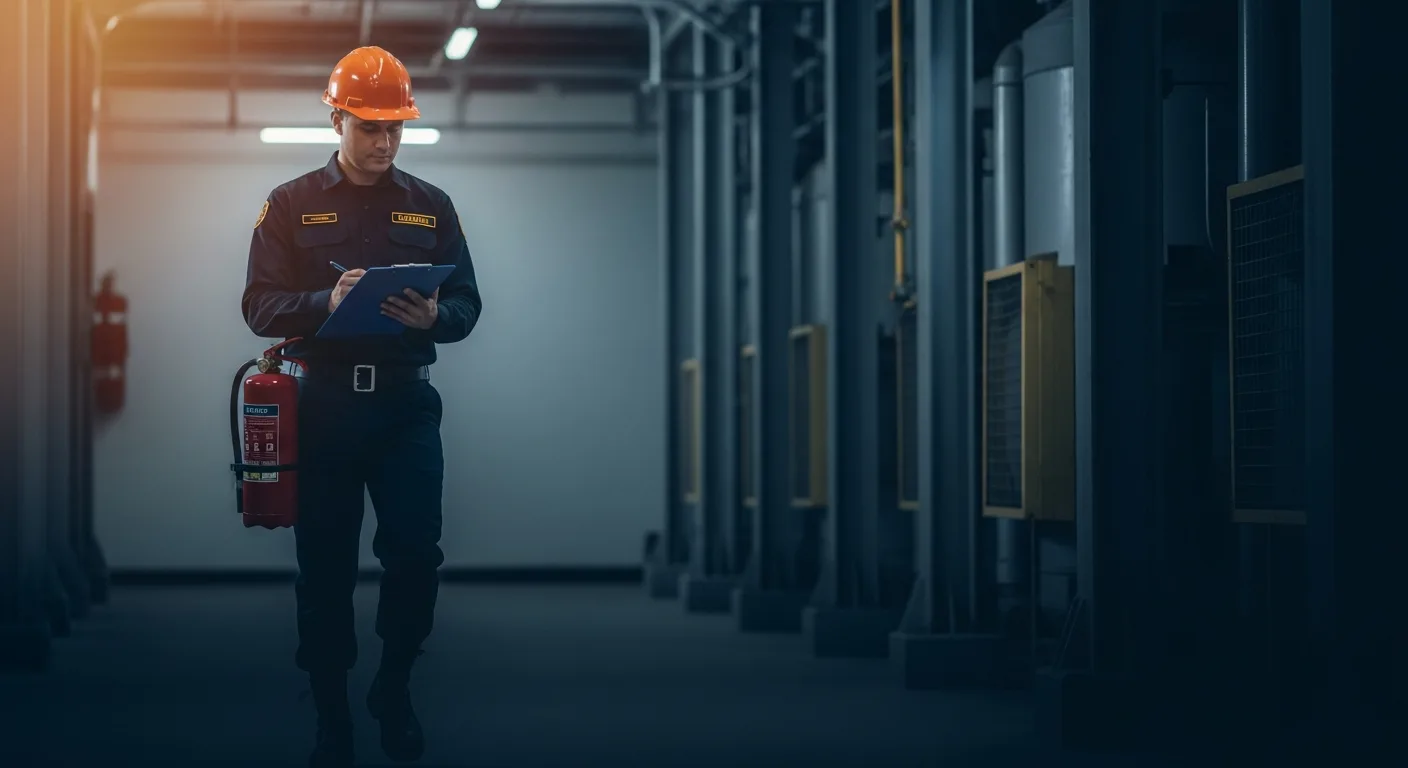
A compliant fire watch is a continuous, active patrol whose sole job is fire watch — the person cannot answer phones, run a front desk, direct traffic, or perform any other duty at the same time. That single-tasking requirement is the point most often misunderstood, and the one inspectors probe first. The guard:
- Continuously patrols the affected areas on a defined route and interval, including occupied floors and concealed, unoccupied, or void spaces where fire can spread unseen
- Watches for any sign of fire, smoke, or abnormal heat and keeps egress paths and exits clear and unobstructed
- Carries a portable fire extinguisher (and, where provided, knows the location of standpipes and manual pull stations) and is trained to use them on an incipient fire
- Maintains a timed, written fire-watch log documenting each round — the artifact discussed below
- Has the authority and the means (a charged cell phone or radio) to immediately notify the fire department, sound the alarm, and initiate evacuation — a fire watch's job is early warning, not firefighting
- Knows the specific scope of the impairment or hot-work operation, when the watch must start and end, and who to escalate to
The log is not optional — it is the evidence. Fire marshals and insurers expect a timed, written fire-watch log as proof that a compliant watch actually happened. A "fire watch" where the person was also working the desk, where rounds have hour-long gaps, or where no log exists at all can fail inspection and jeopardize your certificate of occupancy and your insurance coverage — even if no fire ever occurred. If a fire does occur and your log is missing or reconstructed after the fact, expect a coverage fight.
What a compliant fire-watch log looks like
The fire-watch log is the single artifact an inspector or insurer will ask for, and a vague one can sink an otherwise-fine watch. A defensible log documents, for every round: the date and specific clock time of each patrol; the areas and floors covered — including concealed and unoccupied spaces, not just the occupied areas; the name and signature (or initials) of the person on watch; any hazards or abnormal conditions observed and the action taken; and the times the watch started and ended, tied to when the impairment began and when the system was restored or the hot work's cooling period elapsed.
Rounds should be frequent and consistent — commonly every 15 to 60 minutes depending on the building and what the AHJ specifies — because long or irregular gaps read as gaps in coverage. The log should never be filled in ahead of time or reconstructed at shift's end; entries are made in real time as each round is completed. Keep the completed logs on file; they are your proof of compliance if a claim or inspection follows, and some AHJs require they be produced on demand.
Printable sample fire-watch log template
Copy this format into your own sheet (or ask any provider to match it). Fill the header once per shift; add one row per round.
| Fire Watch Log — Property: __________ · Reason (impairment/hot work): __________ · Watch start: ____ · Impairment began: ____ |
|---|
| Date | Clock time of round | Areas / floors covered (incl. concealed & void spaces) | Observations & action taken | Guard name / initials |
|---|---|---|---|---|
| __/__/__ | __:__ | Floors 1–3, roof void, elec. room | All clear / [hazard + action] | ______ |
| __/__/__ | __:__ | ______ | ||
| __/__/__ | __:__ | ______ | ||
| Watch end time: ____ · System restored & tested: ____ · Fire dept. notified of restoration: ____ · Guard signature: ____________ | ||||
A professional fire-watch company brings a standardized, defensible log like this — not a blank notepad. When you engage a provider, ask to see a blank copy of their log format and confirm it matches what your local fire marshal expects.
Fire watch by setting: how the rules play out
The same code framework applies everywhere, but the practical triggers, stakes, and AHJ expectations differ sharply by occupancy. A few of the most common:
Healthcare (hospitals, nursing homes, surgical centers)
These are among the most demanding settings because occupants can't self-evacuate and CMS / Joint Commission accreditation is on the line alongside the fire code. When a sprinkler zone or alarm loop is impaired, facilities typically implement an Interim Life Safety Measure (ILSM) program that mandates a fire watch, plus tighter round intervals and documentation. A failed watch here can threaten accreditation and reimbursement, not just occupancy.
Hotels and hospitality
Hotels are high-occupancy, 24/7 sleeping occupancies, so an impaired sprinkler or alarm system almost always triggers a mandatory watch to keep the property open and guests in their rooms. Because closing rooms is direct revenue loss, hotels are frequent emergency-dispatch customers — a watch that arrives in a few hours can save a night's occupancy. Front-desk staff cannot double as the fire watch; it must be a dedicated person.
Construction and renovation
On active sites, permanent fire protection is often not yet installed or is temporarily disabled, and hot work is routine — a double trigger. Watches are common through framing, MEP rough-in, and finishing, and pair naturally with broader construction site security and mobile patrol coverage.
Warehouses, manufacturing, and data centers
High-value contents and high-piled storage make suppression outages especially serious here. A sprinkler shutdown for rack reconfiguration, a fire-pump failure, or hot work on a mezzanine can all mandate a watch, and insurers of these assets tend to enforce the notification-and-log requirements strictly.
What a fire watch costs
Fire watch is priced by the guard-hour, and 2026 rates run roughly $28–$45 an hour per guard, with most engagements falling in the $32–$42 range. Emergency or same-day dispatch carries a premium — commonly $50–$150+ per hour for the first shift — and remote sites, hazardous conditions, or holidays push toward the top. Even the rush premium is a bargain next to the $200+/hour fire-department overtime some jurisdictions charge to staff a municipal watch.
Because it's hourly, the real number is a multiplication problem. A single guard around the clock is 168 guard-hours a week — at $28–$45, that's about $4,700–$7,600 per week, or roughly $20,000–$32,000 for a month-long sprinkler retrofit. Here are the common scenarios dollarized:
| Scenario | Guard-hours | Standard rate ($28–$45/hr) | Emergency / rush ($50–$150+/hr) |
|---|---|---|---|
| 4-hr minimum call-out | 4 | $112–$180 | $200–$600+ |
| 12-hr overnight watch | 12 | $336–$540 | $600–$1,800+ |
| 24-hr single day | 24 | $672–$1,080 | $1,200–$3,600+ |
| 24/7 for a multi-day sprinkler repair | 168 / week | $4,704–$7,560 / week | higher for the initial rush shift, then standard |
Cap the exposure with a not-to-exceed. For an open-ended outage, ask the provider for a written not-to-exceed figure — e.g., "24/7 coverage, NTE $7,600/week at $45/hr." It protects you against surprise overtime and holiday multipliers while the repair timeline slips.
Why the price is trivial next to the stakes. Picture a 200-room hotel with an impaired alarm loop. An overnight 12-hour watch costs about $336–$540. Closing the tower for one night at a $180 average rate and 70% occupancy forfeits roughly $25,000 in room revenue — about fifty times the cost of the watch. Now picture the other tail: a fire ignites during an untagged, unwatched sprinkler outage, and the carrier denies the claim because you never posted a watch or kept a log. That's not a $500 problem or a $25,000 problem — it's a six- or seven-figure loss on the building and contents. The "a $40/hr guard would have covered it" framing isn't rhetorical; it's the cheapest line item in the entire outage.
How fast can a fire watch be deployed?
For an emergency impairment, speed is the whole point, and professional providers are built for it: many can have a qualified guard on site within 2 to 4 hours in metro areas, sometimes faster. That's what lets a hotel keep rooms open or a hospital maintain occupancy through an unplanned outage. To move quickly, have three things ready when you call: the reason and scope of the watch (which system, which floors), the required duration or "until further notice," and any AHJ instructions you've already received. For planned work, book several days out at standard rates and skip the rush premium entirely. Either way, confirm the provider documents the patrol exactly as the code and your AHJ require — the log is what turns a guard on site into a compliant, defensible fire watch.
Frequently asked questions
When is a fire watch legally required?+
Does the same out-of-service clock apply to sprinklers and fire alarms?+
How much does a fire watch cost in 2026?+
How long must a fire watch continue after hot work under NFPA 51B?+
What has to be in a compliant fire-watch log?+
Share this guide
Sources
- OSHA — Fire Watch Duties during Hot Work (NFPA 51B 60-minute watch + up to 3 additional hours of monitoring by the PAI)
- Code Red Consultants — Updated Fire Watch Requirements (NFPA 51B 2019 §5.6.1.1 and §5.6.3)
- UpCodes — IFC §901.7 Out-of-Service Systems (base text sets no fixed hour threshold; AHJ discretion)