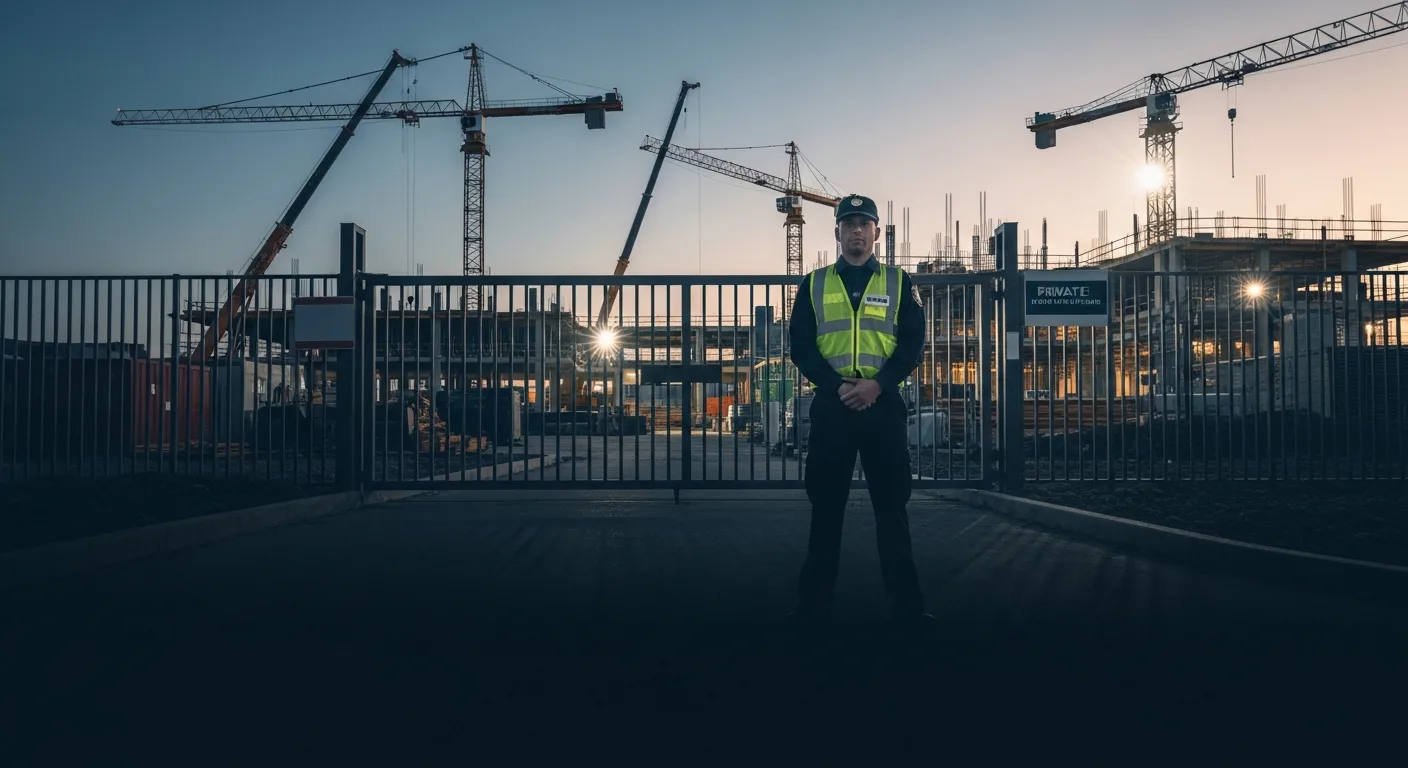
Construction sites are prime targets: high-value, portable assets and little overnight oversight. Worse, an injured trespasser can cost more than the theft. Here's how to secure a site cost-effectively — and the liability trap most owners miss.
Few properties are as exposed as an active construction site: tens or hundreds of thousands of dollars in equipment, copper, materials, tools, and fuel, often behind nothing more than temporary chain-link, with no one on site overnight or over long holiday weekends. It's no surprise the industry loses an estimated $300 million to $1 billion a year to theft, with fewer than a quarter of stolen assets ever recovered. But theft is only half the risk — a trespasser injured on your unsecured site can trigger a liability claim that dwarfs any stolen tool. This guide breaks down what gets stolen and what it really costs you, the hard NER/NICB numbers behind the headlines, how equipment-theft rings operate, the coverage options that work (including remote video guarding, which construction is almost tailor-made for), a fully worked monthly security budget, how to layer a site by build phase, what insurers and lenders expect, and how to vet a firm that has actually worked construction before.
Quick answer: Secure a site in layers: fencing, gates and access control at the perimeter, plus some mix of mobile patrol, remote video monitoring with live talk-down, and — for high-value or high-conflict sites — a stationed guard. A stationed unarmed guard runs about $22–$35/hr (roughly $16,000–$25,600/mo for true 24/7 coverage, which needs 2–4 officers), while remote video guarding and weekend mobile patrol typically cost a fraction of that and are a natural fit for empty overnight sites. And never rely on a "No Trespassing" sign alone: the attractive-nuisance doctrine can make you liable for a trespassing child's injury even though they had no right to be there.
Why construction sites are prime targets
Construction sites combine everything a thief wants: high-value, portable, hard-to-trace assets and almost no oversight. A site is fully staffed and busy during the day, then completely abandoned from quitting time until the next morning — and for 72 hours or more over a three-day weekend. Most theft happens between roughly 5 PM and 7 AM and spikes over long holiday weekends, exactly when there's no one to see it and the nearest supervisor is hours away. Materials arrive on a predictable delivery schedule, equipment is left parked in the open with the keys a common master, and copper and wire sit staged and ready to grab. Add rising scrap-metal and lumber prices and a hot resale market for used machinery, and a site becomes a low-risk, high-reward target that many crews hit more than once during a single build.
What gets stolen — and what it actually costs you
The loss you see on the police report is almost never the real number. Here's what walks off construction sites, in rough order of how often it's targeted:
- Copper, wire and cable — the single most-stolen material, driven by scrap prices. Thieves strip spools of romex, THHN, and grounding wire, and will rip copper out of temp power and partially wired walls, doing far more damage than the metal is worth.
- Power tools and small equipment — cordless drills, saws, generators, compressors, welders, nail guns, laser levels. Small, valuable, untraceable, and easy to resell online or at a pawn shop.
- Heavy equipment — skid steers, loaders, mini-excavators, generators, light towers, and attachments. High-dollar and rarely recovered; a single machine can be a six-figure loss.
- Appliances and fixtures — during finishing, installed refrigerators, ranges, dishwashers, water heaters, HVAC condensers, and plumbing fixtures are pulled straight out of nearly finished units.
- Lumber and building materials — framing lumber, plywood, rebar, drywall, and pipe. Bulky but valuable when material prices spike, and often stolen by the truckload.
- Fuel — diesel siphoned from equipment tanks and jobsite fuel storage, a quiet, repeatable theft that's easy to overlook.
- Catalytic converters — sawed off of jobsite trucks, fleet vehicles, and equipment for the precious metals inside; a fast-growing target that leaves a vehicle down for days.
Now the true cost. The stolen asset is only line one. Add the rental or rush-replacement cost to get a comparable machine back on site, often at premium short-term rates. Add schedule impact: if a skid steer or the temp power disappears, a crew stands idle, a trade misses its window, and the delay cascades into liquidated-damages exposure on a fixed-completion contract. Add collateral damage — a copper strip-out means re-pulling wire and re-inspecting, not just re-buying the metal. Add higher insurance premiums and deductibles after a claim, and the administrative time to file it.
The per-incident number depends heavily on what is taken. The National Equipment Register (NER) pegs the average heavy-equipment theft at roughly $30,000+ per machine, and stolen trucks average north of $40,000 in NIBRS data. But across all construction thefts — folding in the far more frequent tool and material grabs — the average incident is closer to ~$6,000. In other words, the tens-of-thousands figure belongs to heavy equipment specifically, not to the typical theft. Either way, once downtime and rework are counted, the total cost of a serious theft frequently runs several times the sticker value of what was taken.
Equipment theft by the numbers (NER / NICB data)
The generic "a large fraction is never recovered" claim understates the problem. Here is the hard data insurers and equipment registers actually track:
| Metric | Figure | What it means for you |
|---|---|---|
| Estimated annual U.S. construction theft loss | $300M–$1B | ~11,000–12,000 equipment incidents reported per year (many more go unreported) |
| Avg. loss — heavy equipment | ~$30,000+ / machine | Excludes downtime, rental, and schedule cost |
| Avg. loss — trucks | ~$40,000+ / incident | The single costliest category |
| Avg. loss — all thefts (tools + materials + equipment) | ~$6,000 | The "typical" incident is a tool/material grab, not a machine |
| Recovery rate — heavy equipment (no GPS) | ~21% | Fewer than 1 in 5 machines comes back without telematics |
| Recovery rate — tools & small equipment | <7% | Practically gone the moment it leaves the gate |
| Top theft states (NER) | TX (~24%), GA, LA, NC, FL | ~5 states drive over half of reported incidents |
| Peak windows | Peak construction season + long holiday weekends | Memorial Day, Labor Day, and Thanksgiving are recurring spikes |
The through-line: heavy equipment with active GPS/telematics is recovered at a dramatically higher rate than unmarked machines, which is exactly why manufacturers and insurers push registration and tracking so hard. If you operate in a top-five state or run through a long weekend, treat elevated coverage as the baseline, not the exception.
Trailer break-ins and organized equipment-theft rings
Not all construction theft is a smash-and-grab by an opportunist. A large share is organized. Jobsite trailer and conex break-ins are a signature target: a single locked container or gang box holds a crew's entire tool inventory, so one forced door can net tens of thousands of dollars in minutes. Thieves defeat cheap hasps and padlocks with bolt cutters or a pry bar, which is why hardened, shrouded locks and interior-mounted hinges matter.
Equipment-theft rings operate at another level. Machinery is stolen to order, sometimes loaded onto a waiting flatbed and gone before anyone notices, then repainted, re-VIN'd, shipped out of state, or exported. Because heavy equipment has no title system as robust as a car's, recovery rates are dismal — as the data above shows, roughly four in five machines are never seen again. Rings watch multiple sites in a metro, learn which contractors leave keys in the ignition or use the universal keys common to a brand, and time thefts to long weekends. This is the theft pattern behind national tracking efforts and why manufacturers and insurers push hard for equipment registration, hidden VINs, and telematics/GPS: the countermeasures that make a machine hard to fence are the ones that deter the ring in the first place.
Vandalism, arson, and the trespasser-liability trap
Theft gets the attention, but three other exposures can cost more. Vandalism — graffiti, smashed windows, spray-painted equipment, ripped-out wiring done for spite rather than resale — creates cleanup and repair costs and, again, schedule delay. Arson and fire are the catastrophic tail risk: an unoccupied, unsprinklered wood-frame structure full of combustible materials is extremely vulnerable, and a set fire can destroy months of work and neighboring property in a single night. Sites that go dark and unmonitored are the ones that burn; this is also why some jurisdictions and insurers require a dedicated fire watch during hot work or when fire-protection systems are impaired.
Then there is the liability most owners genuinely underestimate: an injured trespasser. In general a property owner owes a trespasser only a limited duty — but the attractive-nuisance doctrine is a major exception that protects trespassing children who can't appreciate danger. A construction site — open excavations and trenches, standing water, scaffolding, ladders, stacked materials, and heavy equipment kids can climb on — is the textbook example of a man-made condition that draws children and can seriously injure or kill them.
A "No Trespassing" sign is often not enough
Courts generally expect affirmative physical measures — secure fencing, locked gates, covered excavations and trenches, secured ladders and equipment, drained standing water — not just signage. If a child is injured on an unsecured site, you can be held liable even though they were trespassing, and the resulting claim can exceed any theft loss you'll ever suffer. Access control also keeps out adult trespassers and squatters, whose injuries and illegal activity create their own liability.
Confirm your state's version of the doctrine. Most states apply the near-universal five-factor test from Restatement (Second) of Torts § 339 (child likely to trespass; owner knows of a dangerous artificial condition; child too young to appreciate the risk; burden of fixing it is slight versus the danger; owner failed to use reasonable care). But application varies: Florida adds an "allurement" element, a handful of states (e.g., Virginia and West Virginia) reject the doctrine outright, and others limit it to children under ~14 or to concealed hazards. The prudent posture is the same everywhere — physically secure the site — but confirm the exact standard with local counsel.
Coverage options: static guard, mobile patrol, and remote video
There is no single right answer — the best programs mix methods — but understanding what each one does well is the key to not overpaying. A static (stationed) guard puts a person on site full time: they control access at the gate, log deliveries and trades, respond immediately to anything, and provide the strongest visible deterrence, but they are also the most expensive option and a single officer can't watch a large site at once. Mobile patrol sends a marked vehicle to make scheduled or random passes — checking the perimeter, gates, and equipment, then leaving — which delivers visible, unpredictable presence across one or several sites at a fraction of a full-time guard's cost, though there are gaps between visits.
Remote video guarding (also called virtual guarding or live video monitoring) is where construction has an unusually strong fit. Because a site is empty after hours, anyone moving on camera at 2 AM is by definition suspicious — there's no crowd to filter, which is exactly the condition AI analytics and remote operators handle best. Cameras (often on solar-powered mobile trailers or light towers) feed a monitoring center where analytics flag movement in the perimeter zone; a live operator verifies the intruder and triggers an on-site talk-down — a loudspeaker announcement ("You on the yellow excavator, you are being recorded, police have been called") that sends most intruders running before anything is taken. Verified events get a priority police response because they're confirmed crimes in progress, not blind alarms. It scales to cover a large or remote site for far less than staffing it, and it captures evidence either way.
| Method | Coverage | Typical 2026 cost | Best for |
|---|---|---|---|
| Static (stationed) guard | Continuous while posted; one person, one location | ~$22–$35+/hr unarmed; 24/7 needs 2–4 officers (~$16,000–$25,600/mo) | High-value or high-conflict sites, gate/delivery access control, urban infill |
| Mobile patrol | Scheduled or random passes; gaps between visits | ~$600–$2,500/property/mo | Overnight and weekend checks, multiple or spread-out sites |
| Remote video guarding (talk-down) | Continuous monitored coverage of the whole site via cameras | Camera trailer + live monitoring commonly ~$1,500–$2,500/mo — a fraction of a 24/7 guard | Empty after-hours sites, large/remote yards, deterrence + evidence |
Most well-run sites layer them: remote video or a camera trailer for continuous coverage and evidence, mobile patrol for periodic physical presence and alarm response, and a stationed guard reserved for the highest-risk phase, the busiest access-control window, or a site where confrontation is likely. In dense, high-cost metros — a downtown high-rise in Los Angeles or an infill project in Chicago — you'll lean harder on stationed access control; on a spread-out suburban or rural build you'll lean on cameras and patrol.
What it costs, and the virtual-vs-guard math
Here is the part most guides skip: real numbers you can put in a budget. A true 24/7 stationed guard is not one salary — it's 2–4 officers to cover three shifts plus relief, which lands around $16,000–$25,600 per month for unarmed coverage (more if the post is armed). By contrast, mobile patrol runs roughly $600–$2,500 per property per month depending on pass frequency, and a remote video guarding trailer with live monitoring commonly runs ~$1,500–$2,500 per month. That gap — an order of magnitude — is the entire reason layering beats blanket guarding on most jobs.
Worked example: a 6-month ground-up build
Say you're a GC on a 6-month wood-frame build in a mid-crime suburb. Instead of guarding it 24/7 the whole time, you layer coverage to the actual risk curve — continuous camera coverage all six months, weekend patrol throughout, and a live night guard only during the 6-week framing/rough-in peak when the most copper, lumber, and tools are exposed:
| Line item | Rate | Duration | Program cost |
|---|---|---|---|
| Solar camera trailer + live monitoring (talk-down) | ~$2,000/mo | 6 months | ~$12,000 |
| Weekend mobile patrol (2–3 passes/night, Fri–Sun) | ~$900/mo | 6 months | ~$5,400 |
| Stationed night guard, framing/rough-in peak only (12h nights @ ~$28/hr) | ~$14,000/mo run rate | 6 weeks | ~$14,000 |
| Total layered program | — | 6 months | ~$31,000 (~$5,200/mo avg) |
Now benchmark that against the brute-force alternative — a single 24/7 unarmed guard post for the whole build at ~$20,000/mo: about $120,000 over six months. The layered program delivers continuous monitored coverage plus a physical presence during the riskiest window for roughly a quarter of the cost — and it produces recorded evidence every night, which a lone guard walking a large site does not. Scale the guard weeks up or down as your exposure changes; the camera-and-patrol base stays cheap and constant.
Security by build phase
Risk isn't static — it moves with the schedule. What's worth stealing (and how a site can hurt someone) changes completely from a muddy hole in the ground to a nearly finished building full of appliances. Match your coverage to the phase instead of paying for a one-size program.
During excavation and sitework, the assets are heavy equipment, attachments, and fuel, and the signature hazard is the open trench or excavation — an attractive-nuisance magnet. During framing and rough-in, exposure peaks: lumber, copper, wire, tools, temp power, and HVAC/plumbing rough materials are all on site, unlocked walls invite copper strip-outs, and the combustible wood frame is at its most arson-vulnerable. During finishing and lockup, the target shifts to installed appliances, fixtures, HVAC condensers, and cabinetry — high-value, easy to pull, and stolen right out of near-complete units.
| Phase | Top assets at risk | Peak threats | Recommended coverage |
|---|---|---|---|
| Excavation / sitework | Heavy equipment, attachments, fuel | Equipment-ring theft; open-trench child-injury liability | GPS/telematics on machines, immobilization, camera trailer, covered/fenced trenches |
| Framing / rough-in | Lumber, copper & wire, tools, temp power, HVAC/plumbing rough | Copper strip-outs, tool-trailer break-ins, arson (exposed wood frame) | Peak coverage: remote video + weekend patrol + stationed night guard; gang-box hardening; fire watch during hot work |
| Finishing / lockup | Appliances, fixtures, HVAC condensers, cabinetry, copper | Pull-outs from near-complete units; after-hours entry through installed doors | Access control at building entries, camera coverage inside, alarm monitoring, delivery-timed installs |
Nightly pre-pour / lockup hardening checklist
Most losses are preventable with a disciplined end-of-day routine. Make this the super's closing checklist — it's the cheapest security you own, and it doubles as evidence you took "affirmative measures" if a liability claim ever lands.
- Master/common keys removed from all equipment; machines immobilized and geofenced (telematics armed).
- Copper, wire, and fuel locked separately and stored out of sight — not staged in the open for a morning grab.
- Gang boxes and conex trailers closed with shrouded, hardened locks and interior-mounted hinges; tool inventory logged.
- Open trenches and excavations covered or barricaded; standing water drained.
- Ladders, scaffolding, and climbable equipment secured or laid down so a child can't mount them.
- Perimeter fence intact, all gates locked, access points reduced to one controlled entry.
- Site lighting on and functioning; dark corners eliminated.
- Camera trailer / video guarding system armed and confirmed online with the monitoring center.
- Deliveries scheduled to arrive the morning they're used — not staged on site over a weekend.
Insurance, lender, and GC requirements
Security isn't only about avoiding loss — it's frequently a contractual and coverage prerequisite. Builder's risk policies, project lenders, and the GC's own contract often push security obligations down to you. But the mechanisms that actually burn contractors are in the fine print, not the headline coverage:
- Theft sub-limits. A builder's risk policy may cap theft losses far below the policy's overall limit — sometimes a small fraction — so a six-figure equipment theft is only partly covered even when you're "insured."
- After-hours and vacancy exclusions. Many policies limit or exclude losses that occur when the site is unattended or "vacant" — precisely the 5 PM-to-7 AM window when nearly all theft happens.
- Protective-safeguards endorsements. If your policy requires a specific safeguard — a maintained fence, a monitored alarm, a nightly guard, a functioning camera system — and that safeguard isn't in place and working at the time of loss, coverage can be voided outright. A contractor who lets the alarm line lapse or pulls the guard early to save money can find a legitimate claim denied on that basis alone.
- Warranty and representation clauses. When you told the underwriter you'd maintain certain security, that becomes a warranty; breaching it gives the carrier grounds to deny.
- GC pass-down and additional-insured terms. The prime contract may require you to carry specific limits, name the GC/owner as additional insured, and maintain named safeguards — with indemnity flowing back to you if a subcontractor's lapse causes a loss.
Concrete example of a denied claim: a framing sub carrying builder's risk with a protective-safeguards endorsement requiring a monitored central-station alarm. To cut cost mid-project, the alarm monitoring was allowed to lapse. Over a long weekend the site was hit for copper and tools. Because the required safeguard wasn't active at the time of loss, the carrier denied the claim under the endorsement — the contractor ate the full loss and the schedule hit. The flip side is the upside: documented, maintained security lowers premiums and deductibles and can be the difference between a covered and a denied claim, so keeping monitoring logs, guard reports, and camera uptime records is both a coverage safeguard and a negotiating lever at renewal.
How to vet a construction security firm
Construction is not the same as guarding a mall or a lobby. Vet for jobsite-specific competence:
- Real construction experience. Ask for jobsite references and how they handle deliveries, trade access logs, and OSHA-adjacent site rules — not just "we do security."
- Licensing and insurance. Confirm state guard/PPO licensing, carry-forward liability and workers' comp, and that they'll name you as additional insured. Cross-check licensing before you sign.
- The right technology partner. If you want remote video guarding, confirm they run (or partner with) a monitoring center with live talk-down and verified-response police relationships — not a passive DVR that just records for later.
- Layered program design. A good firm proposes a phase-aware mix (cameras + patrol + selective guarding) tuned to your build and budget, and adjusts it as the schedule moves — not a flat 24/7 guard quote.
- Reporting and evidence. Insist on daily activity reports, incident documentation, and retained footage — the records that protect you at an insurance renewal or in a liability claim.
Compare a few construction-site security providers in your metro, hand them your schedule and site plan, and ask each to price a layered program against a 24/7 guard baseline. The right partner will show you where a camera trailer and weekend patrol do the same job for a quarter of the cost — and where a stationed guard is genuinely worth it.
Frequently asked questions
How much does construction site security cost in 2026?+
What is the average loss from a construction site theft?+
Is remote video guarding good enough, or do I need a guard on site?+
Can I be liable if a trespasser or child is hurt on my construction site?+
Does my insurance require site security?+
Share this guide
Sources
- National Equipment Register (NER) — Annual Heavy Equipment Theft Report
- NICB — Reports & Statistics
- Construction Equipment Theft Statistics 2026 (data reference: $30k heavy-equipment avg, ~21% / <7% recovery, top states)
- SentryPods — Construction Equipment Theft Data (per-incident range $6k–$30k by class)
- Cornell LII — Attractive Nuisance Doctrine (Restatement §339 five-factor test)