Manned gatehouse, virtual guard, or unmanned access control? For HOA boards and gated communities the right model depends on layout, budget, and risk. Here's how the options compare, what they cost per home, how dues and assessments fund them, and how to run a clean RFP.
For a gated community or homeowners association, security is one of the most visible services the association provides — and one of the most scrutinized line items in the budget. It is also one of the most misunderstood. Residents often expect a private police force; what the association can actually deliver is controlled access, a visible deterrent, and a documented response. The board's job is to match a security model to the community's real layout and risk, fund it responsibly through dues or reserves, and set resident expectations honestly. This guide walks HOA boards, property managers, and homeowners through the gate-staffing options, the roving-patrol choice, the legal limits of what guards can enforce, what each model actually costs per home, the emergency-access and liability items boards forget, and how to run a clean RFP for a licensed provider. If you manage a large apartment community or multifamily portfolio rather than a homeowner-governed association, our companion guide on apartment and multifamily security is the better fit; this one is written for boards and homeowners.
Quick answer: A manned gatehouse gives the strongest access control at one entrance but is the most expensive — a 24/7 staffed gate runs roughly $190,000–$310,000 a year (about $53–$86 per home per month in a 300-home community). A virtual (remote) guard admits visitors by camera and intercom for a fraction of that, typically $1,500–$3,500 per month per gate. Unmanned access — call boxes, RFID transponders, and license-plate readers — costs the least to run (mostly one-time hardware plus maintenance) but puts no human on site. Most communities blend a virtual or unmanned gate with a nightly roving patrol. Guards deter, observe, and report; they are not police, and they cannot enforce beyond your CC&Rs. Fund it through the operating budget from dues, plan for emergency-vehicle access, and hire only a state-licensed, insured firm that names the HOA as additional insured.
Gate-staffing models: manned, virtual, and unmanned
The entrance is where most HOA security budgets are spent and where the biggest cost decisions live. There are three broad ways to staff a gate, and they differ enormously in price and in what they actually do.
Manned gatehouse (stationed gate attendant)
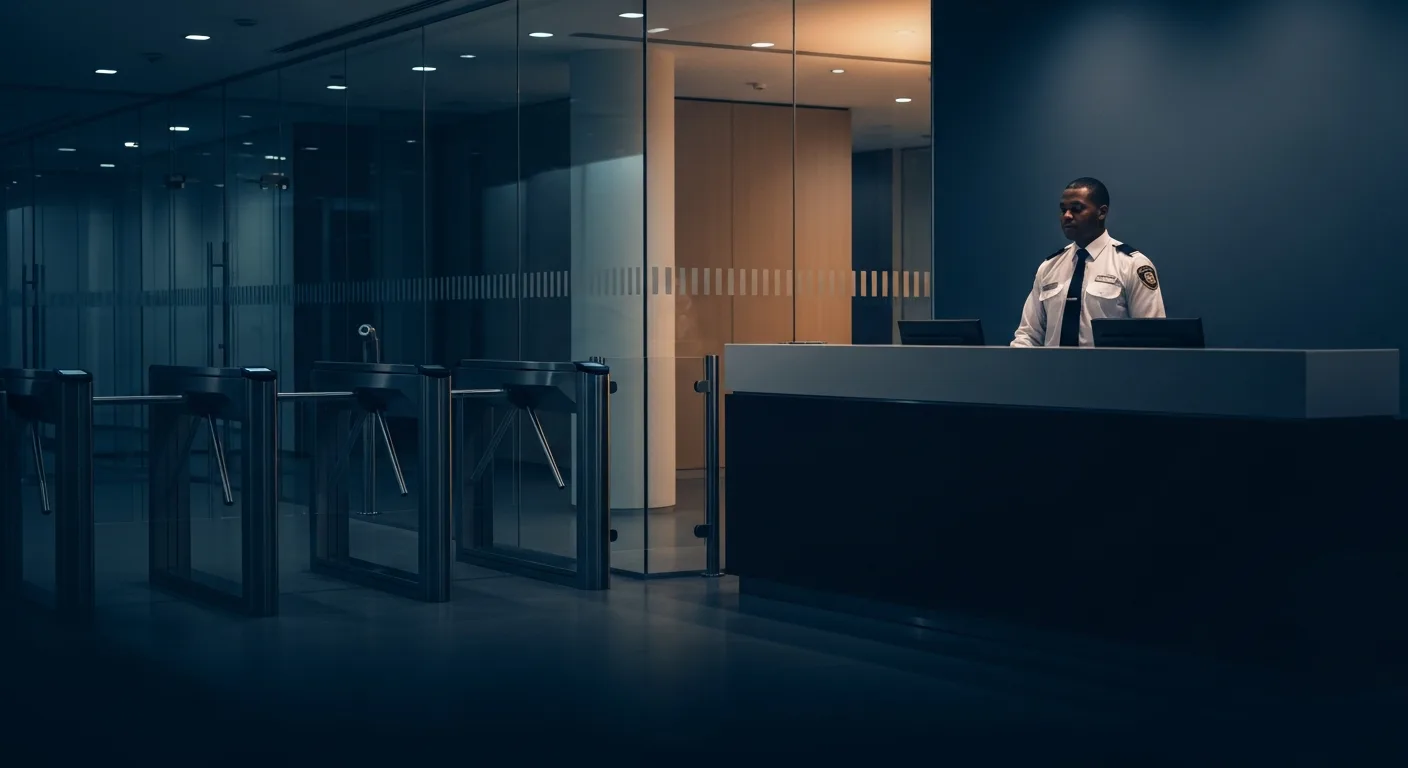
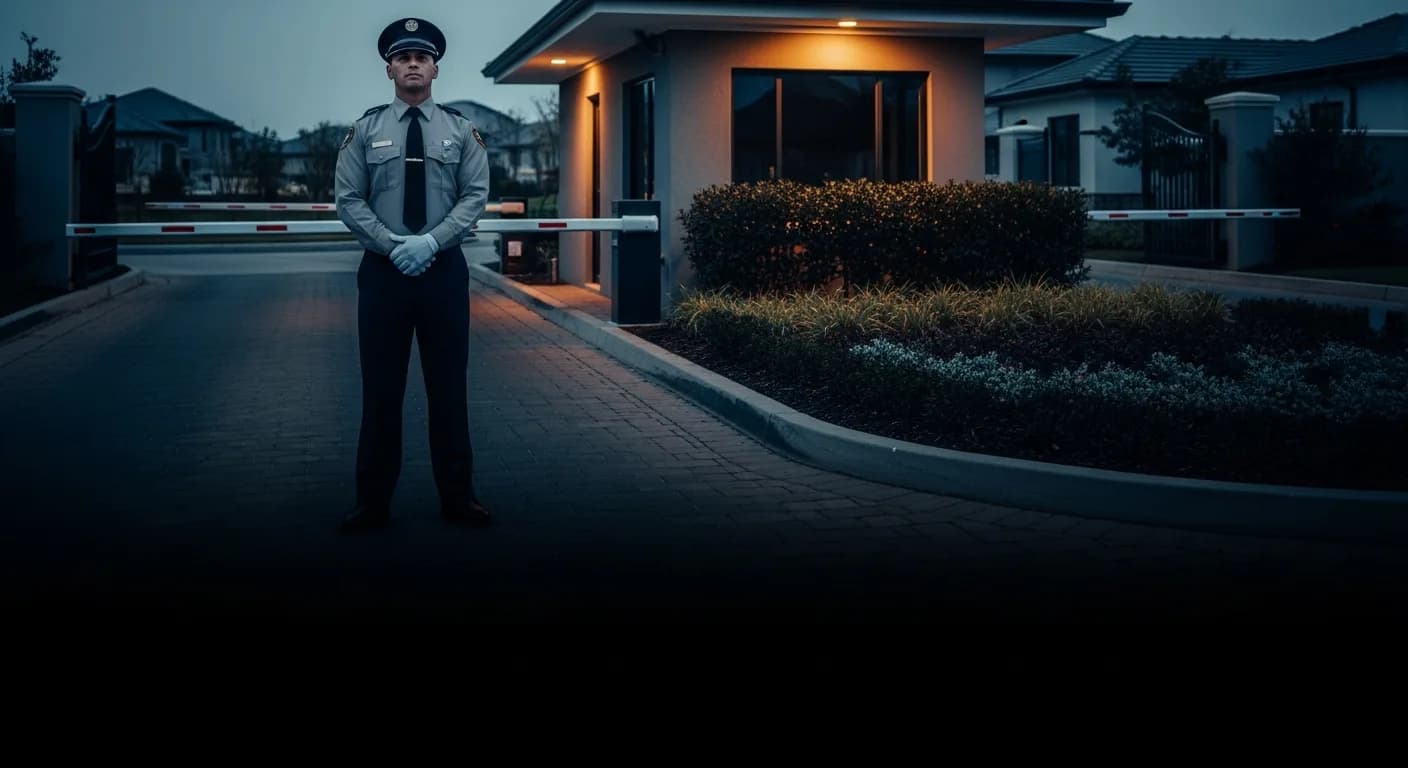
A live attendant in the gatehouse controls and logs every entry — greeting residents, verifying and admitting guests, checking in vendors and deliveries, and calling residents to confirm unexpected visitors. This is the strongest access control money can buy at a single point, and it carries real intangible value: residents recognize the officer, a person can use judgment a machine cannot, and a staffed gate is a genuine deterrent to anyone casing the neighborhood.
The catch is cost. A gatehouse staffed around the clock is three shifts a day, 365 days a year. At an unarmed guard bill rate of $22–$35 an hour — the labor line, not the guard's take-home wage of roughly $16–$25 — continuous coverage means two to four officers across the day, which pencils out to roughly $16,000–$25,600 a month, or about $190,000–$310,000 a year. Many communities compromise by staffing the gate only during peak hours (evenings, weekends) and switching to a virtual or unmanned mode overnight.
Virtual (remote) guard
A virtual guard replaces the person in the booth with a camera-and-intercom kiosk connected to a remote operator at a monitoring center. When a visitor pulls up, the operator sees and speaks with them, verifies against the resident's instructions, and opens the gate — the same access-control function as a manned gate, delivered from off site for a fraction of the cost, typically $1,500–$3,500 a month per gate as a managed service. Live two-way audio is a real deterrent, and every interaction is recorded. The limit is physical: a remote operator can observe, warn, and dispatch, but cannot walk out and intervene, so a virtual gate is strongest when paired with a roving patrol or a police-response arrangement for anything that needs a body on the ground.
Unmanned access control (call boxes, ALPR, RFID)
The lowest-cost tier removes the human from the entrance entirely and lets technology manage it:
- Telephone-entry call boxes. A keypad kiosk (DoorKing, Linear, and similar) dials the resident's phone; the resident presses a key to open the gate for a guest. Cheap and reliable, but only as good as the resident answering — and tailgating behind an admitted car remains the weak point.
- RFID transponders and decals. Windshield stickers or dashboard transponders open the resident gate automatically, keeping the resident lane fast and logged. Decals also make it easy to see which vehicles belong, and credentials can be deactivated the day a home sells or a car leaves the community.
- Automated license-plate recognition (ALPR/LPR). Cameras read and log every plate entering and leaving, opening the gate for registered residents and creating a searchable record of every vehicle by time and date. ALPR is increasingly the backbone of modern gated-community access because it works with no resident action and produces investigation-grade records — but the plate data it generates carries governance obligations covered below.
Unmanned access is the cheapest to run but offers no on-site presence and no judgment — it admits credentials, not people — so most boards pair it with cameras and periodic patrol rather than relying on it alone.
| Gate model | What it does | Typical annual cost | Cost per home (300-home HOA) | Best for |
|---|---|---|---|---|
| Manned gatehouse (24/7) | Live attendant verifies and logs every entry; on-site judgment and presence | ~$190,000–$310,000/yr | ~$630–$1,030/yr (~$53–$86/mo of dues) | High-visibility or high-risk communities that want a person at the gate |
| Manned gatehouse (peak hours only) | Live attendant during evenings/weekends; unmanned or virtual otherwise | ~$70,000–$150,000/yr | ~$230–$500/yr (~$19–$42/mo) | Communities wanting presence when traffic and risk peak |
| Virtual / remote guard | Remote operator admits visitors by camera and intercom; recorded, talk-down capable | ~$18,000–$42,000/yr ($1,500–$3,500/mo) | ~$60–$140/yr (~$5–$12/mo) | Most gated communities wanting real access control without a booth salary |
| Unmanned access (call box, RFID, ALPR) | Technology admits credentials and logs vehicles; no human on site | One-time hardware $10,000–$40,000 + ~$2,000–$8,000/yr maintenance | ~$7–$27/yr after amortizing (~$1–$2/mo) | Low-risk communities, or as the resident lane behind a staffed guest lane |
| Nightly roving patrol (add-on) | Marked vehicle makes scheduled/random rounds of streets and common areas | ~$7,200–$30,000/yr ($600–$2,500/mo) | ~$24–$100/yr (~$2–$8/mo) | Every community — covers everything behind the gate |
Figures are 2026 planning estimates, not quotes. Actual pricing depends on entrance count, hours, local wage floors, and whether officers are unarmed or armed. Always get written bids scoped to your community.
What the gate really costs per home — a dues-impact worksheet
Boards don't decide in the abstract; they decide in dollars per door. The fastest way to make a security choice actionable is to convert the annual cost into a per-home, per-month number and hold it up against current dues. Here is the math a treasurer can run in five minutes, using a 300-home community as the model — divide by your own door count to localize it.
- 24/7 manned gate: ~$190,000–$310,000/yr ÷ 300 homes = ~$630–$1,030 per home per year, or roughly $53–$86 a month added to dues.
- Peak-hours manned gate: ~$70,000–$150,000/yr ÷ 300 = ~$230–$500/home/yr (~$19–$42/mo).
- Virtual / remote guard: ~$18,000–$42,000/yr ÷ 300 = ~$60–$140/home/yr (~$5–$12/mo) — often a tenth of a staffed booth for the same visitor-admittance function.
- Unmanned hardware: a one-time $10,000–$40,000 capital item (reserve-funded) plus ~$2,000–$8,000/yr maintenance = ~$7–$27/home/yr ongoing once amortized.
- Nightly roving patrol: ~$7,200–$30,000/yr ÷ 300 = ~$24–$100/home/yr (~$2–$8/mo).
The blend most 300-home communities can actually afford: a virtual or ALPR guest gate (~$5–$12/home/mo) plus a nightly roving patrol (~$2–$8/home/mo) lands around $7–$20 per home per month — a small fraction of a 24/7 booth — while still delivering recorded visitor screening, logged access, and a documented physical presence behind the gate. Reserve for the hardware, expense the monitoring and patrol from operating dues.
Closing the tailgating gap
Every automated gate — call box, RFID, or ALPR — shares one weakness: tailgating, where an unauthorized vehicle simply follows an admitted car through the open arm before it closes. A gate that logs a single valid credential but passes two cars has failed silently. World-class communities engineer this out rather than hoping residents police it:
- Second (interlocked) gate or vehicle trap. A short sally-port between two arms admits one vehicle at a time; the outer arm won't open until the inner one closes. It is the most reliable anti-tailgate control at higher-risk entrances.
- Tailgate-detection cameras and loop sensors. Modern gate controllers count axles or vehicles across the loop and flag or alarm when two pass on one credential, pushing an alert to the patrol or virtual operator.
- Dwell-time and safety-loop tuning. Shortening the open-arm dwell (while keeping a safety loop so the arm never lands on a car) reduces the window a follower can exploit — a free software adjustment on most operators.
- ALPR alerting on unregistered plates. Pair the reader with an alert rule so any plate not on the resident/guest list that clears the gate generates a real-time notification, turning a passive log into an active tripwire.
- Patrol enforcement. A roving officer positioned at the entrance during peak inbound hours is the human backstop no sensor replaces — and a visible deterrent to habitual tailgaters.
Name the specific anti-tailgating control you're buying in the RFP; a bid that quotes a gate operator without addressing tailgating has quoted you a false sense of security.
Emergency and first-responder access
A gate that keeps the wrong people out is worthless — and a genuine liability — if it also keeps the fire department, an ambulance, or police out during an emergency. This is one of the most overlooked diligence items on any gated board's list, and mishandling it can turn a medical or fire event into a fatality and a lawsuit. Build first-responder access in from day one:
- Knox box or fire-department override. Most fire jurisdictions require (and many local codes mandate) a Knox key box or a coded/keyed override switch so responders can open the gate without waiting. Confirm your local fire marshal's specific requirement before you finalize any gate.
- EMS and ambulance entry. Provide 911 dispatch and local EMS with the current gate code or a dedicated responder credential, and update it whenever codes rotate. A code no one told dispatch about is not access.
- Fail-open vs. fail-secure on power loss. Decide deliberately how the gate behaves when power or the controller fails. Fire codes commonly require vehicle gates to fail open so responders and residents are never trapped; a fail-secure setting can be unlawful and dangerous. Verify against your local code.
- Battery backup and manual release. Spec a battery backup so the gate cycles through short outages, and confirm every gate has a clearly marked manual disconnect responders can operate by hand.
Emergency-access checklist (require in every gate bid): (1) Knox box or approved fire override, sized to the local fire marshal's spec; (2) current gate code/credential on file with 911 dispatch and EMS; (3) documented fail-open behavior on power loss, verified against local fire code; (4) battery backup rated for realistic outage length; (5) labeled manual release at each gate; (6) a written schedule for rotating and re-distributing codes after they change.
Roving courtesy patrol for the neighborhood
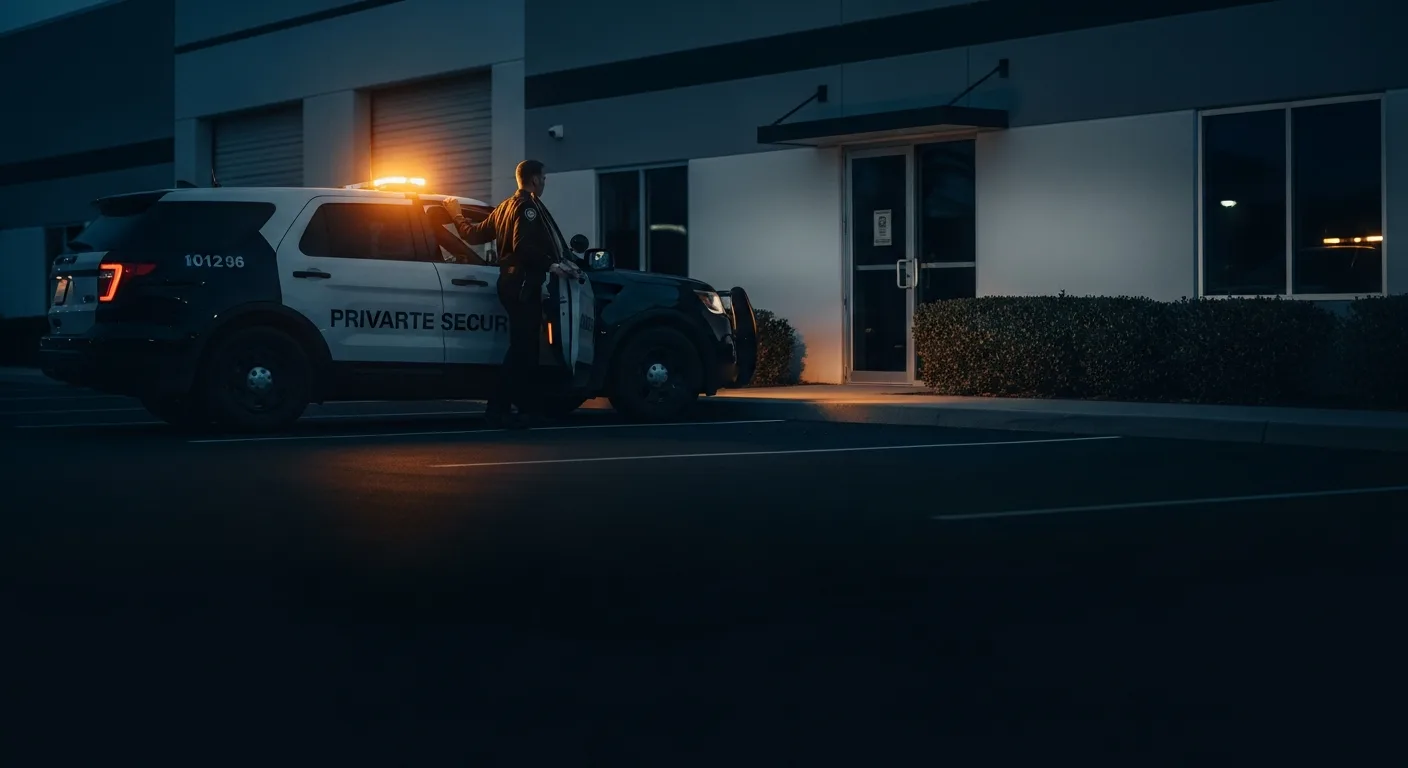
A gate only protects the gate. Everything behind it — the streets, the pool and clubhouse, the mail kiosks, the parked cars, the perimeter fence line — is covered by a roving courtesy patrol: a marked vehicle making rounds on a schedule, checking common areas and lighting, noting open garages and suspicious vehicles, enforcing parking and pool-hours rules, and responding to resident calls. Patrol is the workhorse of neighborhood security because it covers a lot of ground for far fewer paid hours than a stationed post, and its underrated advantage is documentation: a professional patrol produces timestamped, GPS-verified checkpoint logs and photo-backed incident reports that prove exactly what was patrolled and when. See our mobile patrol service and the deeper mobile patrol guide for how routes and checkpoints are built. The trade-off is the gap between passes — a patrol is not continuous presence, and a predictable route is a route someone can time — so good providers randomize passes and tie them to the community's actual problem hours.
What a "courtesy officer" is — and the role-clarity problem
Homeowners sometimes ask why the association doesn't just give a resident free rent to "be security." That arrangement — a courtesy officer, often an off-duty or moonlighting law-enforcement officer who lives in or near the community in exchange for a concession and provides an after-hours point of contact — exists, but it carries a specific trap the board must understand. The word "officer" implies police powers the person does not have while off duty and acting for a private association, and an undefined role creates liability rather than reducing it. Is the person an employee, an independent contractor, or a resident with a benefit? Whose insurance covers their conduct? What are they actually authorized to do — and not do?
Employment classification and liability treatment vary by state and by the exact terms of the arrangement, so if a board goes this route it must define the role, hours, duties, and limits in writing, confirm the classification and insurance with counsel, and never market the person to residents as "security" if their real role is narrower. For most communities, a licensed contract patrol is cleaner: the vendor carries its own insurance and its officers work under a defined, licensed scope.
Setting resident expectations: deter, observe, report — not police
The single most important thing a board can communicate is what security does not do. Private security officers — whether at the gate or on patrol — deter, observe, report, and, where lawful, detain briefly under citizen's-arrest limits. They are not police officers. They do not carry police powers, they generally cannot make arrests beyond narrow statutory limits, and on private community streets they cannot write enforceable traffic citations the way a sworn officer can. When a crime is in progress, the right response is the same one every resident has: call 911. A guard's value is presence and paperwork — being visible enough to deter, and disciplined enough to document — not force. Boards that let residents believe they've hired a private police force set the association up for anger when an officer "just called it in," so it is worth stating the deter-observe-report scope plainly in the community newsletter and in the security contract's post orders.
CC&Rs and the limits of enforcement
An HOA's authority to regulate conduct comes from its CC&Rs (Covenants, Conditions & Restrictions) and rules, and security can only enforce what those documents actually authorize. Guards and patrol officers can enforce community rules the association is empowered to enforce — pool hours, guest parking, speed limits on private roads, clubhouse use — but the enforcement mechanism is the HOA's civil toolkit (warnings, hearings, and fines under the governing documents and state HOA law such as California's Davis-Stirling Act), not criminal citations. Officers can log a violation, notify the violator, and hand the board a documented record for its fine process; they cannot impose penalties themselves, tow at will, or exceed the association's own authority.
The practical implications: write the guard's enforcement authority into the post orders so it tracks the CC&Rs exactly, route violations through the board's established hearing-and-fine process, and don't ask officers to do anything the association itself couldn't lawfully do. Overreach — an officer detaining a resident, or "enforcing" a rule that isn't in the documents — is where an association gets sued.
Cameras and ALPR: privacy, retention, and data governance
Cameras and license-plate readers stretch a residential budget further than any other tool, but they come with governance the board owns. Camera coverage of entrances, amenities, and common areas provides deterrence and evidence, and can be remotely monitored (see our video surveillance guide). Expect roughly $1,000–$5,000 in hardware for a typical 4–10 camera entrance and amenity setup ($150–$500 per camera), with remote monitoring adding $30–$200 a month. ALPR at the gate logs every vehicle in and out. Both create records of residents' and guests' movements — and that data is a liability the board is now responsible for.
ALPR data governance the board must own
ALPR is the fastest-growing HOA access technology, and boards routinely treat it as unambiguously good while ignoring that they are now running a surveillance database. Before you deploy it, adopt a written policy covering:
- Retention. Set a defined retention window (many communities land on 30–90 days) and auto-purge on schedule. Indefinite retention is both a privacy problem and a discovery liability.
- Access control on the logs. Decide who may query plate reads — typically the property manager and designated board officers only — and log every access. A gate camera that any resident or vendor can search is a stalking tool.
- Resident and guest privacy expectations. Disclose in writing that plates are read and logged, what the data is used for, and how long it's kept. Transparency defuses the "secret surveillance" complaint before it starts.
- Sharing with police. Set a standard — for example, releasing reads to law enforcement only on a valid request tied to a specific incident, not through a standing bulk feed. Blanket real-time sharing raises different legal questions than incident-based release.
- State law patchwork. A growing number of states regulate ALPR retention, access, and data-sharing, and requirements differ sharply by state. Confirm your obligations with counsel before deployment, and again if you enable third-party or police sharing.
Negligent security: the HOA's own liability exposure
The liability nobody budgets for: Once an HOA provides security, it can be sued for providing it negligently. Under the "undertaking" doctrine, voluntarily assuming a security function creates a duty to perform it non-negligently — a broken gate left unrepaired, a patrol that stopped running, or cameras that never worked can all become the basis of a claim. Prior crime on or near the property establishes foreseeability, and marketing the community as "secure" or "gated" can itself create expectations a court will hold you to. Protect the association with a vendor certificate of insurance (COI) that names the HOA as additional insured and includes a waiver of subrogation, and be careful how you advertise safety.
Negligent-security litigation targets the property owner or controller — here, the association — when a foreseeable crime harms a resident or guest and the security measures were inadequate or negligently maintained. Three exposures matter most for boards:
- Foreseeability from prior incidents. A pattern of prior break-ins, assaults, or car thefts puts the board on notice; ignoring that history while calling the community "gated" is exactly the fact pattern plaintiffs' counsel looks for. Keep and act on incident logs.
- The undertaking duty. You are not obligated to provide security — but if you do, you must do it with reasonable care and not let it lapse. A gate arm that's been broken for months or a patrol contract quietly cancelled can convert a "we tried" into "we undertook and failed."
- Marketing risk. Advertising "24-hour security" or "secure gated community" in listings and signage can create a duty to actually deliver it. Describe what you provide accurately; don't market a level of protection you don't fund.
Shift as much of this risk to your vendor as the contract allows: require the additional-insured endorsement and waiver of subrogation on the COI, confirm the firm's own general-liability and workers'-comp limits, and have counsel review indemnification language. Our apartment and multifamily security guide covers the parallel "adequate security" analysis for landlord-controlled properties in more depth.
Choosing your blend: a decision matrix and RFP
There is no single right model — the right answer is a blend keyed to your community's size, number of entrances, risk level, and budget. Use the matrix below as a starting point, then confirm with bids.
| Community profile | Recommended blend | Rough per-home cost/mo |
|---|---|---|
| Low-risk, ~300 homes, single entrance | ALPR resident lane + virtual guest gate + nightly patrol | ~$7–$20 |
| Moderate-risk, 300–800 homes, single entrance | Peak-hours manned guest gate + ALPR resident lane + nightly patrol + camera coverage | ~$25–$55 |
| High-risk or high-profile, any size | 24/7 manned gate + interlocked anti-tailgate + ALPR + dedicated patrol + monitored cameras | ~$60–$100+ |
| Multiple entrances, mixed traffic | Staff/virtualize the highest-traffic gate; ALPR-only the others; patrol ties them together | Varies by gate count |
| Tight budget, low incident history | Unmanned ALPR/RFID gate + randomized nightly patrol + good lighting | ~$3–$12 |
RFP scope template
Put these items in writing so every bidder prices the same thing and you can compare apples to apples:
- Community profile: door count, number and type of entrances, road miles, common areas and amenities to cover.
- Gate model requested (manned/virtual/unmanned) and hours of coverage per gate.
- Specific anti-tailgating control required (interlocked gate, tailgate detection, ALPR alerting, entrance patrol).
- Emergency access: Knox box/fire override, fail-open behavior, battery backup, code-rotation and dispatch-notification process.
- Patrol scope: pass frequency, randomization, checkpoint/GPS logging, incident-report format and delivery.
- Post orders: enforcement authority tied to the CC&Rs, escalation and 911 protocol, deter-observe-report scope.
- Technology: camera and ALPR specs, retention window, access-control policy, data-sharing rules.
- Insurance and licensing requirements (see checklist below), reporting cadence, and SLAs.
Vendor-vetting checklist
- State license lookup. Confirm the firm (and armed officers, if any) hold current licenses via your state's regulator; verify the number, don't take the claim.
- Certificate of insurance (COI). Adequate general-liability limits, with the HOA named as additional insured and a waiver of subrogation.
- Workers' compensation. In force for all officers assigned — this is what keeps an injured guard's claim off the association.
- References from comparable communities and a look at real checkpoint/incident-report samples.
- Post orders and supervision: written, community-specific, with a named account supervisor and defined response times.
- Off-duty vs. contract clarity: if you're considering off-duty police (roughly $40–$100+/hr), confirm who carries liability and how it's scoped.
Fund the ongoing pieces through the operating budget from dues, reserve for the hardware, hire only a licensed and insured firm, and set resident expectations honestly. Do that, and the security line stops being the most argued-over item in the budget and becomes what it should be: controlled access, a documented presence, and a defensible record.
Frequently asked questions
How much does gated-community security cost per home?+
How much does an unarmed HOA guard cost per hour?+
Can HOA security guards enforce rules or make arrests?+
How do we keep emergency vehicles from being locked out by the gate?+
Is a gated HOA liable if a crime happens inside the community?+
Share this guide