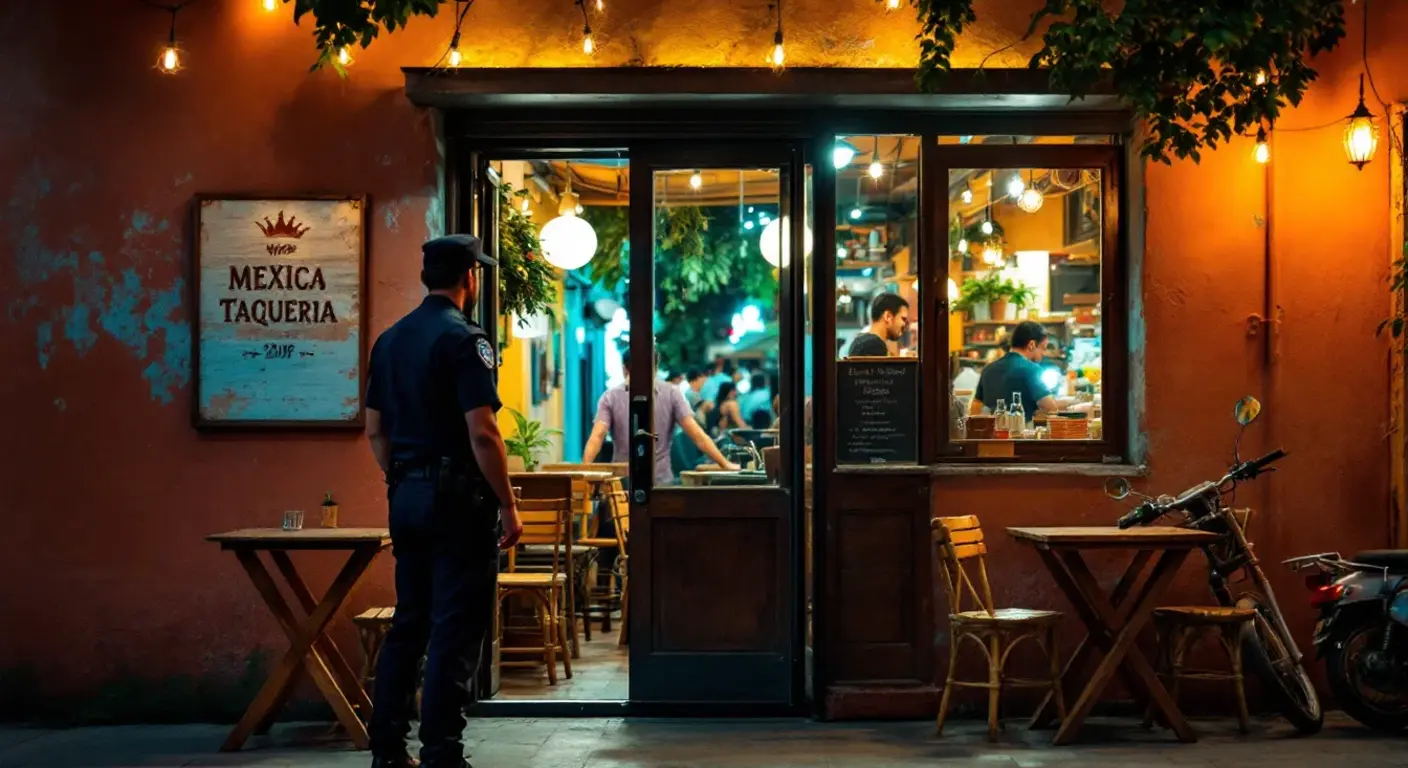
A bouncer isn't just a big guy at the door — in most states they're a regulated security guard. Here's who needs a license, how contract and in-house staff differ, what venue security costs per night, and how to hire without buying a lawsuit.
If you run a bar, nightclub, or busy restaurant, the person you put on the door is one of the highest-liability hires you make. A door officer checks IDs, decides who comes in, manages a crowd that is often intoxicated, and — on a bad night — puts hands on someone. Get the staffing, licensing, and procedures right and they defuse problems before they start. Get them wrong and a single ejection can turn into an assault claim, a liquor-board complaint, and a lawsuit. This guide covers how venue security is regulated, whether your door staff need a state license, contract versus in-house, dram-shop and ID risk, use-of-force, why armed is almost always the wrong call, and what it costs.
In most states, a "bouncer" or door person is legally a security guard and needs a state license or registration — especially when they work for a contract security company. In-house door staff you employ directly sometimes fall under a "proprietary" exemption, but that depends on your state and their duties, and the exemption is narrow and revocable. A few states (notably New York and Texas) regulate by the activity, not the employer, so in-house door staff are covered too. Expect roughly $25–$45 an hour per officer through a licensed company, more on peak nights and for supervisors. Armed security is almost always wrong for a drinking venue. Always verify the license before you hire.
Why bar and nightclub security is different
Most security work is about deterrence and observation. Venue security is about crowd and conflict management with alcohol in the mix — which changes the risk profile entirely. Your door team is making judgment calls all night: who is too intoxicated to admit, whose ID is fake, when a dispute is about to become a fight, and how to remove someone without it escalating. They also sit at the center of two liabilities most owners underestimate: dram-shop exposure (serving a visibly intoxicated or underage patron who then causes harm) and use-of-force claims when an ejection goes physical. That combination is exactly why the states license this work — and why hiring an untrained "big guy" off the street is a genuine legal risk, not a savings.
Is a bouncer a licensed security guard?
Usually, yes. Under most state statutes, anyone who guards property, keeps order, controls access, or protects people for hire is performing a licensed security function — and courts and licensing boards have repeatedly treated door staff as security guards regardless of the "bouncer" label. What varies is who has to hold the credential:
- Contract door staff — supplied by a security company — need the individual guard license or registration in nearly every regulated state, and the company needs its own agency license. This is the clean, low-risk path, and it's the one this guide recommends.
- In-house door staff — employed directly by the venue — sometimes qualify for a "proprietary" or in-house exemption. But that exemption is state-specific, fact-specific, and can be lost the moment their duties look like general security work. In some states it doesn't exist at all.
The single most important takeaway: don't assume your in-house door guy is exempt. Confirm the classification directly with your state licensing board before opening night, because the penalty for guessing wrong falls on the venue.
Does your door staff need a security license? By state
The table below covers priority markets. Read the contract column as reliable and the in-house column as a starting point to verify with the board — the rows flagged as uncertain are genuinely gray areas where the exemption turns on duties and interpretation. Where a state regulates by activity rather than employer, in-house staff get no shortcut.
| State | License required? | Permit / registration | Notes |
|---|---|---|---|
| California | Yes — contract and in-house | Guard Card via a PPO, or Proprietary Private Security Officer (PSO) registration with 16 hours of training if in-house | BSIS explicitly treats bouncers/door supervisors as security; operating without registration carries fines. See our California licensing guide. |
| New York | Yes — bouncers are security guards | NYS DOS registration (8-hour pre-assignment course); NYC adds local rules | Regulated by duty, not employer — in-house door staff are covered. See our New York licensing guide. |
| Texas | Yes — "bouncer/courtesy officer" named explicitly | Non-commissioned (Level II) registration through a licensed company, via DPS | Occupations Code Ch. 1702 regulates by activity, so in-house door staff are covered. See our Texas licensing guide. |
| Illinois | Contract: Yes (PERC + 20-hour training). In-house: likely exempt [verify] | PERC card via IDFPR | Proprietary/in-house is a gray area — confirm classification with IDFPR. |
| Florida | Contract: Yes (Class D, 40-hour training). In-house: No (proprietary) | Class D license via FDACS | Directly employed door staff generally fall under the proprietary exemption. |
| Georgia | Unarmed: no individual license, but training required | Registration with the state board (armed officers register) | Unarmed door staff need training but not an individual guard license; armed is separately regulated. |
| Arizona | Contract: Yes (8-hour training). In-house: may be exempt [verify] | DPS Guard Registration Certificate | A.R.S. §32-2622; confirm in-house status with AZ DPS. |
| Virginia | Contract: Yes (18-hour training). In-house: exempt | DCJS registration | Va. Code §9.1-138 — directly employed staff are generally exempt. |
| Washington | Contract: Yes (8-hour training). In-house: differs [verify] | Guard license via WA DOL | RCW 18.170 — confirm in-house treatment with DOL. |
| North Carolina | Contract: Yes (16-hour training). In-house: [verify] | Registration via the Private Protective Services Board | Confirm in-house classification with the PPSB. |
| New Jersey | Contract: Yes (SORA, ~24-hour training). In-house: exempt | SORA registration via NJ State Police | Directly employed door staff generally fall outside SORA. |
| Pennsylvania | No statewide guard card for unarmed; licensed via the company (county courts) | Company licensed under the Private Detective Act of 1953 | Armed requires Act 235 — which is not valid inside premises that serve alcohol. |
| Ohio | Employee registration if working for a licensed provider; in-house proprietary generally exempt | Registration via PISGS (Class C provider) | ORC Ch. 4749 governs provider-supplied officers. |
| Maryland | Certification even for direct employers (SB 760, 2024) — though unarmed bar staff may be exempt from the 12-hour training [verify] | Certification via Maryland State Police | SB 760 broadened who must certify; confirm the training carve-out with MSP. |
"We employ them directly, so they don't need a license" is the assumption that gets venues cited. A proprietary exemption typically requires the person to work only for your single venue, wear your uniform, and stay within a limited scope — and it evaporates the moment their duties look like general security work or they're shared across locations. In New York and Texas the exemption doesn't help at all, because those states regulate the activity, not the employer. Before you rely on it, get the answer in writing from your state board. When in doubt, hire a licensed contract company and the question disappears.
Contract company vs. in-house door staff
Both models exist for good reasons; the right choice depends on your volume, risk tolerance, and how much of the compliance burden you want to own.
Hiring a licensed security company
A contract firm supplies vetted, licensed, insured officers and carries the agency license, the training records, and — critically — the liability insurance that responds when an ejection goes wrong. You get flexible staffing (scale up for a big Saturday, down on a quiet Tuesday), supervision, and someone else managing background checks, licensing renewals, and payroll for the security function. This is the lower-risk path for most venues, and the one we'd steer a first-time owner toward. Our guide to hiring a security guard company walks through vetting, and you can compare licensed firms in your market in the Los Angeles or Chicago directories.
Building an in-house door team
In-house can be cheaper per hour and gives you direct control over culture and consistency — the same faces on the door who know your regulars. But you absorb everything the contract firm otherwise handles: recruiting and background checks, licensing or the proprietary-exemption analysis, training and documentation, workers' comp on a high-injury role, and — the big one — you carry the liability yourself. If an in-house bouncer injures a patron, the venue is squarely on the hook. Many hospitality groups run a hybrid: a small in-house team for regular nights plus a contract firm for peak nights and special events.
The most under-appreciated difference is where the insurance sits. With in-house staff, an assault-and-battery claim from an ejection lands on your general liability policy — and bar/nightclub GL policies frequently carry an assault-and-battery sublimit or exclusion precisely because insurers know door incidents are costly, so your coverage may be thinner than you assume. With a licensed contract firm, the officers are the vendor's employees on the vendor's policy; a well-run firm carries its own commercial GL (often $1M/$2M) with assault-and-battery coverage, names your venue as an additional insured, and provides a certificate of insurance you should demand and read before opening night. That doesn't make the venue immune — you can still be pulled in on negligent-hiring or premises theories — but it puts a solvent, insured party first in line. Check the COI's limits, the A&B sublimit, and that your entity is actually listed as additional insured; a firm that hesitates on any of those is telling you something.
Dram-shop liability and over-service
Most states have a dram-shop law that can hold a venue liable when it serves alcohol to a visibly intoxicated or underage patron who then injures someone — a car crash, a fight, a fall. The details vary a lot by state: some allow only third-party claims (an outsider hurt by your intoxicated patron), some also allow first-party claims (the intoxicated patron's own injuries), and thresholds range from "knew or should have known" to a higher "willful, reckless, or knowing" service standard. A handful of states have no dram-shop statute at all and fall back on common-law negligence. What's consistent everywhere is that the venue — and its liquor liability insurer — carries the exposure, and that the case usually turns on whether the patron was visibly intoxicated when served.
Security doesn't pour drinks, but it's a frontline control on exactly that question. Door staff who refuse entry to someone already stumbling, floor officers who flag over-served patrons to bar management, and a documented "cut-off" chain all reduce both the harm and the liability. Build the procedure so it's defensible: train the door and floor team to recognize the visible signs (slurred speech, unsteadiness, glassy eyes, aggression), give them clear authority to trigger a cut-off and loop in service staff, and — critically — have them write it down. A dated refusal-of-service and incident log, ideally tied to camera footage, is the single best evidence that your venue exercised reasonable care. When a claim lands months later, contemporaneous documentation is what lets your insurer defend it instead of settling.
ID checks, fake IDs, and capacity
Checking IDs is the door's most repetitive job and one of its highest-stakes. Underage service is a fast track to a liquor-board citation or a dram-shop claim, and modern fake IDs are good — laser-perforated, correctly weighted, with working scan data. A competent door team works a consistent sequence rather than glancing at a birthdate: check the photo against the face, run a finger over the printing and edges for lamination bumps, tilt the card to confirm the holograms and any UV/ghost-image features, do the birthdate math out loud, and ask a disarming question the holder of a real ID answers instantly ("what's your ZIP?", "middle name?"). An ID scanner that reads the PDF417 barcode catches the many fakes whose printed face doesn't match the encoded data and timestamps every entry — useful evidence later — but it isn't a substitute for the eyes; a good template will pass a scanner, so pair the tools.
Know your state's rules before you train the door to confiscate a suspected fake. Some states authorize or even require licensees to seize apparently fraudulent IDs (and give a good-faith defense for doing so); others expose staff to a claim if they take property or detain the holder. When in doubt, the safe posture is refuse entry and, where local rules allow, turn a suspected fake over to police rather than pocketing it — and document the refusal. The door is also your occupancy control: staff should run a clicker count against the posted fire-code capacity, coordinate a one-out-one-in policy at the cap, and hold the line even when there's a crowd outside. Overcrowding is both a life-safety hazard (blocked egress in a fire) and a code violation that can draw a fire-marshal shutdown or cost you your liquor license.
Ejections and use of force
The moment a door officer puts hands on a patron, you've entered the highest-liability territory in the business. The professional standard is minimal, defensible force used only to remove or protect — not to punish, retaliate, or "win." Most serious bar-security lawsuits don't come from the ejection itself; they come from an officer who chased, tackled, choked, or kept striking after the threat was over. The written policy every venue should insist on is de-escalation first, hands-on only as a last resort, and force that stops the instant the person is out or under control. A defensible ejection follows a consistent sequence:
- Verbal first. A supervisor or the closest officer gives a clear, calm instruction and a reason. Give the patron a face-saving exit and a moment to comply.
- Escort, don't drag. If they cooperate, walk them out — ideally two officers, one talking, hands visible, no come-along holds unless necessary.
- Hands-on only if there's an immediate threat to a person, and only enough to control and remove. No strikes to a compliant person, no chokes or neck restraints, nothing to someone already on the ground.
- Call police for a real assault, weapon, or anyone who won't leave — and let officers make the arrest. Your staff removes; law enforcement detains.
- Get them off the property and disengage. Do not follow a patron into the street or parking lot to "finish it"; that's where good ejections turn into criminal charges.
- Document immediately while it's fresh: who, what, when, why, which officers, witness names, injuries, and the camera clip pulled and saved before it's overwritten.
Cameras at the door and choke points protect the venue as much as the patron: they resolve the "he hit me first" disputes that otherwise become he-said/she-said lawsuits, and they discipline your own staff's behavior. When you hire, ask a firm directly about its use-of-force policy, de-escalation and handcuffing training, whether it forbids neck restraints, and how it documents ejections. A company that can't answer crisply is a liability.
Often the venue — and sometimes the security company too. If door staff use excessive force, a patron can sue for assault, and the venue that employed or hired them is typically pulled in under negligence and vicarious-liability theories (negligent hiring, negligent supervision). Hiring a licensed, insured contract firm shifts much of that exposure onto the provider's coverage; using unlicensed or untrained door staff concentrates it on you. This is a core reason to verify licensing and insurance before anyone works your door.
Why armed security is almost always wrong for a venue
For the overwhelming majority of bars, nightclubs, and restaurants, armed door staff are a mistake — legally and practically. You're introducing a firearm into a crowded, intoxicated, high-conflict environment, which multiplies the risk and the liability rather than reducing it. It's also frequently prohibited: in Pennsylvania, the Act 235 lethal-weapons certification that authorizes armed security is not valid inside establishments that serve alcohol, so an armed guard on a bar door in Pennsylvania is operating outside their certification. Other states impose their own restrictions on carrying in licensed liquor premises. The right posture for a drinking venue is trained, licensed, unarmed door staff who are skilled at de-escalation and crowd management. If your threat picture genuinely calls for a firearm, that's a conversation for a security consultant and likely off-duty law enforcement — not a default door hire. Our comparison of licensing and credentials can help you confirm what any officer is actually authorized to do.
How many door staff do you need?
There's no universal formula, but staffing tracks with headcount, layout, and risk. A common rule of thumb for higher-energy nightlife is roughly one officer per 50 to 100 patrons, adjusted up for venues with a history of incidents, multiple entrances and exits, large dance floors, VIP areas, or late-night alcohol service, and adjusted down for quieter rooms. Beyond raw ratios, think in terms of posts: a door/ID position, one or more floor officers, coverage at secondary exits, and a supervisor once you're running several officers. Your local fire-code occupancy and any conditions on your liquor license may effectively set a floor — some jurisdictions and insurers require documented security staffing above a certain capacity. A good contract firm will walk your venue, recommend a staffing plan tied to your peak nights, and scale it for events. Getting this right is as much about coverage of the right positions as it is about total bodies.
What venue security costs
Bar and nightclub security is billed hourly, per officer. Through a licensed company, expect roughly $25–$45 an hour per unarmed officer in most markets, with the top of that range and above for supervisors, high-demand weekend nights, holidays, and large or high-risk venues. Most firms set a minimum shift (commonly 4 hours) and may add a premium for last-minute or peak-night coverage. That hourly bill rate is not the wage — it bundles the officer's pay plus the firm's payroll taxes, workers' comp, insurance, supervision, and margin, which is exactly the overhead you'd otherwise carry yourself in-house.
The right way to budget is by officer-hours — officers × hours × rate — because a busy nightclub runs several posts at once. A worked example for a mid-size club on a Saturday: two door/ID officers, two floor officers, and one supervisor, each for a 6-hour night (roughly 8 p.m. to 2 a.m.). At about $32/hour for the four officers and $45/hour for the supervisor, that's (4 × 6 × $32) + (1 × 6 × $45) = $768 + $270 = about $1,038 for the night, or a "cost per door" you can compare across venues. Scale it down for a quiet Tuesday (one door officer at a 4-hour minimum ≈ $128) and up for a sold-out headliner night with extra exits and VIP coverage. Special events, festivals, or one-off high-traffic nights are often quoted separately and overlap with event security — see our event security guide for how that pricing works. In-house can lower the nominal hourly cost but adds the overhead and liability described above, so compare total cost, not just wage.
How to hire the right venue security
Vet on the fundamentals: a valid state license for both the company and its officers (verify it — don't take their word), liability insurance at a limit that fits your venue, documented training in de-escalation, crowd management, and use of force, and hospitality-specific experience. Ask how they handle ID checks, ejections, and incident documentation, and whether they can scale for your peak nights. Confirm they'll work unarmed and understand your state's rules for alcohol-serving premises. If you employ door staff directly, get your proprietary-exemption question answered in writing by the state board before opening. Our guides to hiring a security company and verifying a license cover the full checklist.
Ready to staff your door the right way? Get free quotes from licensed venue security companies, or browse licensed firms in your market like Los Angeles and Chicago.
Frequently asked questions
Is a bouncer a licensed security guard?+
Should I hire a security company or use in-house door staff?+
Should bar or nightclub security be armed?+
Who is liable if a bouncer injures a patron?+
How much does bar and nightclub security cost?+
Share this guide
Sources
- California BSIS — Security Guard / Proprietary Private Security Officer licensing
- New York DOS — Security Guard Program
- Texas DPS — Private Security (Occupations Code Ch. 1702)
- Florida FDACS — Security Officer (Class D) Licensing
- Pennsylvania State Police — Act 235 Lethal Weapons Certification
- Illinois IDFPR — Private Security, PERC & Guard Registration