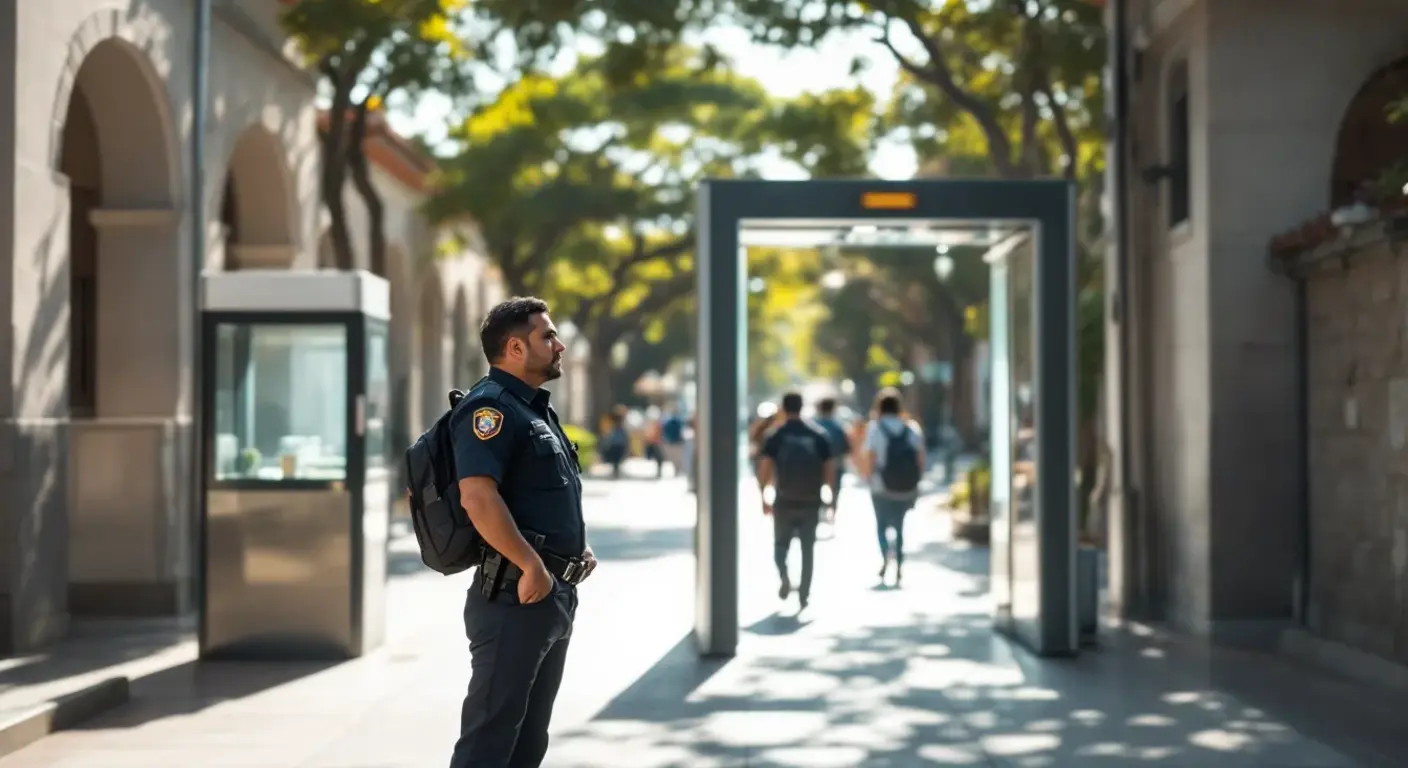
Churches, synagogues, mosques, and temples want to stay welcoming and safe at the same time. Here's how to build a layered security program, when to hire licensed guards, what your state says about armed volunteers, and how to actually win a FEMA NSGP grant.
A house of worship has a security problem no other building shares: it is built to be open. The doors are unlocked on purpose, strangers are welcomed by design, and the whole culture of the place resists anything that feels like a checkpoint. Yet faith communities have also become deliberate targets, and most congregations now want a plan that protects people without turning the sanctuary into a fortress. This guide covers how to build that plan in layers, when a volunteer team is enough versus when to hire licensed officers, what protection actually costs, what your state actually says about arming volunteers, and — the part most articles skip — a genuine, step-by-step walkthrough of the FEMA Nonprofit Security Grant Program (NSGP), the single biggest source of funding available to make it happen.
Quick answer: Most congregations protect their people in layers — welcoming greeters, a trained volunteer safety team, and, for high-attendance services or a specific threat, paid coverage. That paid coverage comes in two flavors people often conflate: off-duty police officers (roughly $40–$100+/hr, sworn arrest authority) and licensed contract security officers (unarmed ~$22–$35/hr, armed ~$30–$48/hr). A single holiday post staffed by two officers for a five-hour service runs about $220–$480. Whether volunteers may carry firearms depends entirely on your state, and carrying is not the same as being authorized to act as security. Federal money is available: the FEMA NSGP funds cameras, access control, barriers, training, and even contracted security, but you apply through your State Administrative Agency (SAA), never directly to FEMA. All NSGP dollar figures below reflect recent cycles — verify the current-year NOFO (released around July) before you budget.
Why houses of worship are a different security problem
Retail stores screen at the door; corporate towers issue badges; nightclubs check IDs. A house of worship does none of that, and doesn't want to. Its mission is hospitality, its budget is tight, its staff is small, and its "security team" is usually volunteers who also usher, greet, and run the sound board. The threat picture ranges from the mundane (medical emergencies, disruptive individuals, theft, custody disputes at a preschool) to the catastrophic (a targeted active-threat attack). A good program has to cover the whole range while keeping the front door feeling like a front door.
The answer is almost never "one armed guard at the entrance." It's a layered posture where most of the work is low-visibility awareness, and the harder capabilities are held in reserve.
The threat is measurable, not hypothetical
Congregational security used to be a hard sell to boards because the risk felt abstract. It no longer is. In the FBI's 2024 hate-crime data, religion-based offenses made up roughly a quarter of all reported hate crimes, with about 2,783 single-bias religious incidents. Anti-Jewish offenses alone reached 1,938 incidents — about 69% of all religiously motivated hate crimes and a record high since the FBI began collecting the data in 1991, including 260 incidents at Jewish houses of worship. Anti-Muslim (228) and anti-Sikh (142) incidents ranked next. And because hate crimes are widely under-reported and only about 85% of law-enforcement agencies contribute data, the real totals are almost certainly higher.
The practical takeaway for a security committee: this is a budget line you can justify to a board with federal data, not a fear you have to sell on a hunch. It is also the argument that unlocks grant funding, because the entire premise of the NSGP is that mission-driven, identity-based organizations face elevated, documented risk.
The layers of a house-of-worship security program
Effective congregational security is built in concentric rings, from the parking lot inward. Each layer buys time and information for the next.
Greeters and ushers: the first, friendliest layer
The people at the door are your earliest warning system precisely because they don't look like security. Trained greeters and ushers watch the parking lot and entrance, make eye contact and warm conversation with everyone (which both welcomes members and lets a bad actor know they've been seen), notice who doesn't fit or seems agitated, and quietly flag concerns to the safety team. This costs nothing and is the highest-leverage layer most congregations have. The training is simple: greet everyone, trust your instincts, know how to discreetly signal the team, and never confront — observe and report.
The volunteer safety team: the core
Most congregations build their program around a volunteer safety team — members who take on security as a ministry. A functioning team has a written plan, a designated leader, a way to communicate (radios or a group text), assigned zones (sanctuary, lobby, children's area, parking), and regular training in situational awareness, de-escalation, medical response, and emergency procedures. The team coordinates greeters, monitors cameras if you have them, manages access to children's areas, responds to medical events and disruptions, and knows exactly how and when to call 911.
Critically, a volunteer safety team is not a substitute for police in a violent event — its job is to detect early, buy time, direct an evacuation or lockdown, and render aid.
Paid coverage: two distinct options, not one
When presence, authority, or armed response is genuinely needed, most congregations reach for outside help — and here the biggest gap in most guidance is that there are two separate models, not one:
- Off-duty police officers. A very common house-of-worship arrangement, and the one most articles omit entirely. These are sworn, active-duty officers working a secondary employment shift, arranged either directly through your local department's off-duty coordinator or through a company that brokers officers. They bring full arrest authority, a marked or recognizable presence, radio access to dispatch, and their department's liability framework. They are the strongest deterrent dollar for dollar, which is why they are the default choice for holidays and credible threats.
- Licensed contract security officers. Guards from a professional company who carry the required state guard license, insurance, training, and, where applicable, an armed-guard permit. Unlike a volunteer, a licensed officer's role, liability, and use-of-force authority are defined and insured by the company. They are typically less expensive than sworn officers and easier to book for recurring coverage.
Congregations usually bring in either option for specific circumstances rather than every service, which keeps it affordable — and the actual numbers are below.
What congregational security actually costs (2026)
The single most common failure in "church security" articles is promising affordability and never printing a number. Here is what protection costs in 2026, in the ranges a real vendor will quote. Everything below is a bill rate (what you pay the company or the department), not a guard's take-home wage — a useful sanity check is that an unarmed guard typically earns $16–$25/hr while the company bills $22–$35/hr to cover insurance, supervision, training, and overhead.
| Coverage type | Typical 2026 bill rate | Best for |
|---|---|---|
| Unarmed contract officer | $22–$35 / hr | Greeting-forward presence, access control, weekly services |
| Armed contract officer | $30–$48 / hr | Elevated posture, cash handling, credible-threat weeks |
| Event / holiday coverage | $35–$60 / guard / hr | High-attendance holy days, festivals, large funerals |
| Off-duty police officer | $40–$100+ / hr | Maximum deterrence and arrest authority for peak-risk services |
| Executive / clergy protection | $75–$150 / hr | A named-threat pastor, rabbi, or imam; traveling clergy |
Worked example — a single holiday post. You want two officers covering a five-hour Christmas Eve, Easter, or High-Holy-Days window (setup, service, and dispersal). Contract security at $22–$48/hr works out to roughly $220–$480 for the two-officer post. Two off-duty police officers at $40–$100+/hr for the same window runs closer to $400–$1,000+. Either way, a congregation can budget one well-protected peak service for the price of a modest guest-speaker honorarium — which is exactly why "hire for the spikes" is the affordable middle path between an all-volunteer team and a full-time guard.
If you ever move toward a permanent presence rather than event coverage, the math changes fast. A single staffed 12-hour post runs roughly $8,000–$12,800/month unarmed or $10,800–$17,300/month armed, and true 24/7 coverage requires 2–4 officers in rotation — on the order of $16,000–$25,600/month unarmed or $22,000–$35,000/month armed. Almost no congregation needs that; it's listed only so you can see why the layered, event-driven model exists. For a deeper breakdown of the armed-vs-unarmed cost and posture tradeoff, see our guide on armed vs. unarmed security.
Build a program even without a grant: the minimum viable plan
Most congregations will not win an NSGP award in any given cycle — the program is heavily oversubscribed (more below). So before the grant chapter, here is a realistic, self-funded starting program that a small or mid-size congregation can stand up for a modest budget. None of it requires a grant, and all of it strengthens a future application.
- Communications — a few hundred dollars. A set of consumer or commercial two-way radios so greeters, ushers, and the safety-team lead share one channel. This is the single highest-return purchase after training.
- Stop the Bleed kits and training — low hundreds. Bleeding-control kits placed with your AEDs, plus a free or low-cost class. Bystander hemorrhage control saves lives in the minutes before EMS arrives.
- Active-threat and de-escalation training — free to low-cost. Run–Hide–Fight instruction (often free from your local police or FBI field office) plus de-escalation practice for the volunteer team.
- A few cameras at key sightlines — $1,000–$5,000 for a 4–10 camera system ($150–$500 per camera), covering entrances, the parking lot, and children's-area doors. Cloud or DVR monitoring typically adds $30–$200/month.
- One holiday officer — $220–$480 per peak service from the cost table above, so your busiest, highest-risk days get professional coverage even if ordinary weeks don't.
- A professional vulnerability assessment — often free. Your local police department, state homeland-security office, or CISA Protective Security Advisor will frequently walk your facility at no charge and produce a prioritized list.
A congregation that does only these things has a credible, layered program — and has already generated the assessment and prioritized needs that a future NSGP application requires.
Volunteers vs. paid officers: how to choose
The honest framing is that these are complementary, not competing, options — but they carry very different risk and cost profiles, and congregations get into trouble when they blur the line.
| Volunteer safety team | Licensed contract officers | Off-duty police | |
|---|---|---|---|
| Cost | Low (training + gear) | $22–$48/hr bill rate | $40–$100+/hr |
| Licensing | Usually none if unpaid and internal — but varies by state | State guard license (+ armed permit) | Sworn officer; department-authorized secondary employment |
| Liability insurance | Falls on the congregation; check your policy | Carried by the security company | Department / municipal framework (confirm in writing) |
| Authority | Same as any private citizen | Defined, trained, and insured | Full peace-officer arrest authority |
| Best for | Weekly presence, greeting, first aid | Recurring paid coverage, armed posture | Peak-risk services, maximum deterrence |
A common and effective model is a volunteer team for ordinary weeks, with paid officers layered in for the highest-risk times. The line congregations must not blur is authority and liability: a volunteer, however well-meaning and well-trained, acts as a private citizen and exposes the congregation to the consequences of their actions, while a licensed officer's or sworn officer's role and use of force are defined, trained, and insured. Before you lean on volunteers for anything beyond observe-and-report, put two questions to your insurance broker in writing — does our policy cover a volunteer safety team, and does it cover armed volunteers if any carry? — because the answer often reshapes the whole plan.
Can worship volunteers carry firearms? A state-by-state reference
This is the single most-asked and most-misunderstood question in congregational security, and the answer is: it depends entirely on your state, and carrying a firearm is not the same thing as being authorized to act as security. Even where a volunteer may lawfully carry inside the building, formally serving as the congregation's posted, identified "security" can trigger private-security licensing requirements (a guard card, an armed-guard permit, or a private-patrol-operator relationship) in many states. Several states have gone the other way and passed statutes that explicitly carve out armed church volunteers. The table below names the actual laws so you can take them to a local attorney — it is a research starting point, not legal advice, and statutes change.
| State | Key statute / status | What it means for a volunteer |
|---|---|---|
| Texas | Occ. Code § 1702.333 (SB 2065, 2017) | Unpaid volunteers providing security on worship premises are exempt from private-security licensing — but must not accept compensation (even gifts) and must not wear a badge/uniform reading "security." Armed volunteers carry under their personal License to Carry. |
| Mississippi | Church Protection Act, Miss. Code § 45-9-171 (2016) | A church may designate a security-program participant who is authorized to carry; the act also extends justifiable-homicide/immunity protections to designated team members. |
| Louisiana | 2018 amendment (Sen. Riser) | Concealed-permit holders and law-enforcement may serve as church security, paid or unpaid; the prior 8-hour annual tactical-training mandate was dropped except where the church's insurer requires it. |
| Alabama | Alabama Church Protection Act | Follows the same "designated church security program" model, providing carry authorization and liability protections for members of an established team. |
| Ohio | Ohio Rev. Code § 2923.126 | Carry in a place of worship is prohibited by default unless the institution "posts or permits otherwise" — so a church may authorize a security team, ideally under a written policy. Caution: if a school shares the property, school-safety-zone rules can override. |
| California | BSIS guard registration + firearm permit | Acting as posted security typically pulls you into Bureau of Security & Investigative Services registration; on-duty carry requires a separate firearm permit. A volunteer "security" role is legally gray. Verify with BSIS. |
| Florida | FDACS Class "D"/"G" licensing | Providing security services generally implicates Class "D" (unarmed) and Class "G" (armed) licensing; a member carrying personally is a different question than staffing a posted security position. |
| New York | Penal Law § 265.01-e (CCIA); Antonyuk v. James | Houses of worship are a "sensitive location" where carry is barred — but a 2023 amendment created a narrow exception for persons responsible for security with formal institutional authorization. The Second Circuit upheld this in Oct. 2024 and the Supreme Court denied review in April 2025, so it is current law. |
Do not treat "can we carry?" as a settled question. Lawful personal carry, an insured armed guard, and a volunteer "acting as security" are three legally distinct things — and one can trigger licensing even when another is fine. Before you arm or post any volunteer, confirm with a local attorney and your state's security regulator, and get your insurer's agreement in writing. When in doubt, use a licensed armed officer or an off-duty police officer, who already carries the license and the liability.
When to bring in paid security
Even congregations with a strong volunteer team hire officers for specific, foreseeable spikes in risk:
- High-attendance holidays and holy days — Easter, Christmas Eve, the High Holy Days, Ramadan, Diwali, and similar peaks draw crowds and, historically, elevated targeting. Book event-rate coverage ($35–$60/guard/hr) or off-duty police weeks in advance.
- A credible or specific threat — after a threatening message, a regional incident, or a warning from law enforcement, a temporary uniformed (or plainclothes) officer adds trained, insured capability fast.
- Large events — concerts, festivals, conferences, and funerals of public figures create crowd-management and access-control needs beyond a volunteer team's scope. See our event security guide.
- Childcare and school operations — a preschool or day school on the property raises custody-dispute and access-control stakes and often its own licensing and background-check obligations.
When you do hire, insist on a valid state guard license, proof of insurance, and officers trained for a hospitality-forward environment — not a hard, aggressive posture that clashes with a worship setting. A security consultant can help you decide the right mix; see security consulting and our consulting guide (typical assessments run $2,500–$25,000, or $100–$250/hr).
How to vet and hire security for your congregation
Generic "check their license and insurance" advice applies to any building. A worship setting has faith-specific requirements a good vendor should meet:
- Integration with your volunteer team, not replacement of it. The officer should report to your safety-team lead, share your radio channel, and know your zones, evacuation routes, and lockdown procedure for the children's area. Ask a candidate company how they brief and hand off with a volunteer team; a blank stare is disqualifying.
- Uniform vs. plainclothes — decide deliberately. A visible uniform maximizes deterrence and is right for a parking lot or a named threat; discreet plainclothes preserves the sanctuary's welcoming feel and is often preferred inside during worship. The best arrangement frequently mixes both. Note that in some states (Texas, for one) the uniform choice also has legal consequences for volunteers.
- Childcare and day-school background-check standards. If officers will be anywhere near children's ministry or a day school, require fingerprint-based background checks that meet your state's childcare standard — not just the company's baseline guard screening — and confirm chain-of-custody for who has access to those areas.
- A written holiday-staffing SLA. Peak dates sell out. A good agreement specifies guaranteed officer count and arrival time for named holidays, a no-show/replacement guarantee, armed-vs-unarmed posture, overtime and holiday-rate terms in advance, and a single point of contact reachable during the service.
- Faith-appropriate temperament. Ask for officers experienced in houses of worship, schools, or hospitals — environments where de-escalation and a calm presence matter more than command authority.
Coordinate with local law enforcement — before anything happens
The relationship you want with police is built on an ordinary Tuesday, not during a 911 call. Concrete mechanisms congregations should put in place:
- Hire off-duty officers directly. Most departments run a secondary-employment or off-duty program with a coordinator who assigns officers to private events. This is the cleanest way to get sworn, armed, arrest-empowered presence for a holiday service — call the coordinator, don't just show up hoping for a cruiser.
- Request extra patrols for holidays. Ask your precinct or sheriff to add your facility to directed/extra patrol for named high-risk dates. This is usually free — an officer swings through during their normal shift — and simply asking puts you on their radar for the day.
- Share floor plans and do a joint walk-through. Invite officers to tour the building, mark entrances, utility shutoffs, the children's area, and safe rooms, and leave current floor plans on file with dispatch or the department. If seconds matter, responders knowing your layout in advance is priceless.
- Exchange direct contacts. Get a named liaison (community-relations officer, crime-prevention unit) and give them your safety-team lead's cell. A warning about a regional threat is only useful if it reaches a human who can act.
Active-threat preparedness every congregation should have
No layer matters if people don't know what to do in the worst moment. Two nationally recognized programs form the baseline, and both are free or low-cost to adopt:
- Run–Hide–Fight — the DHS/FBI-endorsed response framework for an active shooter: escape if you can, hide and barricade if you can't, and fight as an absolute last resort. Train ushers and the safety team to lead evacuation and lockdown, not to hunt.
- Stop the Bleed — trauma-control training and bleeding-control kits placed alongside your AEDs and first-aid supplies. In a mass-casualty event, bystander bleeding control saves lives in the minutes before EMS arrives.
Round this out with a written emergency plan, clearly marked exits, a lockdown procedure for the children's area, an established relationship with local police and fire, and periodic drills. Federal resources — CISA's physical-security performance goals and mitigation guides for faith-based organizations, and Ready.gov's houses-of-worship materials — are free and specifically written for congregations.
Fund it with the FEMA Nonprofit Security Grant Program (NSGP)
The NSGP is the largest source of federal money for house-of-worship security, funding target-hardening (cameras, access control, barriers, blast-resistant film), training, contracted security personnel, and more. Two facts shape everything about how you approach it.
First, you never apply directly to FEMA. You apply through your State Administrative Agency (SAA) — the state office that runs the competition, sets the state deadline (often weeks before FEMA's), and forwards scored applications up. Your first move is finding and joining your SAA's NSGP notification list.
Second, the program is severely oversubscribed. Requests routinely run several times the money available. Funding also swings year to year: FY2024 reached about $454.5M because of a one-time supplemental, while FY2025 dropped back to $274.5M — roughly $180M less — even as demand kept climbing. Over the program's life it has awarded more than $1.8B across 14,000+ applications, and a technically eligible application is simply not the same as a funded one. That reality drives two rules: apply early and polish relentlessly, and if you lost last cycle, apply again — reapplication is normal and expected.
The NSGP calendar, in order
Treat this as a repeatable sequence and start months before the deadline:
- 1. Join your SAA's NSGP notification list — so you learn the state deadline the moment it's set.
- 2. Get a UEI on SAM.gov — you need an active Unique Entity ID (and SAM.gov registration) to receive federal funds. This step alone can take weeks; do it now, not in the final week.
- 3. Complete a vulnerability assessment — the backbone of a competitive application. Use CISA's tools, a police walk-through, or a professional assessor.
- 4. Write the Investment Justification (IJ) — the scored heart of the application (outline below).
- 5. Submit to the SAA by the state deadline — earlier than FEMA's, and firm.
- 6. FEMA reviews and announces — awards typically land months later; plan your project timeline accordingly.
Two artifacts that make or break the application
Reviewers score on how clearly you connect a documented risk to a specific, cost-justified fix. Prepare these two documents and you are most of the way there.
One-page Vulnerability Assessment checklist — walk your property and rate each item (adequate / needs work / absent):
- Perimeter & parking: lighting, sightlines, vehicle standoff/barriers, signage
- Entrances: number of unlocked doors during services, door hardware, ability to lock down quickly
- Access control: children's area, offices, mechanical rooms; key/fob management
- Surveillance: camera coverage of entrances and lot, recording retention, who monitors
- Communications: radios, PA/alerting, how the team reaches 911 and each other
- Detection: alarm/intrusion, panic buttons, glass-break
- People: trained safety team, greeter program, Run–Hide–Fight and Stop the Bleed training, drill cadence
- Documented threat history: prior incidents, hate-crime data for your faith/region, law-enforcement warnings
Investment Justification (IJ) outline — the narrative FEMA actually scores:
- Identification of risk — cite specific threats to your congregation: incident history, credible threats, and the national data (e.g., FBI hate-crime figures for your community). This is where the numbers earlier in this guide earn their keep.
- Vulnerability — the concrete gaps from your assessment.
- Consequence — attendance, childcare/school population, and what a successful attack would mean.
- Proposed project — the exact equipment, training, or contracted security you'll buy, tied line-by-line to the risks and vulnerabilities above.
- Budget & milestones — realistic costs (allowable under the NOFO) and a timeline you can actually execute within the period of performance.
Turn this into a working file. Copy the checklist and IJ outline above into a shared document today, do a walk-through this month, and you'll have a reusable application skeleton — one you refine and resubmit every cycle until you're funded. Because the program is oversubscribed 3–4x in a typical year, the congregations that win are usually the ones that applied more than once with a tighter IJ each time.
Verify the current-year NOFO (released around July) for allowable costs, caps, and deadlines before you commit to a budget — figures and rules shift year to year.
Frequently asked questions
How much does it cost to hire security for a church or synagogue?+
Can church volunteers legally carry firearms as security?+
What is the FEMA Nonprofit Security Grant Program and how do we apply?+
Should we use a uniformed guard or plainclothes officer in the sanctuary?+
Do we need professional security, or is a volunteer team enough?+
Share this guide
Sources
- FBI 2024 hate-crime data on religious institutions (ADL summary)
- FBI 2024 hate crime report — Jewish community most-targeted (Secure Community Network)
- FEMA FY2025 Nonprofit Security Grant Program NOFO & fact sheet
- FEMA FY2025 NSGP Fact Sheet (funding levels)
- Texas Occupations Code § 1702.333 — Certain Volunteers (church security exemption)
- Texas Attorney General — Volunteer Security in Houses of Worship
- Mississippi Church Protection Act — Miss. Code § 45-9-171
- Louisiana armed church security law (2018) — Guns.com
- Ohio Revised Code § 2923.126 — carry in places of worship
- New York CCIA sensitive-location worship provision & Antonyuk v. James