Fire watch runs about $28–$45 per guard per hour, usually 24/7 until your system is restored. Here's when it's legally required and how to keep the cost down.
Fire watch typically runs about $28–$45 per guard per hour (2026 US estimate) — a premium over standard unarmed guards at $22–$35/hour. The cost is driven by the fact that fire watch is usually mandated 24/7 until the impaired system is restored, plus documented patrol tours, code-compliant logs, and coordination with the fire marshal. Two levers cut the bill the most: restore the failed system fast, and — where your fire code allows it — use a trained in-house employee instead of an emergency guard firm. Expect a 4-hour shift minimum and possible mobilization fee on short watches.
Fire watch is one of the few security services you don't choose to buy — a code official, insurer, or fire marshal makes you buy it. That urgency, and the compliance paperwork attached to it, is exactly why it prices above a routine guard post. This guide breaks down when it's legally required, what you'll actually pay in 2026, the shift minimums and premiums that surprise buyers, and how to keep a mandated watch from running longer, larger, or pricier than it needs to.
What fire watch is and when it's legally required
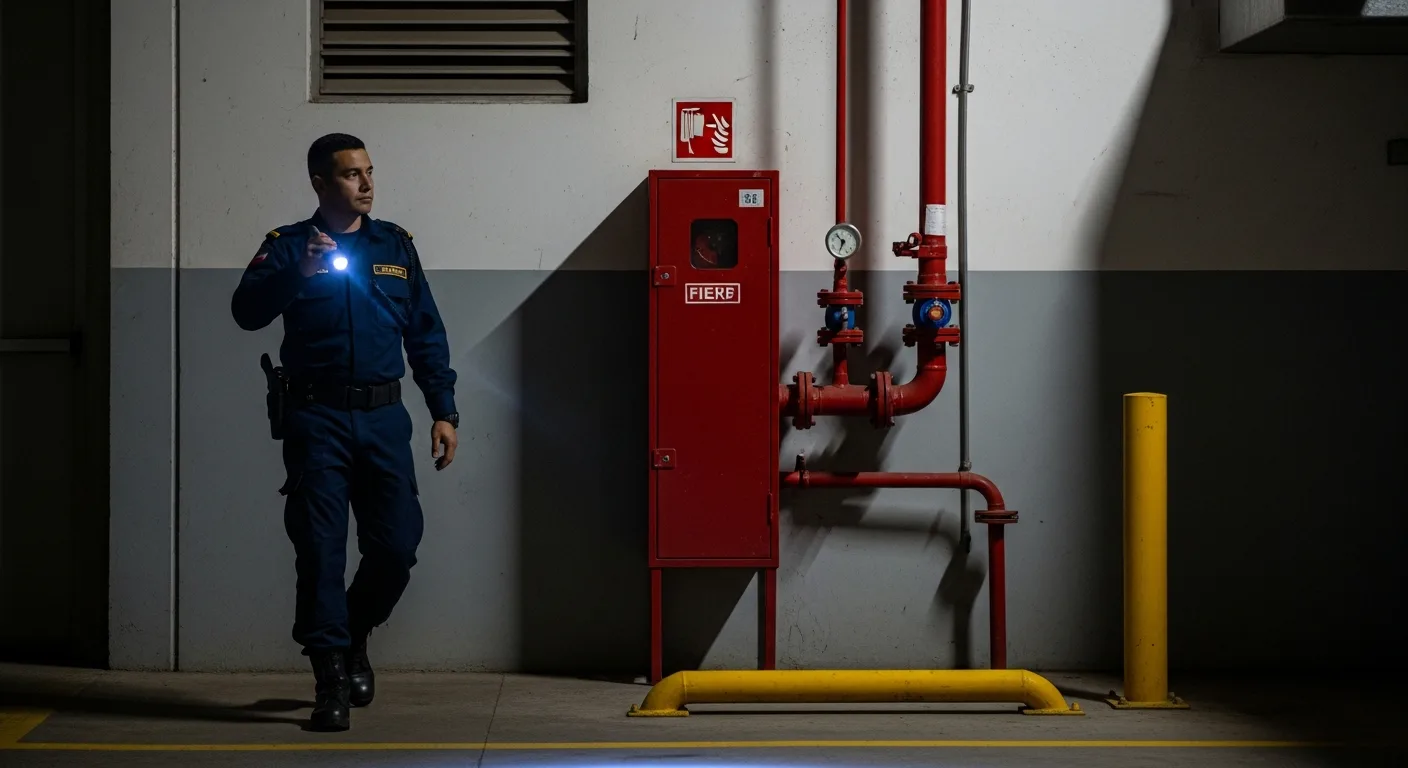
Fire watch is a dedicated person (or crew) whose sole job is to patrol a building, look for signs of fire, and immediately alert occupants and the fire department if one starts. It's a human stand-in for a fire-protection system that isn't working. Unlike a general security guard who deters theft or manages access, a fire watch attendant follows a defined route on a fixed schedule and logs every tour. When the trigger is welding or torch work, it overlaps with dedicated hot-work fire-watch coverage — same role, different cause.
Under the International Fire Code (IFC) and NFPA standards adopted across most US jurisdictions, a fire watch is commonly required when:
- The sprinkler system is impaired — shut down for repair, freeze damage, or renovation. Many jurisdictions trigger a mandatory watch once a sprinkler system is down for more than a set window (often 4–10 hours in a 24-hour period).
- The fire alarm or detection system is out of service — testing, upgrades, or a fault the vendor can't fix same-day.
- Hot work is underway — welding, cutting, grinding, or torch work, where a fire watch must stay during the work and typically continue monitoring for 30–60 minutes after it stops.
- A fire marshal or code official orders it — after a violation, during a large public assembly, or when occupancy conditions create elevated risk.
Why it costs more, and what drives the bill
Fire watch prices at roughly $28–$45/hour versus $22–$35/hour for a standard unarmed post. That gap reflects real added burden: the attendant is trained on fire-watch procedures, stays alert and mobile for the entire shift (no stationary lobby sitting), and carries the liability of producing a legally defensible log. Because it's usually an emergency, short-notice engagement, you also lose the volume discounts of a long-term routine-coverage contract.
Within that rate band, four variables move the total more than anything else:
- Duration and 24/7 mandate. Fire watch is usually required continuously until the impaired system is restored — nights, weekends, and holidays included. Round-the-clock coverage means three shifts, and off-hours carry premium rates (quantified below). This is the single biggest cost lever.
- Number of watch tours. The AHJ sets how often the attendant must walk the full route — commonly every 15, 30, or 60 minutes. Larger or multi-floor buildings may require multiple attendants to complete tours on time (see the scaling scenario below).
- Patrol logs and documentation. Every tour is recorded with time, location, and observations. Some providers use electronic patrol-tour systems (guard-tour wands, QR checkpoints), which improve defensibility and can factor into the rate.
- Fire marshal coordination and equipment. The provider often communicates directly with the AHJ, confirms procedures, and provides logs on demand. Some also itemize equipment — attendant PPE, a portable fire extinguisher, and a direct means to summon the fire department (radio or dedicated phone line) — which can add to a quote.
For a fuller picture of baseline pricing, see our guide on how much security costs and how it compares to 24/7 guard coverage.
Shift minimums and off-hours premiums
Two numbers the hourly rate hides can swing a short watch by hundreds of dollars:
- Shift/callout minimum. Emergency guard engagements almost always bill a 4-hour minimum per shift, and some add a one-time emergency mobilization or callout fee ($75–$250) to stand up a watch on short notice. A 90-minute hot-work watch still bills four hours — so on very short jobs the minimum, not the hourly rate, sets your floor.
- Night, weekend, and holiday premiums. The 24/7 mandate is the biggest lever precisely because off-hours cost more. As a 2026 planning estimate, expect roughly +15–30% for overnight/weekend hours and time-and-a-half (+50%) on recognized holidays. On a continuous watch, a third of your hours are overnight — that premium is baked into the higher end of the $28–$45 band.
Can in-house staff perform the fire watch — and slash the cost?
This is the single largest cost-avoidance lever most buyers miss. Many AHJs permit a trained employee — not just a licensed guard firm — to serve as the fire-watch attendant, especially for hot-work and shorter impairments. If yours does, you can take the hourly guard rate to zero and pay only your staffer's ordinary (or overtime) wage.
| Factor | In-house employee | Professional service |
|---|---|---|
| Hourly cost | Regular/OT wage (often $18–$30/hr loaded) | $28–$45/hr + minimums |
| Setup speed | Immediate if trained | Fast, but callout fee may apply |
| Training/logs | You must train and supply a compliant log | Included; provider owns defensibility |
| 24/7 coverage | Hard — needs 3+ rotating staff | Turnkey three-shift staffing |
| Liability | Falls on you if the log fails | Insured provider carries it |
Worked scenarios: what real watches cost
A single point estimate underrepresents the range, so locate your own case. All figures are 2026 US estimates, not firm quotes; all professional rows assume the 4-hour shift minimum applies and exclude any mobilization fee.
| Scenario | Staffing | Rate | 24-hour | 4-day | 2-week |
|---|---|---|---|---|---|
| Daytime hot-work watch (single shift, tours q30) | 1 attendant, ~4–8 hrs | ~$32/hr | ~$130–$260 (4-hr min) | — | — |
| Small building, impaired alarm, 24/7 | 1 attendant, 3 shifts | ~$35/hr | ~$840 | ~$3,360 | ~$11,760 |
| 60k-sq-ft building, impaired sprinkler, 24/7 tours q30 | 1 attendant, 3 shifts | ~$38/hr | ~$912 | ~$3,650 | ~$12,770 |
| Large multi-floor complex, 24/7 tours q30 | 2 attendants, 3 shifts | ~$40/hr | ~$1,920 | ~$7,680 | ~$26,880 |
The 60,000-sq-ft sprinkler case — a burst riser, repairs quoted at four days, mandated tours every 30 minutes — lands near $3,650 for the four-day watch. Stretch it to two weeks because the part is backordered and it pushes past $12,700, rivaling a chunk of a monthly guard budget in days. Note the jump to the two-attendant row: a large or multi-floor building that can't be toured on time by one person roughly doubles the bill, which is why buyers at big facilities should never assume the single-attendant number. The lesson is blunt — duration and headcount are everything. Model your own case with our security cost calculator before you commit.
For scale on the routine side, a single 12-hour daily standard post runs about $8,000–$12,800/month. That ties out to the hourly rate once you show the math: 12 hrs × ~30 days ≈ 360 hrs/mo, and 360 × $22–$35 ≈ $7,920–$12,600 of straight time. The published top of ~$12,800 sits a hair above raw straight-time because the monthly figure also carries supervision, overhead, and holiday loading — not a higher headline rate.
Does insurance or the repair vendor cover the watch?
Before you absorb the whole cost, check whether someone else should. Two recovery angles are worth a call:
- Your own policy. Some property or business-interruption coverage treats a mandated fire watch as a covered mitigation expense tied to a covered loss (e.g., a burst-pipe sprinkler failure). Ask your broker whether the watch qualifies before you assume it's out of pocket.
- The at-fault contractor. If a repair, sprinkler, or hot-work contractor caused the impairment — or dragged out the fix — their liability coverage may owe you the watch cost. Document the impairment window and the repair timeline; that record is what supports a reimbursement claim.
How to minimize fire-watch cost
You can't legally skip a mandated watch, but you can shrink it:
- Restore the system fast. The watch ends when the sprinkler or alarm is back and inspected. Expedite the repair vendor, keep spare parts on hand for known-vulnerable components, and schedule the AHJ re-inspection the moment work finishes. This is the highest-leverage move.
- Use in-house staff where allowed. If your AHJ permits a trained employee, this can eliminate the hourly guard rate entirely (see the comparison above).
- Right-size the watch. Confirm with the AHJ exactly how many attendants and what tour frequency are actually required — don't over-staff on a provider's default. A single-building, single-floor impairment rarely needs a crew. This is the flip side of the AHJ call at the top of the guide.
- Bundle with existing coverage. If you already retain a provider for mobile patrol or on-site guards, ask whether they can supply the fire watch at a preferred rate rather than sourcing an emergency vendor at spot pricing — and whether the callout fee is waived.
- Compare quotes even under pressure. Emergencies tempt you to accept the first number. Pulling two or three competitive quotes from vetted security companies — even quickly — protects you from spot-market gouging.
- Don't buy an invalid watch. The cheapest hourly rate is the most expensive outcome if the provider is unlicensed and the AHJ throws out the log: you may have to re-run the entire watch and eat a code penalty on top. A valid, defensible watch done once beats a cheap one done twice. Confirm licensing and insurance up front — see how to verify a company's license and what to check on contracts and insurance.
What a compliant fire-watch service documents
The log is the product you're actually paying the premium for. A defensible log is what prevents a re-run of the watch, an insurance denial, or a code fine — and if a fire occurs or the AHJ audits, it's the only proof the watch was performed. A compliant service maintains a written or electronic record that includes:
- Time of each tour, matching the required frequency (e.g., every 30 minutes), with no unexplained gaps.
- Route and checkpoints covered, showing the full building or impaired zone was walked.
- Observations — smoke, heat, unusual odors, blocked exits, or "all clear."
- Attendant identity and contact, plus the equipment on hand and the direct means to summon the fire department.
- Start and end of the impairment, tying the watch to the system-out window — the same record that supports an insurance or contractor reimbursement claim.
Keep signed copies; many jurisdictions require records be available on request and retained after the impairment clears. When you vet providers, ask to see a sample log and confirm they use time-stamped patrol-tour verification. For broader hiring guidance, read how to hire a security guard company.
Frequently asked questions
How much does fire watch cost per hour in 2026?+
Can one of my own employees do the fire watch instead of hiring a guard company?+
What does a fire watch cost for a multi-day impaired sprinkler?+
Will insurance or the repair contractor pay for the fire watch?+
When is a fire watch legally required?+
Share this guide