Mobile patrol costs about $600–$2,500 per property per month for logged drive-by checks — a fraction of a standing guard post. Here's what moves the price and when to use it.
Mobile patrol runs about $600–$2,500 per property per month (2026 US estimate) for drive-by patrols with logged visits, typically 1–4 checks per night. It is far cheaper than a standing officer because a patrol vehicle serves a route of many properties, so you share the cost. A single dedicated guard post, by comparison, runs roughly $8,000–$12,800 per month for one 12-hour daily shift — patrol typically costs 5–15× less than a single overnight post. Get line-item quotes and confirm every visit is GPS-verified before you sign.
Mobile patrol is the workhorse of cost-conscious physical security: instead of paying an officer to stand on your property all night, you buy a share of a marked vehicle that sweeps through on a schedule. For empty lots, small retail strips, construction sites, and after-hours offices, it delivers a visible deterrent at a fraction of a guard post's price. This guide breaks down how patrol is priced, what moves the number, what inflates it beyond the quote, and when it beats — or should be paired with — a dedicated security guard.
What mobile patrol is and how it's priced
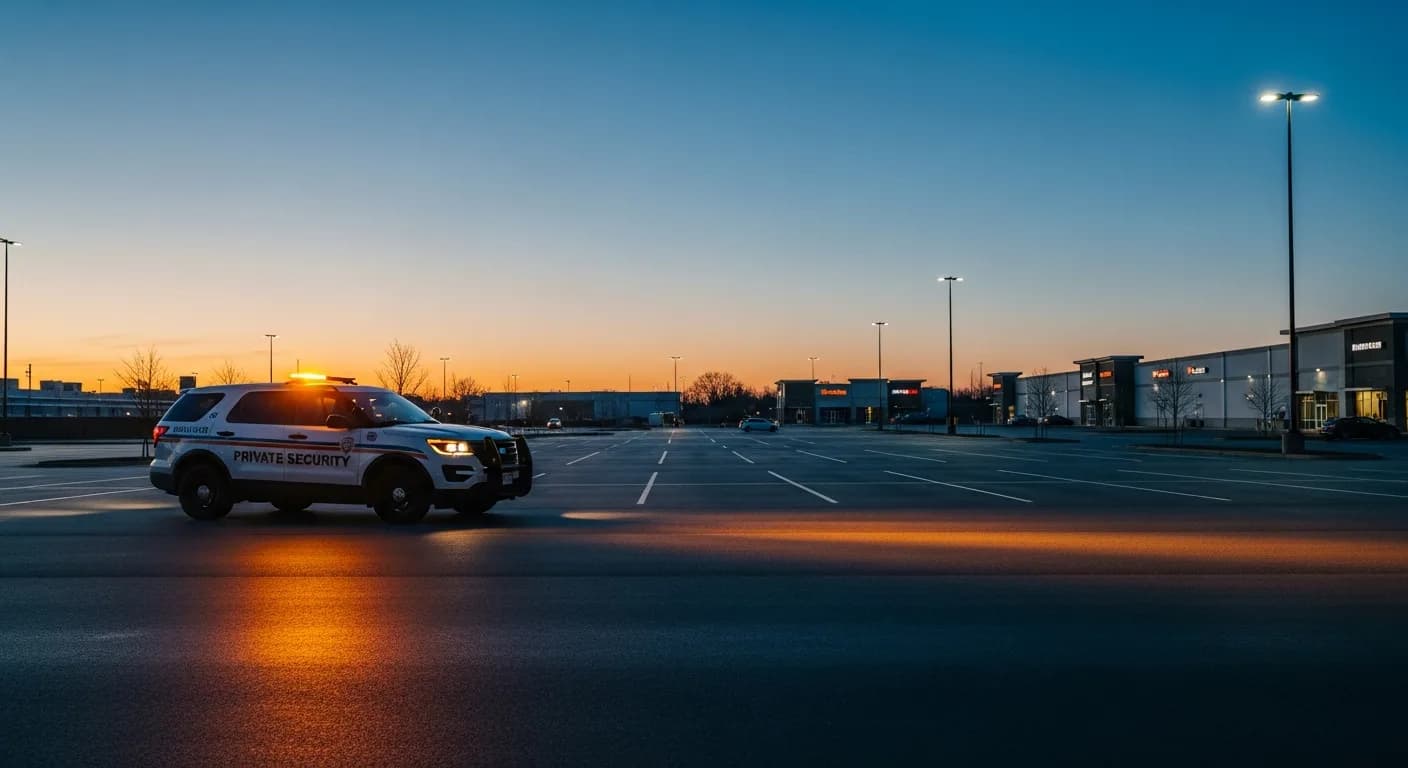
Mobile patrol is a marked security vehicle that drives to your property on a route, performs a defined check (exterior sweep, door and gate pulls, lighting and hazard scan), logs the visit, and moves on to the next client. Because one officer and one vehicle cover many stops per shift, the cost is spread across the whole route — that is the entire economic advantage.
Pricing is almost always per property, per month, quoted against a number of checks per night rather than an hourly rate. Expect roughly $600–$2,500 per property per month (2026 US estimate) for drive-by patrols with logged visits, typically 1–4 checks per night. The low end buys a single nightly random check on a dense urban route; the high end buys multiple nightly visits, interior walk-throughs, or a lightly-populated rural route where the officer burns real drive time reaching you.
A per-visit anchor to sanity-check any quote. Because you're buying a slice of a shared route, it helps to translate the monthly band into a per-check cost. A single logged drive-by check tends to run roughly $20–$45 per visit (2026 US est.) on a reasonably dense route. Multiply by your checks-per-night and by ~30 nights: three nightly checks at ~$25 each ≈ $2,250/mo of raw visit cost before route-density discounts pull it back toward the middle of the band. If a quote implies far more than ~$45 per logged check, you're either on a thin rural route or paying for add-ons that should be itemized.
What drives the price
Six variables move a patrol quote up or down. Understanding them — and their rough magnitude — lets you buy exactly the coverage you need instead of a padded package. Treat the dollar deltas below as 2026 US estimates, not firm quotes.
- Checks per night. The single biggest lever. Each additional nightly logged check typically adds ~$200–$500/mo, because it multiplies the vehicle time you consume. Going from one check to three roughly triples that consumed time, which is why a one-check contract can sit near $600 while a four-check contract with walk-throughs pushes past $2,000.
- Route density. The second-biggest lever, and it can swing a quote ±25–40%. If your property sits among many of the provider's other clients, drive time between stops is trivial and your share is cheap. An isolated site on the edge of a route costs more because the officer travels farther to reach only you.
- Property size and complexity. A single storefront is a two-minute check. A multi-building campus, a large lot with multiple gates, or a site requiring an interior walk pulls the officer off the route longer and typically adds ~$150–$600/mo versus a simple perimeter drive-by.
- Alarm-response and lock-up add-ons. Dispatching the patrol vehicle to an alarm activation, or having the officer physically lock and unlock the building at set times, are billable extras — often a flat per-response fee (~$25–$75 each) or a monthly uplift (~$100–$400/mo). See the add-on table below.
- Drive time. Rural and exurban sites carry a real windshield-time premium — commonly +15–35% over an equivalent site inside the provider's cluster. The farther you are, the more of the officer's paid shift you consume just being reached.
- Officer type. Standard patrol officers are unarmed. Upgrading to an armed patrol officer typically adds ~30–60% to the patrol line (often ~$300–$1,200/mo depending on checks and market), reflecting higher wages, licensing, and insurance — see armed vs. unarmed security guards and armed security services.
Add-on costs: what nudges you up the band
Most patrol quotes start as a bare drive-by number. The extras below are where a $1,400 baseline quietly becomes a $2,200 invoice. Ask which of these are included versus billed separately, and get each on its own line.
| Add-on | Typical cost (2026 US est.) | How it's billed |
|---|---|---|
| Lock-up / unlock service | ~$100–$300 / mo | Monthly uplift for scheduled secure + open |
| Per-alarm-response dispatch | ~$25–$75 / response | Per event, often beyond a small monthly allotment |
| Extra nightly check | ~$200–$500 / mo each | Monthly, per added check |
| Interior walk-through | ~$150–$400 / mo | Monthly uplift over perimeter-only |
| Armed officer upgrade | +~30–60% (~$300–$1,200 / mo) | Premium on the patrol line |
Hidden fees and what's excluded from the base price
The quoted monthly figure is rarely the whole bill. Before you compare providers on headline price, ask what's excluded — these items materially change your effective monthly cost:
- Fuel surcharges. Some providers pass through a fuel/mileage line, especially on rural routes — a few percent of the contract, sometimes indexed to gas prices.
- Holiday and overtime billing. Coverage on holidays or requested extra runs is often billed at a premium (1.5–2×), not the standard nightly rate.
- Per-alarm-response fees beyond an allotment. "Alarm response included" frequently means a few responses; extras bill per event (see the add-on table).
- Setup / onboarding. A one-time site survey, checkpoint/QR installation, and key intake can carry a setup fee (~$100–$500).
- Report-portal or technology fees. Access to the GPS/geotagged reporting dashboard is sometimes a separate monthly SaaS-style line.
Mobile patrol vs a dedicated guard post — the cost gap
The gap is enormous, and it is the whole point of choosing patrol. A standing (dedicated) guard post runs about $8,000–$12,800 per month for one 12-hour daily shift. Mobile patrol on the same property might run $600–$2,500 per month — because with a post you pay for every minute an officer stands there, while with patrol you pay only for your slice of a shared route.
| Option | Typical monthly cost (2026 US est.) | Coverage | Best for |
|---|---|---|---|
| Mobile patrol | $600–$2,500 / property | 1–4 logged checks per night | Deterrence on empty or low-risk sites |
| Dedicated guard post (one 12-hr shift) | $8,000–$12,800 | Continuous on-site presence, half the day | Access control, incidents, constant visibility |
| 24/7 dedicated coverage | ~$16,000–$25,600 | Continuous, around the clock — 2–4 officers total staff two stacked 12-hr posts, including relief/coverage | High-risk or high-traffic properties |
When each makes sense: choose patrol when the property is mostly empty during the covered hours and you need a credible deterrent and a documented response path — construction sites, self-storage, vacant retail, after-hours business parks. Choose a dedicated post when there is something happening that needs a human present: access control, a lobby, an active loading dock, crowd presence, or a documented incident history. For the full cost picture on continuous coverage, see our 24/7 security guard cost and armed guard cost guides, and the broader how much does security cost overview.
Regional and metro price variation
The national $600–$2,500 band shifts with local labor rates, licensing costs, and how dense the provider's route is in your area. Patrol wages track the local guard market, so a high-wage coastal metro sits toward the top of the band while a low-cost rural county can dip below it. Use this as a directional adjustment, not a quote:
| Market type | Rough position in the band | Why |
|---|---|---|
| Major metro (high-wage state) | ~$1,200–$2,500+ | Higher guard wages, licensing/insurance, congestion; routes dense but expensive |
| Suburban | ~$800–$1,800 | Moderate wages, workable route density |
| Rural / exurban | ~$600–$1,200 base, plus drive-time premium | Lower wages but thin routes mean real windshield time added to your share |
Two same-sized sites with identical check schedules can land 40%+ apart across markets. When you collect quotes, compare providers within your metro rather than against a national average.
A worked example: nightly patrols for a small commercial property
Say you run a single-building commercial property in a suburban business park that closes at 6 PM. You want visible coverage overnight but nothing is happening on-site after hours. You buy three randomized checks per night, each an exterior sweep plus door and gate pulls, on a route where the provider already services several neighbors. Here's the build-up (2026 US est.):
- Base: 3 randomized nightly checks on a dense suburban route ≈ $1,450/mo. (Roughly three checks × ~$25/visit × ~30 nights, discounted for strong route density — landing mid-band, not at the raw ~$2,250.)
- + Lock-up / unlock service (secure the gate at 8 PM, open at 6 AM) ≈ +$200/mo.
- + Alarm-response clause (small monthly allotment for dispatch on activation) ≈ +$150/mo.
- = Total ≈ $1,800/mo, near the upper portion of the mid-band — still well inside the $600–$2,500 range.
Compare that to a single overnight guard post: even one 12-hour dedicated shift starts around $8,000/mo, so the post costs several times the patrol figure — roughly 4–5× more here — for a site where no one is around to guard anything but the perimeter. For your own numbers, run the scenario through the security cost calculator, then pull real bids from vetted security companies.
Monitored video as a standalone alternative
Cameras aren't only a patrol add-on. For a genuinely empty site, remote/live video monitoring — a live operator watching AI-triggered feeds and issuing voice-down warnings or dispatching police — can be a competing lower-cost option, not just a supplement. Rough 2026 US estimate: ~$250–$1,200 per site per month for monitoring service (equipment/installation separate), which can undercut a multi-check patrol contract while delivering near-continuous eyes instead of a few nightly minutes.
The trade-off: monitoring has no boots-on-the-ground physical response, so it shines on fenced yards, storage, and construction where deterrence-plus-dispatch is enough — and pairs well with a single nightly patrol check for physical verification. Weigh it against patrol in our video surveillance service overview and the how much does security cost guide.
How to combine patrol with cameras or a night post to cut cost
The cheapest strong setup is usually a hybrid. Patrol provides the human deterrent and physical response; technology and a targeted post fill the gaps between visits.
- Patrol + cameras. Pair patrol with video surveillance — ideally monitored — so a live operator can dispatch the patrol vehicle the moment something triggers, instead of hoping the next scheduled check catches it. This turns 1–2 cheap nightly checks into effectively continuous coverage.
- Patrol + a short night post. Put a dedicated officer on-site only for your highest-risk window (say, the first hours after close), and let patrol cover the quiet overnight stretch. You pay for one short shift instead of two.
- Escalation clause. Structure the contract so patrol is the baseline and a post spins up only if incidents recur — you avoid over-buying coverage you may never need.
Contract terms: minimums, length, and cancellation
The rate is only half the commercial picture — the commitment you sign to affects real cost. Patrol contracts vary widely, so read these terms before the price:
- Minimum term. Some providers offer true month-to-month; many want a 6–12 month initial term to justify onboarding and route planning. Longer lock-ins sometimes buy a lower monthly rate — decide whether the discount is worth the reduced flexibility.
- Auto-renewal. Many contracts auto-renew for successive terms unless you give notice. Note the renewal window so you aren't rolled into another 12 months by default.
- Cancellation and notice. Look for the required notice period — commonly 30 days, sometimes 60 — and any early-termination fee within an initial term. Confirm whether you can cancel for non-performance (e.g., missed or unverifiable checks) without penalty.
- Rate-change clause. Check how and when the provider can raise rates (fuel/wage escalators, annual CPI bumps) and whether you get notice.
What to confirm in a patrol contract
Patrol is only worth paying for if the visits actually happen and are provable. Before you sign, confirm:
- Checks are logged and GPS-verified. Insist on time-stamped, geotagged proof of every visit — QR/NFC checkpoint scans or GPS breadcrumbs — delivered in a report you can review. Without this you are paying on trust.
- A written response protocol. Know exactly what the officer does on finding an open door, an alarm, or a trespasser, whom they call, and expected response time for alarm dispatches.
- Insurance and licensing. Verify general liability coverage, and if lock-up or key-holding is involved, appropriate bonding. Check the provider's license before signing — see how to verify a security company license and our contracts and insurance guide.
- Randomization and no substitution. Confirm visit times are randomized and that a body camera or supervisor audit prevents "phantom" logged checks.
- All-in pricing, in writing. Get fuel, portal/technology, setup, and per-response fees itemized so the headline monthly rate is the whole story.
Do your diligence with how to hire a security guard company, then request competing quotes so you can compare checks-per-night, add-ons, contract terms, and per-visit proof side by side. The right patrol contract gives you a dedicated post's deterrent value at a small fraction of its cost.
Frequently asked questions
How much does mobile patrol security cost per month?+
Why is mobile patrol so much cheaper than a dedicated guard?+
What add-ons increase a patrol bill beyond the base quote?+
How much does armed mobile patrol add?+
Is remote video monitoring cheaper than mobile patrol?+
Share this guide