Manufacturing security protects the production floor, your IP and your people — not just storage. Here's the access-control, theft and safety program a plant needs.
A manufacturing plant is a harder security problem than most buyers assume. You are not just guarding a building — you are protecting a live production process, expensive machinery, proprietary methods, and a workforce moving through shift changes around the clock, while a steady stream of contractors, freight drivers, and vendors flows through your gates every day. Manufacturing plant security has to reconcile all of that: keep the line running, keep trade secrets off a competitor's floor, keep copper and tooling from walking out the back, and keep people safe enough to satisfy OSHA. This guide is written for the operations, facilities, and EHS leaders who actually buy that protection, and it focuses on what makes a factory different from a distribution center.
Effective manufacturing plant security layers four things: a controlled perimeter and staffed gate that separates people, vehicles, and freight; access control that treats employees, contractors, and visitors as distinct populations with distinct clearances; surveillance and patrol coverage over production areas, tool cribs, scrap yards, and utility rooms; and written procedures tied to your OSHA safety program. If your facility mainly stores and ships finished goods rather than producing them, read our warehouse and industrial security guide instead — the threat model there is inventory shrink and cargo, not production IP and machinery.
What manufacturing plant security actually protects
Warehouse security is about goods at rest: pallets, SKUs, cargo, and dock throughput. Manufacturing security is about a process in motion. The assets you are defending are not just the finished product sitting on a rack — they are the machines making it, the people running them, the proprietary way you run them, and the raw materials feeding them. That shifts the entire program. A distribution center can lock down at the dock and the fence line; a factory has to protect the interior floor, the tool crib, the R&D and prototype areas, the maintenance shops, the chemical and utility rooms, and the scrap and waste streams — all while the building is deliberately open to a rotating cast of outside labor.
Because production rarely stops, the coverage model is different too. Many plants run two or three shifts, which means your highest-risk moments are shift changes and the thin overnight window, not just after-hours. The people problem — verifying who is inside a moving, mixed workforce — is usually a bigger exposure than the perimeter fence. If your operation blends production with significant warehousing and outbound freight, you will run a hybrid program that borrows from both playbooks; our warehouse and industrial security resource covers the storage-and-distribution half so this guide can stay focused on the production side.
The threats that are specific to a production floor
Generic "guards and cameras" proposals miss the risks that actually cost manufacturers money. There are five that deserve named attention.
Intellectual property and trade-secret loss
For many manufacturers, the crown jewel is not the product — it's the method. Tooling geometry, process parameters, formulations, custom fixtures, and prototype designs are what a competitor cannot legally replicate. Physical security is a first line of defense for that. The FBI treats trade-secret theft and economic espionage as a top counterintelligence priority, and the Commission on the Theft of American Intellectual Property has estimated IP theft costs U.S. firms hundreds of billions of dollars a year. The federal Economic Espionage Act (18 U.S.C. §§ 1831 and 1832) carries up to 10 years' imprisonment for domestic trade-secret theft and organizational fines up to $5 million or three times the value of the secret — but a prosecution is a poor consolation prize once your process is on a competitor's floor. Most real-world losses come through insiders and visitors, not master thieves: a contractor photographing a fixture, a departing employee copying CAD files, a "tour" that lingers over a proprietary line.
Machinery, tooling, and copper/metal theft
Manufacturing plants are dense with high-value, portable, and resellable metal. Copper in wiring, panels, motors, and bus bar is a standing target — the U.S. Department of Energy has estimated metal theft costs American businesses roughly $1 billion a year, and record copper prices in 2024–2025 pushed incidents to new highs across industrial sites. Beyond copper, tool cribs full of expensive hand tools, precision instruments, spare parts, and even scrap bins of production offcuts are all resale-ready. Theft here isn't just the replacement cost — stripping copper out of a live panel or pulling a component off a machine can halt a line and create a serious safety hazard.
Contractor and vendor access abuse
A working factory can host dozens of outside people on a normal day: maintenance techs, calibration vendors, temp labor, sanitation crews, freight drivers, and installers. Each is a legitimate reason to be inside — and each is a potential vector for theft, IP capture, or an unescorted wander into a restricted area. The problem is rarely a stranger jumping the fence; it's an authorized outsider going somewhere they shouldn't. Access control that can't distinguish a badged employee from a one-day contractor is the single most common gap we see.
Sabotage, tampering, and the cyber-physical overlap
Manufacturing has been the most-attacked industry in IBM's X-Force Threat Intelligence Index for several years running, accounting for over a quarter of all incidents, precisely because the sector has an extremely low tolerance for downtime. Much of that is a cyber problem, but the physical and digital layers meet on the plant floor: unattended HMI terminals, network jacks in the open, control cabinets left unlocked, and USB access to PLCs. Physical access control over control rooms, MDF/IDF closets, and OT equipment is part of your security program, not just IT's.
Workplace violence and internal threats
Terminations, labor disputes, domestic situations that follow an employee to work, and disgruntled-insider incidents are real hazards in a large blue-collar workforce. As covered below, they also carry a specific compliance dimension.
Protecting IP and trade secrets on a live floor
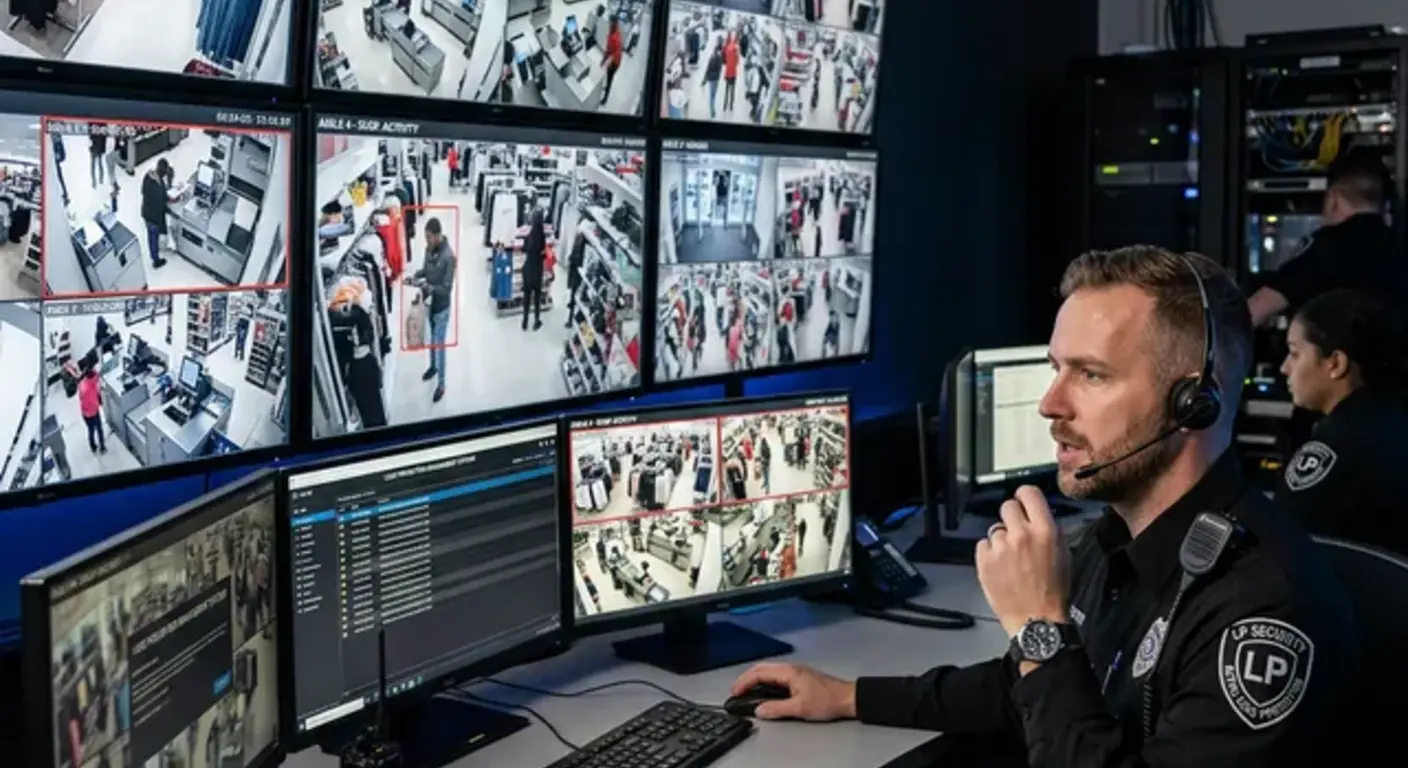
You cannot pat down every departing worker, and you shouldn't try. Trade-secret protection on a production floor is about zoning and friction. Divide the plant into concentric zones — general employee areas, controlled production, and restricted (R&D, prototype, proprietary lines, tool design) — and make access to each zone a deliberate, logged decision. The tighter the zone, the fewer badges open it, and the more likely a person entering is escorted or recorded. Camera coverage over proprietary lines does double duty: it deters casual photography and gives you evidence if a leak is investigated later. A professional video surveillance design that covers process areas, exits, and the scrap stream — not just the parking lot — is central to this.
Contractor, visitor, and shift-change access control
This is where most manufacturing plant security programs succeed or fail. The goal is to treat your gate and lobby as a filter that sorts people into the right population with the right escort level before they ever reach the floor.
| Population | Verification at entry | Access granted | Escort / oversight |
|---|---|---|---|
| Employees | Badge + biometric/PIN at turnstile | Their zone only, by role | None; anti-passback enforced |
| Temp / contract labor | Day badge, ID check, roster match | Assigned area, time-boxed | Supervised by area lead |
| Vendors / maintenance | Pre-registered, ID + work order | Specific equipment/room | Escorted to and from job |
| Freight drivers | Gate check, BOL/appointment match | Dock/staging only | Held at dock, no floor access |
| Visitors / tours | Signed NDA, host notified, badge | Defined route only | Host-escorted at all times |
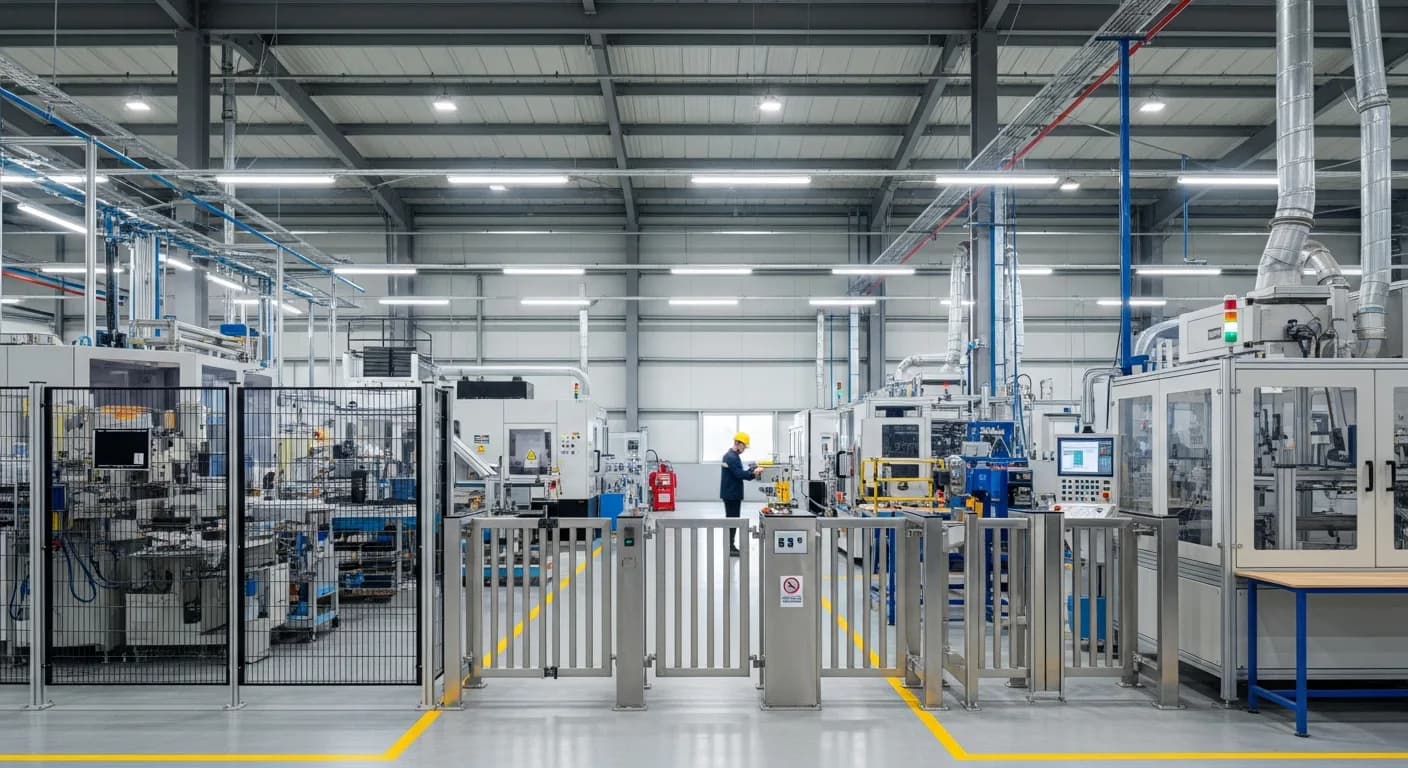
A staffed gate is what makes this real. A trained officer verifies drivers against the appointment schedule, keeps freight separated from the pedestrian flow, and controls the vehicle queue so tailgating and unlogged entries don't happen. Inside, unarmed security guards handle lobby check-in, badge issuance, NDA collection, and the escort rotation. Shift change is the pressure test: a well-run program pushes hundreds of people through in fifteen minutes without letting one unbadged person ride the crowd inside. That takes staffing and turnstiles, not goodwill. For plants that can't justify a 24/7 static post on every gate, scheduled and random mobile patrol coverage of the perimeter, scrap yard, and outlying utility structures closes the gaps between fixed posts — and after-hours patrols are one of the most cost-effective deterrents against copper and equipment theft.
Whether any of these roles should be armed is a site-specific risk decision. High-value metals, cash handling, credible threats, or a history of violent incidents can justify it; a low-risk consumer-goods plant usually does not need it. Make that call on documented risk, insurance guidance, and local law — not on optics.
Where manufacturing plant security overlaps with OSHA and workplace safety
Security and safety are the same conversation in a factory more than in almost any other setting. OSHA has no standalone workplace-violence standard, but it enforces the General Duty Clause — Section 5(a)(1) of the OSH Act — which requires employers to provide a workplace "free from recognized hazards" likely to cause death or serious physical harm. The Occupational Safety and Health Review Commission's Integra Health Management decision and subsequent appellate rulings confirmed OSHA can cite an employer for failing to protect workers from foreseeable violence when there is a direct nexus between the work and the risk. Penalties run to about $16,550 per serious violation and up to $165,514 for willful or repeated violations.
What that means for a plant buyer: your security program is also part of your safety compliance. A documented workplace-violence prevention plan, controlled access that keeps out-of-role people off dangerous equipment, a reliable way for workers to summon help, trained officers who can de-escalate a terminated employee at the gate, and post-incident procedures are all things OSHA regards as feasible, expected abatement. Security officers overlap with safety in mundane but important ways too — enforcing PPE and no-entry rules at zone boundaries, controlling the crowd during an evacuation, and logging incidents. When you scope a vendor, ask how their officers are trained on your emergency action plan, not just on patrol routes. For multi-site manufacturers coordinating this across an enterprise, a corporate security program aligns plant-level posts with centralized policy, investigations, and executive protection.
Building your program: a buyer's checklist
Use this to scope proposals and compare vendors on the things that matter for a factory rather than a generic building.
| Layer | What to specify |
|---|---|
| Perimeter | Fence-line integrity, gate control, vehicle/pedestrian separation, scrap-yard and utility-structure coverage |
| Gate & access | Staffed post, appointment matching for freight, distinct employee/contractor/visitor credentials, anti-passback, badge audit trail |
| Interior zoning | Restricted R&D/prototype/tool-crib zones, escort rules, control-room and OT-closet locking |
| Surveillance | Coverage of production lines, exits, tool cribs, scrap/waste, dock; retention period; remote monitoring |
| Officers | Post orders, de-escalation and EAP training, escort staffing for shift change, incident reporting |
| IP controls | Visitor NDAs, clean-phone rules in restricted zones, access logs, exit procedures for departing staff |
| Compliance | Written workplace-violence prevention plan, OSHA General Duty alignment, vendor licensing and insurance verified |
Before you sign, run the vendor through basic due diligence: confirm their state guard-company license, pull a current certificate of insurance, and check that officer training matches your risk. Our guides on verifying a security company's license and reading a certificate of insurance from a security vendor walk through exactly what to demand — and why an underinsured contractor becomes your liability if something goes wrong.
What manufacturing plant security costs
Pricing is driven by staffing model far more than by the building. A single 24/7 gate post — the round-the-clock coverage most plants need — is the biggest line item, because it takes roughly 4.5 officers to staff one position continuously across shifts and relief. Add technology (access control, cameras, monitoring) as capital plus a monthly service fee, and patrol as an add-on. Rates vary by market, armed vs. unarmed, and officer skill level. Rather than guess, model your actual coverage: our security cost calculator estimates monthly spend from post count and hours, and the pillar guide on how much security costs breaks down the drivers. For 24/7 coverage specifically, the round-the-clock guard cost guide shows how the 4.5-officer math translates into a monthly number.
The buyer takeaway
A factory is not a warehouse with machines in it. The money in manufacturing plant security goes to the production-specific risks: protecting the process and IP that competitors want, controlling a workforce that includes daily outsiders, defending high-value metal and tooling, and satisfying the OSHA duty to keep workers safe. Buy the program in layers — perimeter, gate, zoning, surveillance, trained officers, and written procedures — and hold every vendor to real licensing, insurance, and factory-specific training rather than a boilerplate patrol quote. If storage and outbound freight are a big part of your footprint, pair this with our warehouse and industrial security guidance so both halves of the operation are covered.
Ready to move? Get competing quotes from licensed guard companies that serve industrial sites — describe your shift pattern, gate count, and restricted zones, and compare proposals on the checklist above.
Frequently asked questions
How is manufacturing plant security different from warehouse security?+
How do I protect trade secrets and IP on a production floor?+
Do manufacturing plants need armed security guards?+
Is workplace security part of OSHA compliance for manufacturers?+
How much does security for a manufacturing plant cost?+
Share this guide
Sources
- TAPA Facility Security Requirements (FSR) Standard — 2026 revision
- OSHA — Workplace Violence Enforcement (General Duty Clause, Section 5(a)(1))
- FBI — Economic Espionage / theft of trade secrets (top counterintelligence priority)
- Congress.gov (CRS R42682) — Economic Espionage Act penalties, 18 U.S.C. §§ 1831/1832
- ASIS International — Copper theft trend and ~$1B annual DOE loss estimate
- USTelecom — The Growing Crisis of Copper Theft (2024–2025 incident data)
- IBM X-Force — Manufacturing the most-attacked industry (Threat Intelligence Index)