Retail theft, organized retail crime, and California's new workplace-violence mandate have stores rethinking security. Here's how to compare uniformed, plainclothes, mobile, and virtual models — and hire the right one without buying liability you don't need.
Retailers are hiring security in numbers not seen in years — pushed by rising in-store theft, high-profile organized retail crime (ORC), and a wave of new state laws that turn workplace-violence prevention into a legal duty rather than a nice-to-have. California's SB-553 was the first, and as of 2025 it is no longer alone: New York's Retail Worker Safety Act now imposes a comparable retail-specific obligation, and more states are drafting their own. But retail security is easy to get wrong: the wrong deployment model can raise your liability instead of lowering it, and buying a uniformed guard when you needed a policy and a camera upgrade wastes money. This guide explains the deployment models, what the data actually says about shrink and ORC, what each store type actually needs, what it all costs, and how to hire a licensed provider that fits your store.
Quick answer: Most stores are best served by a uniformed, observe-and-report officer — visible deterrence with low liability — layered over cameras and electronic article surveillance (EAS). Plainclothes loss-prevention officers who physically apprehend shoplifters recover more merchandise but carry real false-arrest and use-of-force exposure. Armed guards are rarely appropriate for routine retail. Budget roughly $22–$35 an hour unarmed in most metros ($30–$48 armed for the few cases that justify it). And if you operate in California or New York, a guard does not satisfy the workplace-violence laws (see the legal-duty section below) — you still need a written plan, an incident log, and recurring training.
Why retailers are hiring security in 2024–2026
Two forces are driving demand. The first is shrink — the industry term for inventory losses from theft, fraud, and error. The second is a genuine rise in violence tied to theft: employees and customers confronted, weapons displayed, and smash-and-grab incidents that turn a property crime into a safety crisis. For an operations, loss-prevention, or facilities lead, the job is no longer just protecting margin; it's protecting people and meeting new legal duties.
Before you spend, though, it's worth being precise about what the numbers do and don't say, because the retail-crime conversation has been distorted by figures that were later walked back.
What the shrink and ORC data actually shows
The most-cited benchmark comes from the National Retail Federation's National Retail Security Survey. In its 2023 report (covering fiscal year 2022), the NRF put the average shrink rate at about 1.6% of sales, which it translated to roughly $112.1 billion in losses. Within that shrink, external theft (shoplifting and ORC) accounted for about 36%, internal/employee theft about 29%, and process or administrative errors the remainder. Those are useful directional figures — but treat them as FY2022 estimates, not gospel, and note that survey-based shrink numbers vary year to year and by retail segment.
A widely repeated ORC statistic was retracted — don't cite it
You'll still see claims that "organized retail crime accounts for about half of all shrink." The NRF retracted that specific figure in December 2023 after acknowledging the underlying number was misattributed. Independent analysts have estimated ORC's share of shrink at a much smaller slice — on the order of a few percent — and, honestly, no one has a precise national number. When you build a business case for security spend, anchor it to your own store's incident data and loss reports, not a headline percentage. ORC is real and worth defending against; the exact national dollar figure is genuinely uncertain.
On violence specifically, the NRF's surveys have reported that a large majority of retailers — roughly two-thirds in the 2023 report — said ORC incidents had grown more violent year over year. That trend, more than any single dollar figure, is what's putting guards back in stores: the risk isn't just lost product, it's an escalation that endangers staff and shoppers. ORC pressure concentrates in large metros — the Los Angeles, San Francisco/Oakland, Houston, New York, and Seattle markets are frequently named — but theft and safety concerns show up in stores of every size.
Which stores actually need a guard — a scoring rubric
Not every location needs an officer, and spreading a thin security budget evenly across a fleet is usually a mistake. The stores that justify a dedicated guard tend to share a few traits: a documented incident history, high-value or high-resale merchandise, a high-traffic or high-crime location, extended or late hours, and a large sales floor that staff can't watch while serving customers. But a buyer with 40 stores can't triage a fleet on adjectives. Score each location instead.
Store risk-scoring worksheet. Rate each location 0–3 on the five factors below, sum the score (max 15), and map it to a recommended model. Run it quarterly off your own loss reports so the ranking follows the risk.
| Factor | 0 (low) | 1 | 2 | 3 (high) |
|---|---|---|---|---|
| Incident history (trailing 12 mo.) | None | Minor theft only | Repeat theft or 1 confrontation | Violent incident or organized hits |
| Merchandise resale value | Low (bulky/low-value) | Mixed | Some high-demand SKUs | Jewelry, electronics, RX, high-theft brands |
| Hours | Daytime only | Closes by 8pm | Late evening | 24-hour or very late close |
| Local crime index | Low | Below average | Above average | ORC hotspot / high-crime |
| Unmonitored floor size | Small, one sightline | Moderate | Large, several blind spots | Sprawling / multi-level, poor camera coverage |
| Total score | Recommended model |
|---|---|
| 0–4 | Camera + EAS only, plus staff training. No posted officer. |
| 5–8 | Camera/EAS baseline plus a mobile patrol for opening/closing. |
| 9–12 | Posted unarmed, observe-and-report officer during peak/late hours. |
| 13–15 | Full-time uniformed officer; consider a tightly governed plainclothes loss-prevention program at flagship level, and armed only if the store meets the narrow criteria below. |
Use the worksheet to concentrate guard hours where the risk and the recoverable loss are highest. A flagship in a downtown ORC hotspot has different needs than a suburban strip-mall unit, and the right answer is rarely the same model everywhere. Get matched with licensed providers once you know which tier each store lands in.
Uniformed vs. plainclothes loss prevention
The single most important design decision is visible deterrence versus covert apprehension, because it determines both effectiveness and liability.
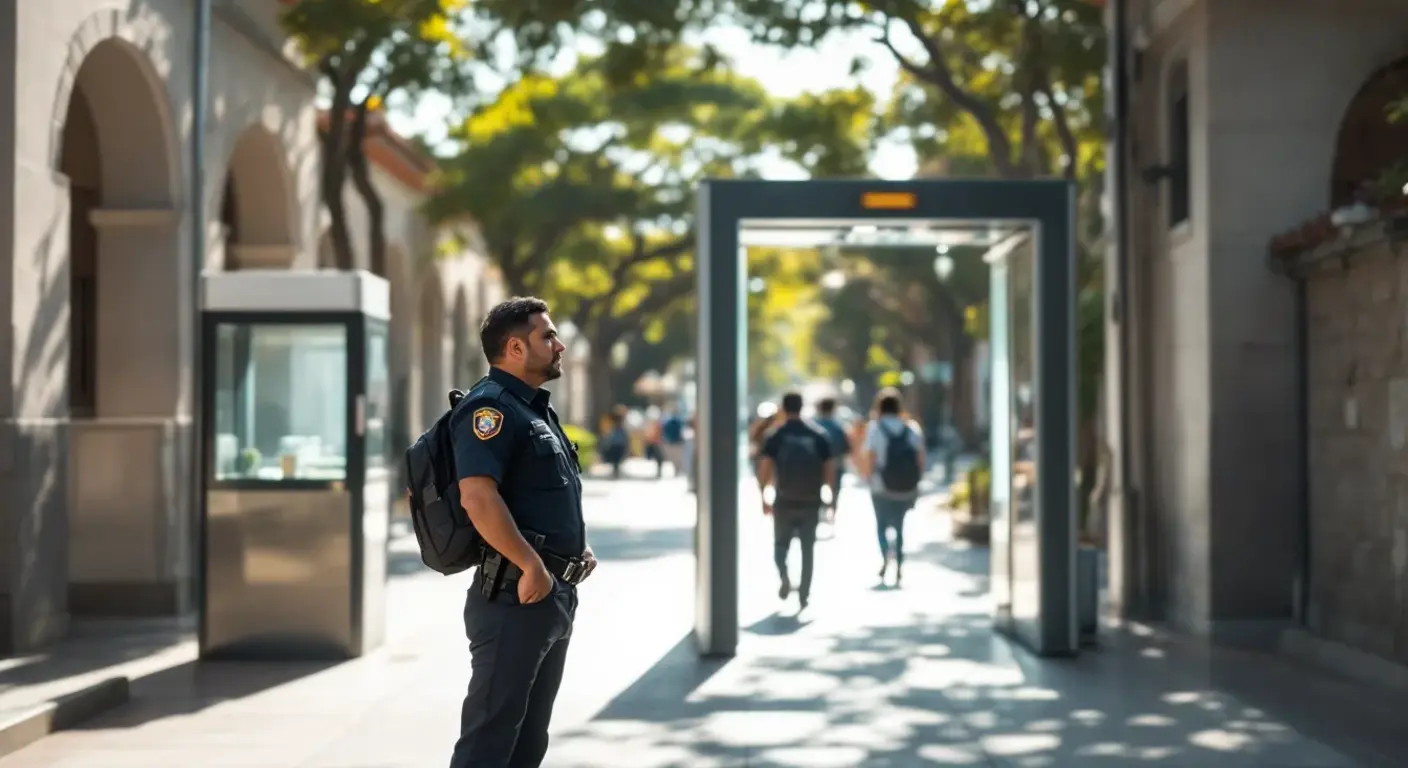
A uniformed officer works by presence. A shoplifter who sees a guard at the door often simply leaves or goes elsewhere; the officer's value is that incidents don't happen in the first place. Crucially, most reputable retail security operates on an observe-and-report ("no-touch") basis: the officer documents, deters, and calls police, but does not chase or physically detain. That keeps liability low and is what most stores actually want.
A plainclothes loss-prevention (LP) officer works by detection and apprehension — blending in with shoppers, watching for concealment, and, under a strict store policy, stopping and detaining a suspect. LP officers recover more merchandise and build stronger ORC cases, but they operate in the highest-liability zone in all of retail security: false arrest, wrongful detention, and use-of-force claims. Retailers that use apprehension must have a written detention policy (built around the "shopkeeper's privilege" standards that vary by state — see the table below), disciplined training, and video to back up every stop. This model belongs to sophisticated operators, not a corner store.
In practice, the choice is less "which is better" than "which risk am I buying." Uniformed presence trades recovery for prevention: you stop fewer thieves in the act, but incidents don't happen in the first place, and your liability floor is low. Plainclothes LP raises recovery and case-building but every apprehension is a potential lawsuit, and a single mishandled stop — wrong person, excessive force, a chase into traffic — can cost more than a year of recovered merchandise.
A useful test: if you can't name who wrote your detention policy, who trained the officer on it, and where the video of each stop is stored, you are not ready for apprehension. Many chains land on a blend: uniformed officers at the door in most stores, with a small, tightly governed plainclothes program reserved for a few high-shrink flagships where the recoverable loss justifies the exposure.
Shopkeeper's privilege: merchant-detention law by state
The entire plainclothes-apprehension liability argument rests on shopkeeper's privilege — the doctrine that lets a merchant temporarily detain a suspected shoplifter without automatic liability for false imprisonment. Every state has some version, but the standard of proof, the permitted manner, and the immunity language vary. The table below shows five high-volume-retail states; the pattern (reasonable cause + reasonable manner + reasonable time) is common nationwide, but the specifics govern how your detention policy must be written.
| State | Statute | Standard | What's distinctive |
|---|---|---|---|
| California | Penal Code § 490.5(f) | Probable cause | Detention only for a reasonable time in a reasonable manner; nondeadly force; may search bags/packages but not clothing; may request but not demand ID. |
| New York | General Business Law § 218 | Reasonable grounds | Framed as an affirmative defense to false-arrest/imprisonment claims; reasonable time to investigate; limits fingerprinting. |
| Texas | Civ. Prac. & Rem. Code § 124.001 | Reasonable belief | Minimalist grant to detain in a reasonable manner for a reasonable time to investigate ownership; 2024 amendment added a theft-education-program option in lieu of reporting. |
| Florida | Fla. Stat. § 812.015 | Probable cause | Broadest class of detainers; requires law enforcement be called immediately after custody; express statutory immunity when procedures are followed. |
| Illinois | 720 ILCS 5/16-26 | Reasonable grounds | Permits off-premises detention only on immediate pursuit; possession of a theft-detection shielding device is deemed reasonable grounds. |
Three rules that hold in every state: (1) The privilege authorizes an investigative detention, not a full arrest — tackling and "arresting" someone invokes citizen's-arrest law and far higher liability. (2) No statute sets a hard clock, but courts routinely uphold detentions under an hour and reject multi-hour holds. (3) The privilege exists to investigate ownership and summon police, not to interrogate. Have counsel draft your policy to the strictest state you operate in and verify the current statutory text before you rely on it — these provisions change (Texas and Florida were both amended recently).
Why armed guards are usually the wrong call in retail
It's tempting to equate "serious about security" with "armed," but for routine retail the opposite is usually true. Introducing a firearm into a shoplifting confrontation dramatically raises the stakes and your liability, and most theft simply doesn't warrant it — the industry consensus is to let merchandise walk rather than escalate over property.
Armed security can make sense for narrow cases: high-value inventory (jewelry, firearms, cannabis, precious metals), cash-heavy operations, or a store with a documented history of violent crime. For everyone else, a visible unarmed officer plus good cameras is both safer and cheaper. Our guide to armed vs. unarmed guards walks through when the upgrade is justified.
No-touch, observe-and-report: the default policy for a reason
Whatever model you choose, most retailers should adopt an explicit observe-and-report, no-pursuit policy and put it in the contract. Under this approach, the officer deters, documents, and summons police, but does not physically engage a fleeing shoplifter or chase into a parking lot. This isn't timidity — it's risk management. The vast majority of costly retail-security lawsuits stem from a physical confrontation that went wrong: an injury during a detention, a wrongful stop, a pursuit that ended in harm to the suspect or a bystander. A no-touch policy removes that exposure while preserving the deterrent value of a visible officer. If you do want apprehension authority, make it a deliberate, well-trained exception with legal review — not the default your guard improvises in the moment.
What retail security actually costs in 2026
Every figure below is a 2026 planning estimate, not a firm quote — your rate depends on metro, hours, risk, and volume. But a buyer needs a total-cost-of-ownership picture, not a single hourly number. Anchor your budget to these ranges (see our full security cost guide for the wage-vs-bill-rate breakdown).
| Line item | Typical 2026 cost | Notes |
|---|---|---|
| Unarmed guard (bill rate) | $22–$35/hr | ~$8,000–$12,800/mo for one 12-hour post, 7 days/week. |
| Armed guard (bill rate) | $30–$48/hr | ~$10,800–$17,300/mo per 12-hour post. Rarely appropriate for routine retail — reserve for jewelry, cannabis, firearms, cash-heavy, or documented violence. |
| 24/7 door coverage | 2–4 officers | ~$16,000–$25,600/mo unarmed; ~$22,000–$35,000/mo armed. Continuous coverage needs multiple officers to cover shifts, breaks, and relief. |
| Mobile patrol for closing | $600–$2,500/property/mo | Scheduled and random visits at open/close — the cost-effective step below a posted officer. |
| CCTV install (4–10 cameras) | $1,000–$5,000 | ~$150–$500 per camera installed; NVR/VMS extra. See our CCTV guide. |
| Camera / alarm monitoring | $30–$200/mo | Per site; higher for live guard-monitored video. |
| EAS system (pedestals + tags) | ~$2,000–$8,000 install | Plus consumables: hard tags reusable, labels ~$0.02–$0.15 each; deactivators at POS. |
Worked example — a single high-shrink flagship (annual program). One uniformed 12-hour post at $28/hr ≈ $122,600/yr. A closing mobile patrol at $1,200/mo ≈ $14,400/yr. A camera refresh (8 cameras + VMS) amortized ≈ $4,000 year one, plus monitoring at $120/mo ≈ $1,440/yr. EAS refresh + labels ≈ $3,000. Year-one total ≈ $145,000, dropping to ~$140,000 in steady-state years once capex is spent. Compare that against the store's documented recoverable loss before you commit — for many mid-shrink locations, the camera + EAS + patrol tier (well under $25,000/yr) is the better ROI.
The technology layer, explained
We keep recommending "cameras and EAS" as the cheaper alternative to a guard — so here's what those tools actually are and what they cost. For many stores, the right first spend is technology plus training, not a posted officer.
Electronic article surveillance (EAS)
EAS is the pedestal-and-tag system that alarms when tagged merchandise passes the door. Two dominant technologies: AM (acousto-magnetic), which tolerates metal and dense retail environments well, and RF (radio-frequency), which is cheaper per label and common in apparel. Tags come as reusable hard tags (removed at POS with a detacher) or disposable soft labels (deactivated at checkout). Source tagging — the manufacturer embeds the label before shipment — cuts in-store labor and is standard for high-theft categories. Note that EAS and RFID are not the same: RFID reads unique item-level IDs for inventory accuracy and can double as loss data, but item-level RFID is a bigger investment than basic RF/AM EAS.
CCTV and video management (VMS)
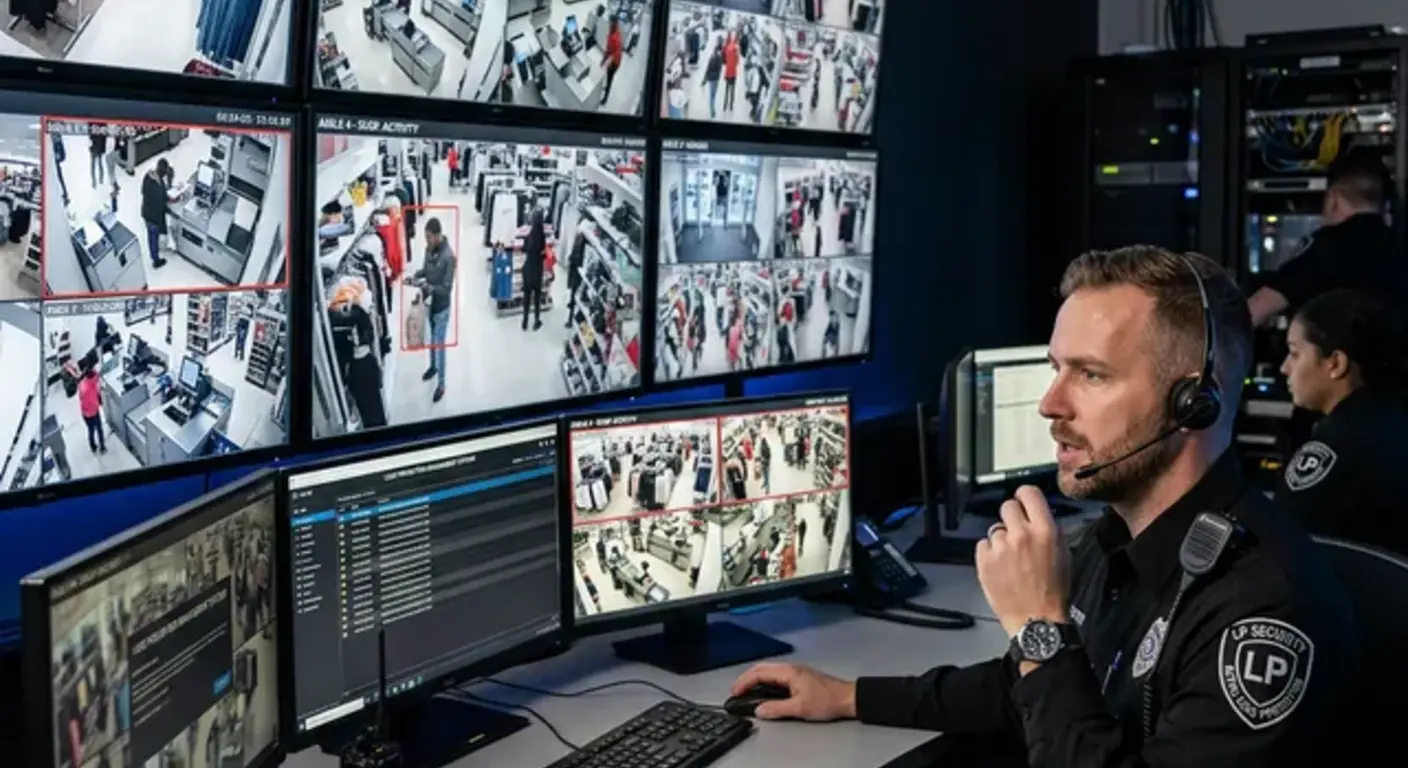
Modern retail CCTV is less about recording and more about the VMS software layer — analytics that flag loitering, tailgating at exits, or POS exceptions, and that let you pull clean, time-stamped clips for a case. Budget $150–$500 per camera installed and $30–$200/mo for monitoring (more for live guard-monitored feeds). Coverage of entrances, POS, high-value fixtures, and exits matters more than raw camera count.
License-plate readers, fitting-room controls, and benefit-denial tags
License-plate readers (LPR) at parking-lot exits capture getaway vehicles — often the single piece of evidence that turns a repeat ORC crew's incidents into a chargeable pattern. Fitting-room controls (attendants, item-count limits, garment counters) target a classic concealment point. Benefit-denial tags — ink tags that stain a garment if forced, and locking "spider wraps" or keeper cases — make stolen goods worthless or unsellable rather than merely alarming, which is especially effective against organized resale. Deploy these selectively on your highest-resale SKUs rather than store-wide.
Vertical playbook: what your store type needs
Risk profile and the right model change sharply by category. Use this as a starting point, then run each location through the scoring worksheet above.
| Vertical | Recommended model | Typical high-theft targets | Armed? |
|---|---|---|---|
| Grocery / supermarket | Uniformed observe-and-report at peak/close + mobile patrol; strong EAS on meat, HBA, liquor | Meat, health & beauty, liquor, baby formula | No |
| Apparel / big-box | Uniformed door presence + EAS + fitting-room controls; tightly governed plainclothes only at flagships | High-brand apparel, footwear, accessories | No |
| Jewelry | Access control + locking cases + trained staff; armed can be justified | Precious metals, watches, loose stones | Sometimes |
| Cannabis dispensary | Access control, cash handling, vault, cameras; often armed by regulation — see our dispensary security guide | Product inventory, cash | Often (check state rules) |
| Pharmacy | Locked cases + benefit-denial + camera coverage; observe-and-report officer in high-diversion areas | Controlled substances, HBA, high-demand OTC | Rarely |
| Convenience / gas | Cameras, drop safes, height strips, panic alarm; late-night patrol; armed only with documented violence | Cash, tobacco, lottery, alcohol | Rarely |
| Electronics | Locking fixtures + spider wraps + EAS + camera analytics; uniformed presence in ORC metros | Phones, laptops, gaming, small high-value SKUs | No |
The new legal duty: CA SB-553, NY, and more states following
A uniformed guard is a security measure. It does not, by itself, satisfy the workplace-violence-prevention laws now on the books. If you operate in California or New York, you have an affirmative compliance obligation regardless of whether you post a guard.
California — SB-553 (Labor Code § 6401.9, effective July 1, 2024). Nearly every employer must maintain a written Workplace Violence Prevention Plan, keep a violent-incident log (retained five years), provide annual training, and record and investigate incidents. It is enforced by Cal/OSHA and applies broadly — not just to retail.
New York — Retail Worker Safety Act (Labor Law § 27-e). Signed September 2024; the policy, training, and notice provisions took effect June 2, 2025. Employers with 10+ retail employees statewide must adopt a retail workplace-violence-prevention policy and provide interactive training (annually, or every two years for employers with fewer than 50 retail employees). Separately, employers with 500+ retail employees statewide must provide a silent-response button from January 1, 2027 — a device that summons a security officer, manager, or supervisor (the amended law dropped the original "dials 911" requirement). New York's Department of Labor publishes a model policy and model training employers may adopt.
The takeaway for a multi-state retailer: California is no longer the outlier. New York now imposes a retail-specific duty, and several other states are drafting similar bills. Build your workplace-violence program to the strictest jurisdiction you operate in — written plan, incident log, recurring interactive training, and a mechanism for employees to summon help — and layer physical security (guards, cameras, EAS) on top of it, not in place of it. A guard contract is not a compliance document; confirm your policy, log, and training satisfy each state where you operate.
An organized-retail-crime response playbook
ORC is different from a lone shoplifter: it's coordinated theft for resale, often by crews that hit multiple stores and know exactly how a "let it walk" policy works. That doesn't change the safety rule — you still don't chase or confront an armed crew over merchandise — but it does change what your team should do around the incident.
- Prioritize safety and documentation over recovery. Train staff and officers to observe, note descriptions, vehicles, and plates from a safe distance, and let the crew leave. No one should be injured over recoverable product.
- Preserve the evidence a case actually needs. Clean, time-stamped video of the entry, the concealment, and the exit — plus the specific items and their value — is what turns an incident report into a chargeable case. Assign someone to pull and store footage before it overwrites. LPR at the exit closes the loop on the getaway vehicle.
- Report every incident, even the small ones. Police and prosecutors build ORC cases on patterns. A single $400 grab looks minor; the same crew across ten stores crosses felony thresholds. File a report each time and keep your own incident log so the pattern is visible.
- Share intelligence across locations and with peers. Many metros run ORC associations and retail-crime networks where loss-prevention teams and police exchange suspect images, vehicle descriptions, and fencing leads. Regional and national information-sharing platforms exist for the same reason. Feed them and use them.
- Design the store to slow crews down. Move high-resale merchandise off easy grab-and-run displays, add locking fixtures, keeper cases, or benefit-denial tags selectively, tighten receipt and return controls that fences exploit, and position a visible officer where it disrupts the crew's exit path.
- Make the guard part of the reporting chain. A good contract officer isn't just deterrence; they should be documenting, feeding your incident log, and coordinating with your LP team and local police — which is exactly the capability to test when you vet a firm.
None of this requires a plainclothes apprehension program. Deterrence, disciplined documentation, and intelligence-sharing do most of the work — and they carry none of the false-arrest exposure.
How to calculate your own shrink rate
National averages make headlines. Your own number makes the budget. Shrink is the gap between the inventory your books say you should have and the inventory you actually count, expressed as a share of sales over the same period — and it is the only figure that will survive a conversation with your CFO.
The formula. Shrink % = (book inventory value − physical inventory value) ÷ net sales × 100, measured over one period, at one location. Run it at retail value and again at cost: the retail figure is what industry benchmarks like the NRF survey report, while the cost figure is what actually came out of your margin.
A worked example. A store does $4,000,000 in net annual sales. Its book inventory at retail is $820,000; the physical count comes back at $756,000. That is ($820,000 − $756,000) ÷ $4,000,000 = 1.6% shrink, or $64,000 of lost value — right at the FY2022 industry average cited above. Whether that is a crisis depends entirely on your margin. At a 35% gross margin you would need to sell roughly $183,000 of additional merchandise just to earn that $64,000 back. That ratio — not the raw loss — is the number that justifies a security budget to a finance team.
Three things make the calculation honest rather than decorative:
- Separate known loss from unknown loss. Damages, markdowns, spoilage, recalls and vendor short-shipments are recorded losses. If they are sitting inside your shrink number, you are attributing accounting to crime and will buy the wrong control.
- Count often enough to localize it. An annual store-wide physical tells you that you lost money. Cycle counts by department or by high-risk category tell you where and roughly when — which is the difference between "we need security" and "we lose $900 a month of one SKU from one fixture on weekend evenings."
- Do not skip process error. Administrative and paperwork error has historically been a substantial slice of shrink in industry surveys — receiving mistakes, mis-scans, wrong units of measure, unrecorded transfers. A meaningful share of what feels like theft is a data problem, and it is by far the cheapest kind to fix.
Build the business case in this order. Take your per-store shrink dollars → subtract the portion you can attribute to process and paperwork → divide the remainder by your gross margin to get the sales-equivalent → compare that against the annual cost of the control you are considering. A part-time officer at $28/hour for 30 hours a week is roughly $43,700 a year. If the recoverable, security-addressable loss at that store is smaller than that, the honest answer is technology and process first.
Internal theft: the loss a guard at the door will not stop
Survey data has consistently put employee theft in the same order of magnitude as external theft — the NRF's FY2022 split put external theft at about 36% of shrink and internal theft at about 29%. A uniformed officer standing at the entrance does essentially nothing about that second bucket. If you have never separated the two in your own loss data, you may be buying deterrence for the smaller half of your problem.
The controls that actually address internal loss are process controls, not posts:
- POS exception reporting. The highest-yield tool in loss prevention. Flag voids, no-sales, post-void refunds, no-receipt returns, manual price overrides, employee-discount abuse, and "sweethearting" (under-ringing for friends). Rank cashiers by exception rate per transaction rather than raw dollars, or you will only ever investigate your busiest people.
- Refund and return discipline. Manager approval above a threshold, refunds returned to the original tender wherever possible, and a periodic review of refunds clustered to one associate or one register.
- Back-door and receiving controls. Alarmed and monitored rear doors, no personal bags in the stockroom, and two-person verification on high-value receiving. A propped back door defeats every dollar you spent at the front.
- Separation of duties. The person who counts the safe should not be the person who reconciles the deposit. This is basic and routinely ignored in small-format retail.
- An anonymous reporting channel. Tip lines surface more internal theft than surveillance does, and they are cheap. Employees usually know.
Investigate carefully — this is where retailers get sued. The federal Employee Polygraph Protection Act broadly prohibits most private employers from requiring, requesting or even suggesting a lie-detector test, with narrow exemptions that carry strict procedural conditions. Loss-prevention interviews are further governed by state law, and in a unionized workplace an employee may be entitled to union representation during an investigatory interview they reasonably believe could lead to discipline. Run internal-theft investigations through HR and counsel — not through your guard vendor, and not through an officer improvising in a stockroom.
Civil recovery: what a merchant may demand after a theft
Separate from any criminal case, most states have a civil recovery (or "civil demand") statute allowing a merchant to seek damages from a shoplifter — typically the value of unrecovered merchandise plus a statutory penalty, and in many states from the parent or guardian of a minor. It is the least-understood tool in retail loss prevention, and the one most often outsourced without review.
The specifics vary substantially: the penalty amounts, the caps, the notice requirements, whether a demand may be sent before any conviction, and whether recovery is available at all in a given fact pattern are all creatures of state law, and a few states restrict the practice more tightly than others. Verify the current statute for every state you operate in — and have counsel, not a vendor, tell you what your letters may say.
Four practical realities worth knowing before you build a program around it:
- Collection rates are low. A large share of demands go unpaid and most merchants do not litigate small claims. Treat civil recovery as a deterrent and a partial-recovery tool, not a revenue line.
- Third-party demand vendors carry reputational and legal risk. Firms that send demand letters on contingency have drawn consumer-protection and debt-collection scrutiny over the years, particularly around aggressive language and demands sent to minors. If you use one, review the template yourself.
- It is not leverage over a criminal case. Conditioning release, or a promise not to report to police, on payment is a serious exposure — including potential claims of extortion or false imprisonment. Keep the civil demand entirely separate from the decision to involve law enforcement.
- It changes nothing about detention. The shopkeeper's-privilege rules covered above still govern how the incident may be handled in the store. A civil-recovery statute is not authority to hold someone longer or search them.
Guards or technology first: running the numbers
Officers and technology do three different jobs — deterrence, detection and evidence — and most retailers buy one when they needed another. Here is a rough annual-cost comparison using the same rate assumptions as the pricing section above, so you can put the options on one page.
| Control | Rough annual cost | What it actually delivers | Where it is weakest |
|---|---|---|---|
| Part-time officer (30 hrs/week, peak hours) | ~$34,000–$55,000 | Visible deterrence, staff safety, live de-escalation, escalation to police | Everything outside the posted hours; internal theft entirely |
| Officer coverage, all open hours | Scale from the hourly rate — a single 24/7 post runs roughly $190,000–$306,000 | Continuous presence and response | Cost — product loss alone rarely justifies it |
| EAS pedestals plus tagging | Quoted per entrance, with tags priced per unit; the recurring cost is tagging labor, not hardware — get local bids | Detection at the door, strong deterrence against casual theft | Determined and organized offenders, especially with shielding devices |
| Camera and VMS refresh (8–16 cameras) | ~$1,200–$8,000 installed, plus roughly $360–$2,400/yr if monitored | Evidence, case-building, POS exception review, pattern detection | Preventing anything in real time unless someone is actually watching |
| Benefit-denial tags on top-loss SKUs | Low, and per-item | Makes stolen goods unsellable, which is what actually deters resale-driven theft | Merchandise you cannot practically tag |
| Remote or virtual guarding (after hours) | Mid four to low five figures per year | Voice-down intervention and verified alarm response overnight | Daytime, in-store staff safety |
The decision rule most retailers eventually land on is simple: technology and process first; a guard where people are at risk. If your loss is product walking out the door and your staff feel safe, cameras, EAS, benefit-denial tags and tightened process return more per dollar than a posted officer. But if your staff are being confronted, threatened, or expected to handle incidents they were never trained for, that is a safety problem rather than a shrink problem — and a trained human being is the control, because no camera has ever de-escalated anything.
We cover that tradeoff at length in security guards vs. cameras, and if the question is how many officers a multi-store footprint actually needs, how many security guards do I need works through the staffing math.
How to hire a licensed retail security provider
Once the scoring worksheet tells you which stores need coverage and at what tier, vet providers on the things that actually protect you:
- State licensing. Both the company (agency/PPO license) and its officers must be licensed in your state. Verify it — don't take a logo on a website at face value.
- Insurance. General liability plus, critically, coverage that responds to assault, false arrest, and wrongful detention if you use any apprehension. Ask for the certificate and the limits.
- Written policies in the contract. Put your observe-and-report / no-pursuit rule (or your governed apprehension exception) in writing, along with incident-reporting duties and evidence-handling.
- Training and supervision. Who trains the officer on your detention policy, how often, and who supervises them on site? For plainclothes, this is non-negotiable.
- Reporting integration. The officer should feed your incident log and coordinate with police — test this in the interview.
When you're ready, get matched with licensed retail security providers in your market and compare bids against the cost ranges above — remembering that the goal is the right model per store, not the same officer everywhere.
Where to go next: retail security by service, city and guide
To compare licensed providers, start with our loss prevention and retail security directory, which lists companies by market with their state license status shown. If your requirement is a straightforward uniformed post rather than a dedicated LP program, the security guard services directory is the better fit, and for after-hours parking-lot and strip-center coverage see mobile patrol providers.
By market:
- Retail loss prevention companies in Los Angeles — one of the markets where ORC pressure is most often reported.
- Retail loss prevention companies in Chicago.
- Retail loss prevention companies in New York City — where the Retail Worker Safety Act obligations discussed above apply.
- All licensed security companies in Miami, or browse licensed security companies in San Francisco.
Related guides:
- How to hire a security guard company — scoping, bidding and contracting, step by step.
- Security guards vs. cameras — the deterrence-versus-evidence tradeoff in full.
- Security guard use of force law — essential reading before you write any detention or intervention policy.
- Private investigation services — for internal-theft cases, ORC pattern work and surveillance that goes beyond what a store officer can do.
- How many security guards do I need — coverage math across a multi-store footprint.
- Car dealership security and cannabis dispensary security — high-value retail formats with their own rules.
- Negligent security liability — what a premises-liability claim looks like when a customer or employee is harmed in your store.
Frequently asked questions
How much does retail security cost in 2026?+
Should a retail store use uniformed guards or plainclothes loss prevention?+
Are armed guards a good idea for retail?+
Does hiring a security guard satisfy California SB-553 or New York's Retail Worker Safety Act?+
How do I decide which of my stores actually need a guard?+
Share this guide
Sources
- NY DOL — Retail Worker Safety Act
- NY DOL — Retail Worker Safety Act FAQs
- Littler — NY law requiring retail workplace-violence training, policies, and panic buttons
- Fisher Phillips — New York amends Retail Worker Safety Act: 5 takeaways
- California Penal Code § 490.5 (merchant's privilege) — Shouse Law
- New York General Business Law § 218 — Justia
- Texas Civil Practice & Remedies Code § 124.001 — Texas Statutes
- Florida Statutes § 812.015 — Florida Senate
- Illinois 720 ILCS 5/16-26 (detention) — FindLaw
- National Retail Federation — National Retail Security Survey 2023 (FY2022 shrink rate and loss estimates)
- 29 U.S.C. § 2002 — Employee Polygraph Protection Act, prohibitions on lie detector use (Cornell LII)
- U.S. Bureau of Labor Statistics — Occupational Outlook Handbook: Security Guards (area wage benchmarks)