A dealership's biggest exposure is the unguarded lot after close. Here's how to stop inventory, catalytic-converter and parts theft with patrol, cameras and access control.
A car dealership is one of the hardest retail environments to protect: your most valuable inventory sits outside, unlocked in principle, on a lot that is visible from the street and empty from closing time until the sales team arrives the next morning. Add a showroom full of keys, a finance office handling PII and payments, and a steady stream of strangers who need to drive your merchandise off the lot to buy it, and the risk surface is enormous. Effective car dealership security is not a single camera or a night guard — it is a layered program that combines lighting, video surveillance, physical barriers, and a human presence timed to when your lot is actually exposed. This guide breaks down the real threats auto dealers face, the security model that works, and what it costs.
Most dealerships get the best return from a hybrid model: 24/7 CCTV with active or AI monitoring, secured gates and lot lighting as the deterrent baseline, and scheduled mobile patrol or an overnight guard covering the after-hours window when lot and catalytic-converter theft happens. Expect roughly $25–$35/hour for unarmed guards, $250–$600 per night for mobile patrol, and a few thousand dollars upfront for camera coverage. Get matched with licensed local providers at /get-quotes.
The threats a car dealership faces
Auto dealers carry a mix of risks that no single measure solves. Understanding which one is driving your losses tells you where to spend first.
After-hours lot and inventory theft
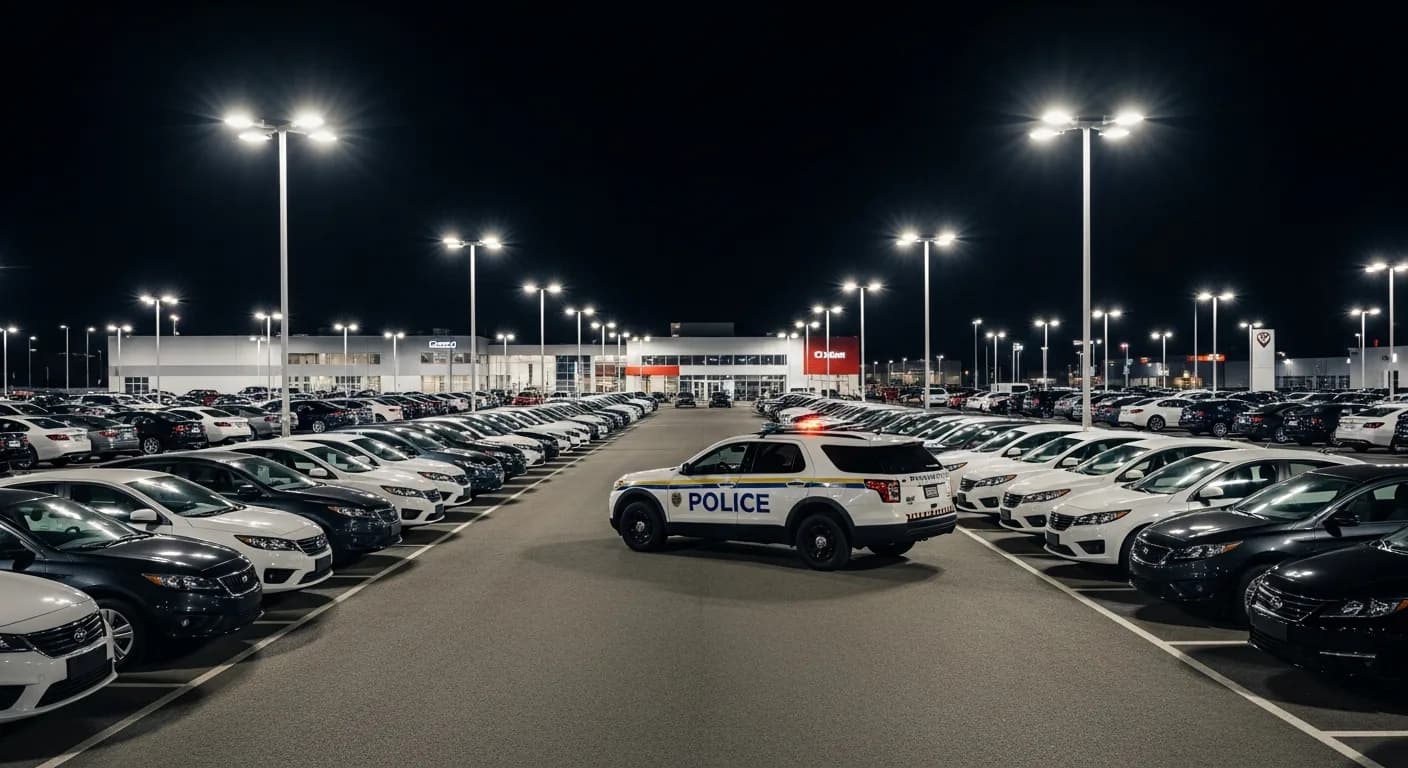
You cannot park every vehicle indoors. That single fact is the root of dealership vulnerability — inventory worth millions sits on an open lot for the 12–14 hours a day the business is closed. Thieves target unlocked units, cars with keys left in lockboxes, and (increasingly) whole vehicles driven off after a fob is cloned or a spare key is grabbed. Overnight is when the lot is a soft target: dark corners, no staff, and slow law-enforcement response in sprawling commercial districts.
Catalytic converters, wheels, and parts
The signature dealership crime of the last five years is the catalytic converter. Converters contain rhodium, palladium, and platinum — metals worth more per ounce than gold — and a thief can cut one out in a couple of minutes with a battery-powered saw. According to the National Insurance Crime Bureau (NICB), reported converter thefts peaked at roughly 64,000+ in 2022, fell to about 43,674 in 2023, and dropped again to around 14,036 in 2024, a decline the NICB credits to public awareness, police crackdowns, and lower metal prices. The critical caveat for a dealer budgeting security: this is a cyclical crime tied to commodity prices, and 2025–2026 data points to a rebound as precious-metal prices climb. A stolen converter nets a thief $50–$250 (up to ~$800 on a hybrid), but replacement at a dealership averages roughly $2,300–$2,500 per vehicle — and a crew can hit a dozen units in one night. Wheels, tires, tailgates, and airbags are stolen from lots for the same reason: fast to remove, easy to fence.
Test-drive and showroom risk
The sales model requires handing keys to strangers. Test-drive fraud — a "buyer" who never returns, or who swaps a real car for a straw-purchase scheme — is a persistent loss channel, as is showroom "grab" theft of accessories, laptops, and merchandise. Well-run dealers photograph a driver's license, verify insurance, and send a salesperson on every drive; a visible guard presence in the showroom reinforces that these steps are non-negotiable.
Keys and the finance office
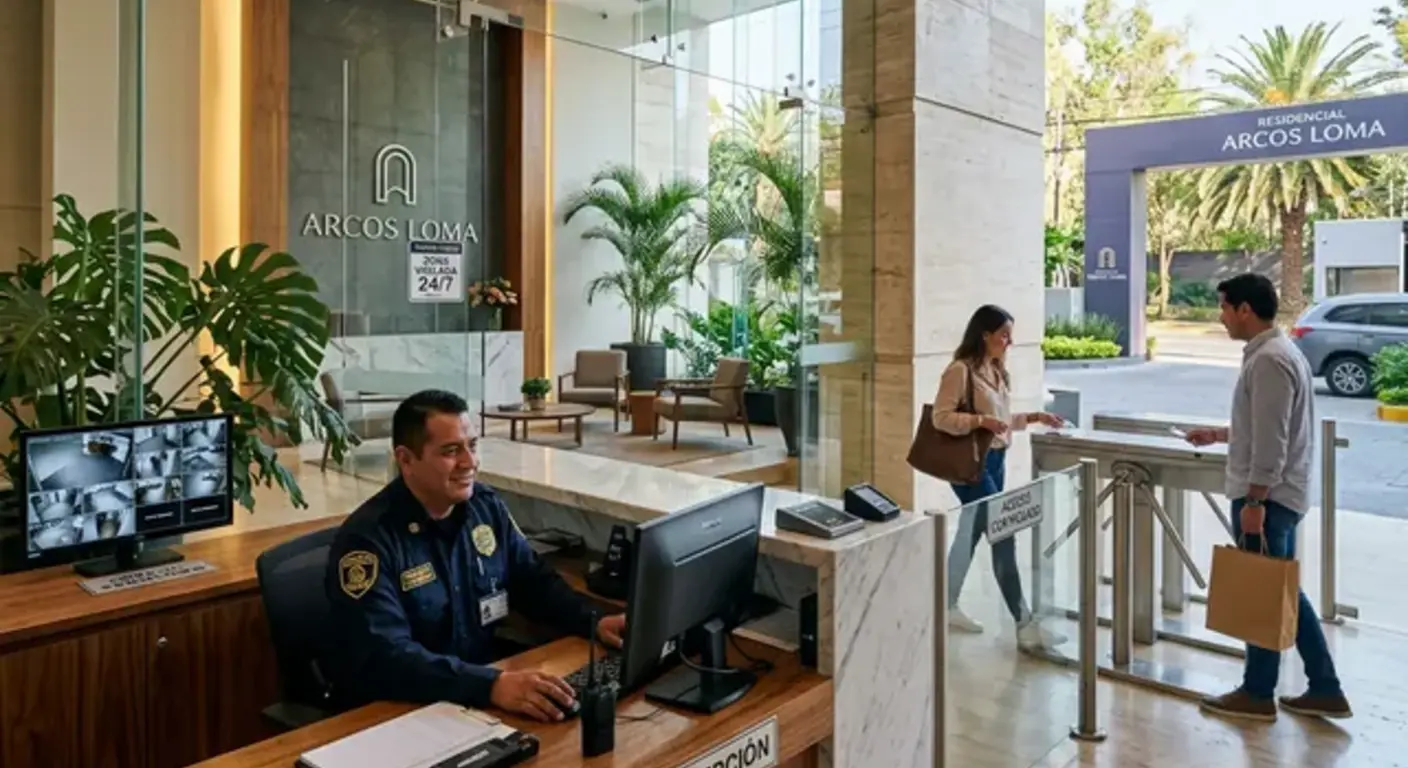
Two internal points deserve dedicated attention. Keys are the whole game — a managed key-control cabinet (electronic, audited, PIN-access) prevents both external theft and internal shrinkage. The finance and insurance office, meanwhile, handles Social Security numbers, credit applications, and payment data; it needs access control, a monitored safe, and the same physical-security discipline you would apply to any office handling sensitive records. Dealers subject to the FTC Safeguards Rule already have obligations around protecting customer financial data, and physical security is part of that program.
The core security model for dealerships
The model that consistently works is mobile patrol + CCTV + gate, layered so each element covers the others' blind spots. No single layer is sufficient; together they turn a soft target into a hard one.
| Layer | What it does | Best for |
|---|---|---|
| Perimeter (gates, bollards, lighting, wheel locks) | Slows and deters entry; removes dark cover | Baseline for every lot |
| Video surveillance + active monitoring | Detects, records, and enables real-time intervention | Evidence + remote deterrence |
| Mobile patrol (marked vehicle, randomized) | Visible deterrent during the exposed overnight window | Cost-efficient after-hours coverage |
| On-site security guard | Continuous presence, access control, incident response | High-value lots, urban theft hotspots |
| Key control + finance-office access control | Stops internal loss and key-enabled drive-offs | Every dealership |
Video surveillance done right
Cameras are only a deterrent if someone (or something) is watching. Passive DVR footage helps you file a police report after the loss; monitored video — either a central station or AI analytics with live audio talk-down — actually prevents it. For dealerships, prioritize license-plate-capture cameras at entrances, wide coverage of the back rows where converter theft happens, and thermal or low-light units for unlit sections. Camera systems are covered in more depth in our retail loss-prevention guide, and the physical-inventory logic carries over from warehouse and industrial security, where the same "high-value goods on an open footprint" problem drives design.
Mobile patrol vs. a dedicated guard
The trade-off is coverage versus cost. A dedicated overnight guard gives you continuous eyes and immediate response but costs the most. Mobile patrol — a marked vehicle making randomized checks several times a night — delivers a strong visible deterrent at a fraction of the price, which is why most dealerships anchor their after-hours plan on it. The randomization matters: a patrol that arrives at exactly 2:00 a.m. every night is a patrol thieves plan around.
When to add armed coverage
Most dealership theft is property crime committed by people who flee when confronted, so unarmed guards and patrols handle the vast majority of scenarios. Consider armed security only if your lot is in a high-crime corridor, you've had armed confrontations, or you're protecting exotic/high-line inventory. Armed service costs more and raises the liability profile; it should be a deliberate decision, not a default.
What car dealership security costs
Pricing depends on lot size, location, hours of coverage, and whether you go human, electronic, or (ideally) both. Typical 2026 US ranges:
| Service | Typical cost | Notes |
|---|---|---|
| Unarmed overnight guard | $25–$35/hour | ~$300–$450 for a 12-hour night shift |
| Armed guard | $35–$55/hour | High-risk lots only |
| Mobile patrol (contract) | $250–$600/night | Shared across multiple stops lowers per-visit cost |
| CCTV system (install) | $3,000–$15,000+ | One-time; scales with camera count/analytics |
| Live/AI video monitoring | $200–$800/month | Per site, depends on hours and camera count |
For a full breakdown of guard pricing and how coverage hours drive the number, see how much security costs and our mobile patrol cost guide. To model your specific lot, run the numbers in the security cost calculator. The economics usually favor the hybrid model: a single serious converter-theft night ($2,300+ per vehicle across several units) can exceed a month of patrol coverage, so the deterrent tends to pay for itself.
A buyer's checklist for hiring dealership security
- Verify the license. Every state that regulates guards requires the company and its officers to be licensed; confirm it before you sign. Our guide on verifying a security company's license walks through the state-by-state checks.
- Demand a certificate of insurance. Require general liability (and for armed service, an appropriate policy) naming your dealership as additional insured. See what to check on a COI.
- Insist on post orders. Written instructions covering lot tours, key-lockbox checks, test-drive protocols, and who to call in an incident.
- Get verifiable patrol logs. GPS/checkpoint-scanned tour reports, not a vendor's word.
- Match coverage to your exposure window. Don't pay for a daytime guard if your losses happen at 3 a.m. — put the spend where the risk is.
- Layer, don't substitute. Cameras plus patrol plus lighting beats any single expensive measure.
The full vetting process is covered in how to hire a security guard company, and you can compare licensed providers in your area on our directory.
Don't skip the free deterrents
Before you add headcount, close the cheap gaps. Trim landscaping that gives cover, upgrade to bright LED lot lighting, install wheel locks and converter-etching or cages on high-target units, fence and gate the back rows, and stamp VINs on converters. Industry groups including the National Automobile Dealers Association back the federal Preventing Auto Recycling Theft Act (PART Act), which would fund VIN-stamping and criminalize converter trafficking — worth tracking, and a free deterrent you can implement now via a local stamping program. These measures cost little and make your lot the harder target on the block, which is often all it takes to send thieves elsewhere.
Buyer takeaway
Car dealership security is a layered-deterrence problem, not a shopping-list problem. Start with the free perimeter and lighting fixes, add monitored video surveillance for detection and evidence, and anchor your after-hours defense with randomized mobile patrol — stepping up to a dedicated or armed guard only where your specific risk justifies it. Lock down keys and the finance office as their own priorities. Then buy from a licensed, insured, local provider with verifiable patrol reporting.
Ready to protect your lot? Get matched with vetted, licensed security companies that cover auto dealerships in your area, or browse providers directly in our directory.
Frequently asked questions
How much does security cost for a car dealership?+
What is the best way to prevent catalytic converter theft at a dealership?+
Do I need armed guards at my dealership?+
Should I hire an on-site guard or use mobile patrol?+
How do I verify that a dealership security company is legitimate?+
Share this guide
Sources
- NICB — catalytic converter theft data (2022–2024 trend, ~14,036 in 2024)
- NICB — catalytic converter theft prevention and dealership guidance
- Kelley Blue Book — catalytic converter theft and ~$2,300 replacement cost
- NBC News — catalytic converter thefts decline after pandemic-era surge
- Congress.gov — S.2238, Preventing Auto Recycling Theft (PART) Act, 119th Congress
- Dealership Guy News — dealers/NADA back PART Act on converter theft