Data center security is the physical layer that keeps unauthorized people away from the racks. Here's the threat model, the layered access design to demand, and what a 24/7 program costs.
A data center is one of the highest-value, lowest-tolerance environments a security program can protect. Inside a single hall sits millions of dollars of customer hardware, tenant data governed by contracts and regulators, and uptime commitments measured in minutes per year. Yet the fastest way to breach that environment is rarely a firewall exploit — it's a person walking through a door they shouldn't. Strong data center security is the physical layer that keeps unauthorized humans away from racks, cages, and the power and cooling plant that keeps them running. This guide explains the threat model, the layered access design buyers should demand, the compliance frameworks that force those controls, and roughly what a professional guard-and-monitoring program costs.
Data center security is a layered physical-protection program: a hardened perimeter, tiered access zones with mantraps and multi-factor entry, a 24/7 licensed guard force, and a monitored security operations center (SOC) tied to camera and access-control systems. It exists to stop intrusion, tailgating, insider theft, and social engineering, and it is effectively mandatory to pass SOC 2, ISO 27001, and PCI DSS physical audits. Expect a manned site with round-the-clock coverage to run roughly $180,000–$450,000+ per year depending on post count, armed vs. unarmed staffing, and market.
The data center threat model
Before pricing guards or cameras, get precise about what you are defending against. Physical threats to a colocation or enterprise facility cluster into four categories, and each drives a different control.
Physical intrusion
The classic scenario: an outsider forces or defeats a barrier to reach hardware, cabling, or a network jack. Because a live network port or an unlocked console inside the data hall can bypass every logical control you own, perimeter hardening and locked, monitored zones matter as much here as anywhere. This is the same defensive logic behind warehouse and industrial security, scaled up to a facility where a single stolen drive can be a reportable breach.
Tailgating and piggybacking
The most common real-world failure is not a broken lock — it's an authorized person holding the door for someone who isn't. Tailgating defeats even biometric readers because the credential check happened, just not for the second body. Mantraps (interlocking two-door vestibules that admit one person at a time) and anti-passback logic exist specifically to close this gap, and a guard watching the entry point is the human backstop.
The insider threat
Employees, contractors, and cleaning crews already hold legitimate access. The risk is misuse: pulling a drive, photographing a rack layout, or propping a door. Controls here are procedural — least-privilege badge zoning, escorted access to sensitive halls, access-log review, and immediate deprovisioning tied to HR offboarding. In multi-tenant colo, one tenant's technician must never be able to reach another tenant's cage.
Social engineering
Attackers impersonate delivery drivers, HVAC vendors, fire inspectors, or "the new datacenter tech" to talk their way past reception. A trained guard force that verifies work orders, calls back the sponsoring tenant, and refuses to be rushed is the single most effective countermeasure — technology can't argue with a confident stranger, but a well-briefed officer can.
Layered access: how a secure facility is zoned
Serious data center security is built as concentric rings, so that defeating one layer only lands an intruder in the next controlled zone rather than at the racks. Each ring tightens the credential requirement and shrinks the population allowed through.
| Layer | Zone | Typical controls | Who's allowed |
|---|---|---|---|
| 1 | Perimeter / property line | Fencing, vehicle standoff/bollards, gate with credential or guard check, exterior lighting and cameras | Anyone with business on site |
| 2 | Building lobby / reception | Staffed reception, visitor registration, ID verification, badge issuance, turnstiles | Registered visitors and staff |
| 3 | Interior circulation | Badge-controlled doors, mantrap vestibule, anti-tailgating monitoring | Badged personnel by zone |
| 4 | Data hall entry | Multi-factor (badge + biometric), anti-passback, escort requirement for visitors | Authorized techs only |
| 5 | Cage / rack / cabinet | Locked cages, keyed or badge-locked cabinets, per-cage cameras in colo | Specific tenant/owner |
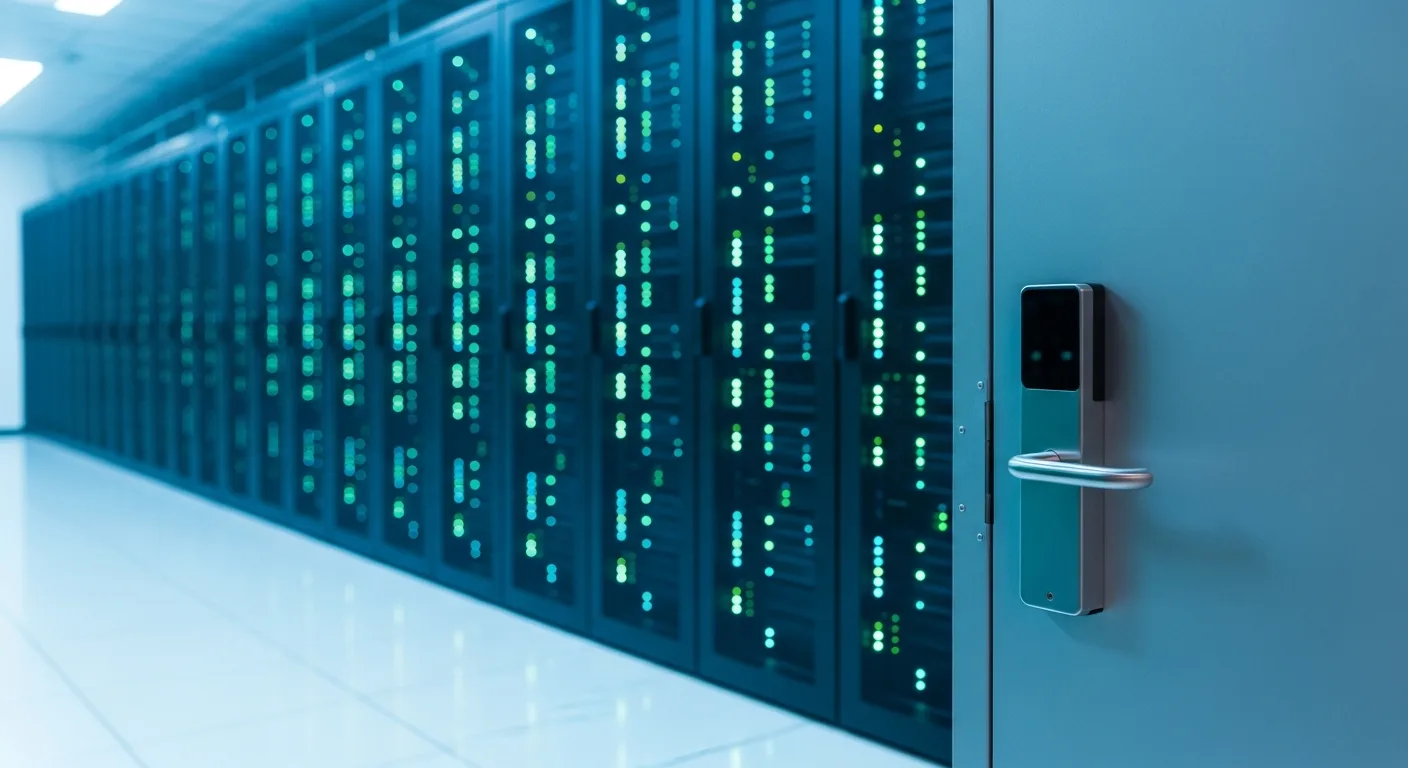
Two design details separate a real program from a checkbox one. First, multi-factor at the hall — something you have (badge) plus something you are (fingerprint, iris, or vein) — so a lost or cloned card alone can't reach the racks. Second, the mantrap, which physically enforces single-person entry and is where tailgating attempts die. Video coverage should be continuous from the fence line to the cabinet, and camera and access-control logs should be retained and tamper-protected.
The guard force and the 24/7 SOC
Cameras and card readers generate events; people decide what they mean and respond. A credible data center security program pairs technology with a staffed security guard force and a monitoring hub.
What the on-site officers do
- Staff the entry point 24/7, verify identity and work orders, and issue/collect visitor badges.
- Watch the mantrap and lobby for tailgating and refuse rushed or unverified entry.
- Conduct interior and perimeter rounds, checking that doors, cages, and loading docks are secured — the same patrol discipline offered as standalone mobile patrol at less critical sites.
- Escort vendors (HVAC, electrical, fire, cleaning) through sensitive zones and stay with them.
- Respond first to alarms, propped doors, and forced-entry events, and coordinate with law enforcement.
Whether officers should be armed is a facility-by-facility decision driven by the surrounding crime environment, insurance and tenant requirements, and the value at risk. Many colocation and enterprise sites run unarmed officers with strong access control and rapid police coordination; hyperscale, financial, or defense-adjacent facilities more often require an armed posture. This is a core part of the broader corporate security conversation and should be documented, not improvised.
The security operations center
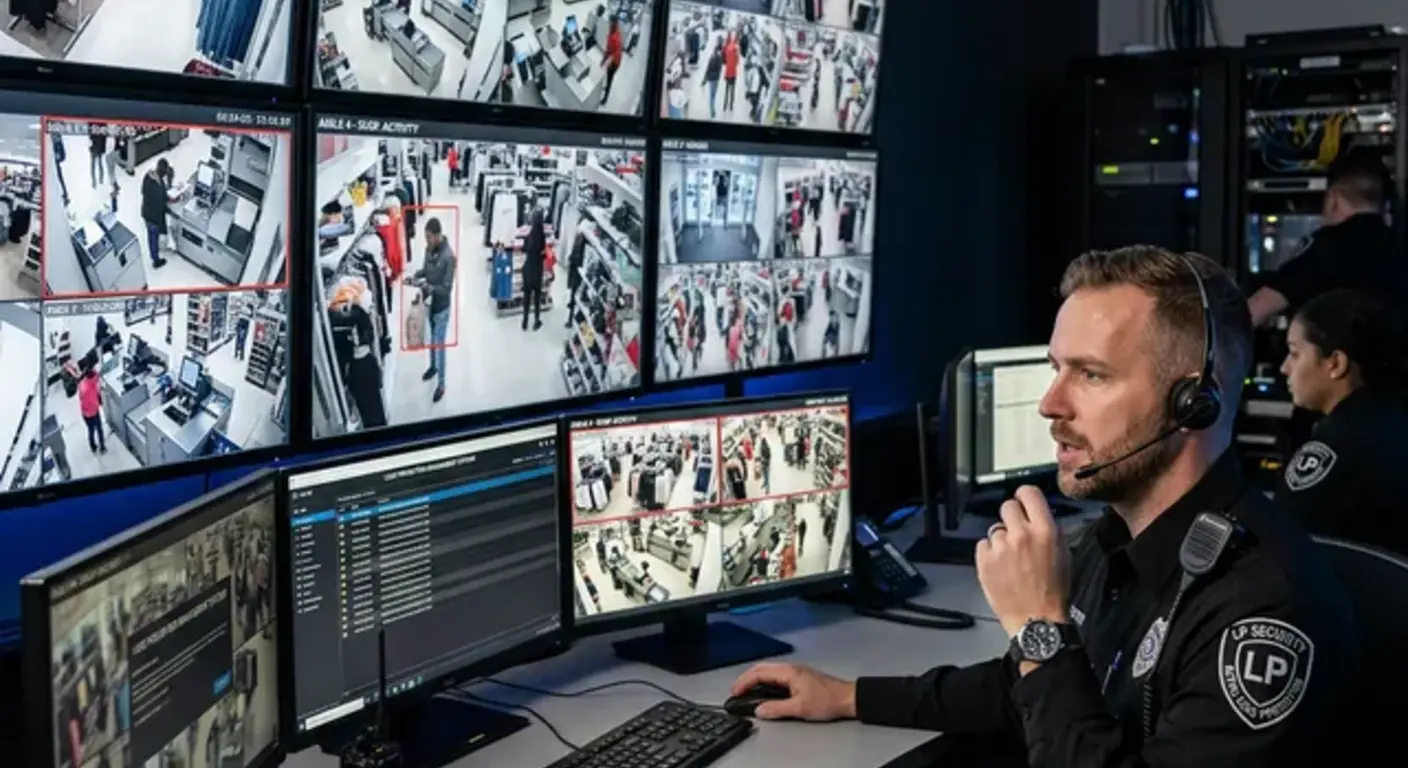
The SOC is the room where video surveillance feeds, access-control alarms, intrusion sensors, and environmental alerts converge. A staffed SOC — on-site at large facilities, or a monitored central station for smaller ones — turns raw signal into dispatch: it correlates a badge-in with a camera view, flags a door held open too long, and escalates. Buyers should confirm who watches the SOC overnight and on holidays, the escalation tree, and how quickly an alarm becomes a physical response.
Visitor and vendor management
Most breaches of a data center's physical layer walk in through the front door with apparent authorization. A disciplined visitor and vendor process is therefore non-negotiable and is explicitly tested by auditors:
- Pre-authorization: access requests are approved in advance and communicated to the guard force; in colo, the tenant authorizes their own people to the facility.
- Distinct badges: visitor credentials must be visually distinct from staff badges, and must be surrendered or deactivated on exit or expiration.
- Logged in and out: name, sponsor, purpose, and timestamps captured for every visit and retained.
- Escort in sensitive areas: visitors and vendors are accompanied inside data halls and never left alone with hardware.
Because vendor access is where social engineering and third-party liability meet, always confirm your security provider carries and can produce proof of coverage — see our guidance on the certificate of insurance for a security vendor before signing.
Compliance drivers: why buyers actually fund this
For most operators, the budget for data center security is unlocked not by fear but by an audit. Four frameworks do the heavy lifting.
SOC 2 — physical access controls (CC6.4)
The AICPA Trust Services Criterion CC6.4 requires an entity to "restrict physical access to facilities and protected information assets (for example, data center facilities, backup media storage, and other sensitive locations) to authorized personnel." In practice that means badge readers, surveillance, visitor logs, escort procedures, and access reviews — and for highly sensitive on-premise data centers, biometric controls and mantraps. If you host in colocation, your auditor will expect you to review the facility's own report and to prove you control who you authorize.
ISO 27001 — physical controls (formerly A.11, now A.7)
ISO/IEC 27001's physical and environmental controls lived in Annex A.11 under the 2013 version and were reorganized into Annex A.7 "Physical Controls" in the 2022 revision, which also added a dedicated control, A.7.4 Physical Security Monitoring, requiring monitoring systems to detect intrusions. Certificates against the 2013 structure expired after 31 October 2025, so buyers should map to the current A.7 controls — secure perimeters (A.7.1), physical entry (A.7.2), and monitoring (A.7.4) among them.
PCI DSS — Requirement 9
Any facility touching cardholder data inherits PCI DSS Requirement 9, "Restrict physical access to cardholder data." It mandates monitored entry via cameras and/or access-control readers, tamper protection on those systems, retention of camera feeds and/or access logs for at least three months, distinct visitor badges that are surrendered on exit, visitor logging, and restriction of publicly accessible network jacks. It is one of the most prescriptive physical-security mandates a buyer will encounter.
Uptime Institute Tiers — availability, and what they don't cover
The Uptime Institute Tier Classification System (Tier I Basic Capacity through Tier IV Fault Tolerant) grades a facility's power and cooling resilience — Tier III is "Concurrently Maintainable" and Tier IV is "Fault Tolerant," delivering up to 99.995% availability. Buyers should understand that the Tier standard rates infrastructure redundancy, not guard force or access control; a Tier IV facility can still have weak physical security. Use Tier ratings to judge uptime, and the frameworks above to judge intrusion resistance.
How data center security is bought and what it costs
Physical protection at a data center is procured as a bundle: a manned guard contract, an access-control and video system (often already installed by the facility), and SOC monitoring. The guard force is usually the largest recurring line item, because 24/7 coverage of even a single post is expensive.
Round-the-clock coverage of one post requires roughly 4.5 full-time officers to cover all shifts, weekends, and relief. At typical U.S. bill rates, a single 24/7 unarmed post runs on the order of $180,000–$300,000 per year; armed coverage and multi-post sites push well past that. The variables that move your number:
| Cost driver | Effect on price |
|---|---|
| Armed vs. unarmed officers | Armed typically adds several dollars per hour per post |
| Number of posts / coverage hours | Each additional 24/7 post ≈ another full staffing stack |
| Officer certifications & vetting | Cleared, background-heavy staffing costs more |
| SOC / central-station monitoring | Adds a monthly monitoring fee on top of guards |
| Local labor market | Major metros bill materially higher than rural |
For a grounded starting estimate, work through the specifics with our security cost calculator, and read the deeper breakdowns on 24/7 security guard cost and the broader corporate security guide. Treat any quote that skips post count, armed status, and coverage hours as incomplete.
Buyer's checklist and takeaway
Before you sign a data center security contract, confirm the vendor can deliver on the fundamentals below.
| Requirement | Confirmed? |
|---|---|
| Licensed guard company; officers individually licensed for your state | ☐ |
| Verified insurance (general liability + workers' comp), COI available | ☐ |
| Documented 24/7 coverage with relief and no gaps | ☐ |
| Written visitor/vendor SOP: pre-auth, distinct badges, logging, escort | ☐ |
| SOC / monitoring with a defined alarm-to-response escalation tree | ☐ |
| Access & camera logs retained (≥3 months) and tamper-protected | ☐ |
| Officer training on tailgating and social-engineering scenarios | ☐ |
| Controls mapped to your SOC 2 / ISO 27001 / PCI DSS obligations | ☐ |
The takeaway for buyers: data center security is won or lost at the human layer. Cameras, biometrics, and mantraps are necessary, but they only work when a trained, licensed, 24/7 guard force and a monitored SOC stand behind them — and when your visitor and vendor discipline is tight enough to survive an audit. Scope the posts you actually need, insist on compliance-aligned procedures, and always verify the company's license before signing.
Ready to protect your facility? Get free quotes from licensed, insured data center security providers in your area, or browse vetted security companies near you to start comparing coverage and rates today.
Frequently asked questions
What is data center security?+
How much does 24/7 security cost for a data center?+
What compliance standards require physical security for data centers?+
What is a mantrap and why do data centers use them?+
Do data center security guards need to be armed?+
Share this guide
Sources
- AICPA 2017 Trust Services Criteria (SOC 2, including CC6.4 physical access)
- SOC 2 CC6.4: Restrict Physical Access to Facilities and Assets — WatchDog Security GRC Wiki
- ISO/IEC 27001:2013 vs 2022 comparison (Annex A.11 → A.7 physical controls) — ANAB
- ISO 27001 Physical Controls of Annex A.7 Explained — IseoBlue
- PCI DSS 4.0 Requirement 9: Restrict Physical Access and Log/Monitor Access — Tripwire
- PCI DSS v4.0.1 Requirements and Testing Procedures (official)
- Uptime Institute Tier Classification System (Tier I–IV)
- Explaining the Uptime Institute's Tier Classification System — Uptime Institute Journal