
Cameras record; guards intervene. Here's the honest trade-off between security guards and cameras — cost, deterrence, response — and when a hybrid beats either alone.
When a business decides to protect a property, the choice usually gets framed as a single either/or question: hire people or install technology. The security guards vs cameras debate matters because the two tools solve different problems. A camera records what happened. A guard changes what happens. Getting this wrong is expensive in both directions — over-staff a low-risk site and you burn payroll; rely on cameras alone at a high-risk site and you end up with high-definition footage of a loss you could have prevented. This guide breaks down what each option actually does, where each fails, how the costs compare at a high level, who carries the liability, and why the answer for most buyers is not one or the other but a deliberate blend.
Cameras deter casually and document reliably; they cannot physically intervene, and someone still has to watch and respond to them. Guards deter strongly and intervene in real time, but cost far more per hour and can't be everywhere at once. For most commercial properties the winning setup is a hybrid: cameras for 24/7 coverage and evidence, plus a human layer — on-site guards where risk is concentrated, or mobile patrol and remote video monitoring where it's spread out. Choose guards when you need real-time intervention and presence; choose cameras when you need coverage, evidence, and deterrence at scale; combine them when you need both.
Security guards vs cameras: what each one actually does
The cleanest way to reason about the security guards vs cameras question is to separate two jobs that people constantly conflate: deterrence (stopping something before it starts) and intervention (stopping something in progress). Both tools deter. Only one intervenes.
What cameras do well — and what they can't do
A modern CCTV system provides continuous, tireless coverage across multiple angles, timestamps every event, and creates evidence that holds up with police and insurers. Visible cameras deter opportunistic actors who don't want to be recorded, and analytics (motion zones, line-crossing, license-plate capture) can flag events in near real time. For scope, angle count, and system design, see our video surveillance and CCTV guide.
What a camera cannot do: it can't walk toward a threat, ask someone to leave, unlock a door for an employee, render aid, or make an arrest. It doesn't stop a theft in progress — it documents it. And a camera only has security value if someone is actually watching the feed and able to act on it. An unmonitored camera is a forensic tool, not a preventive one.
What guards do well — and what they can't do
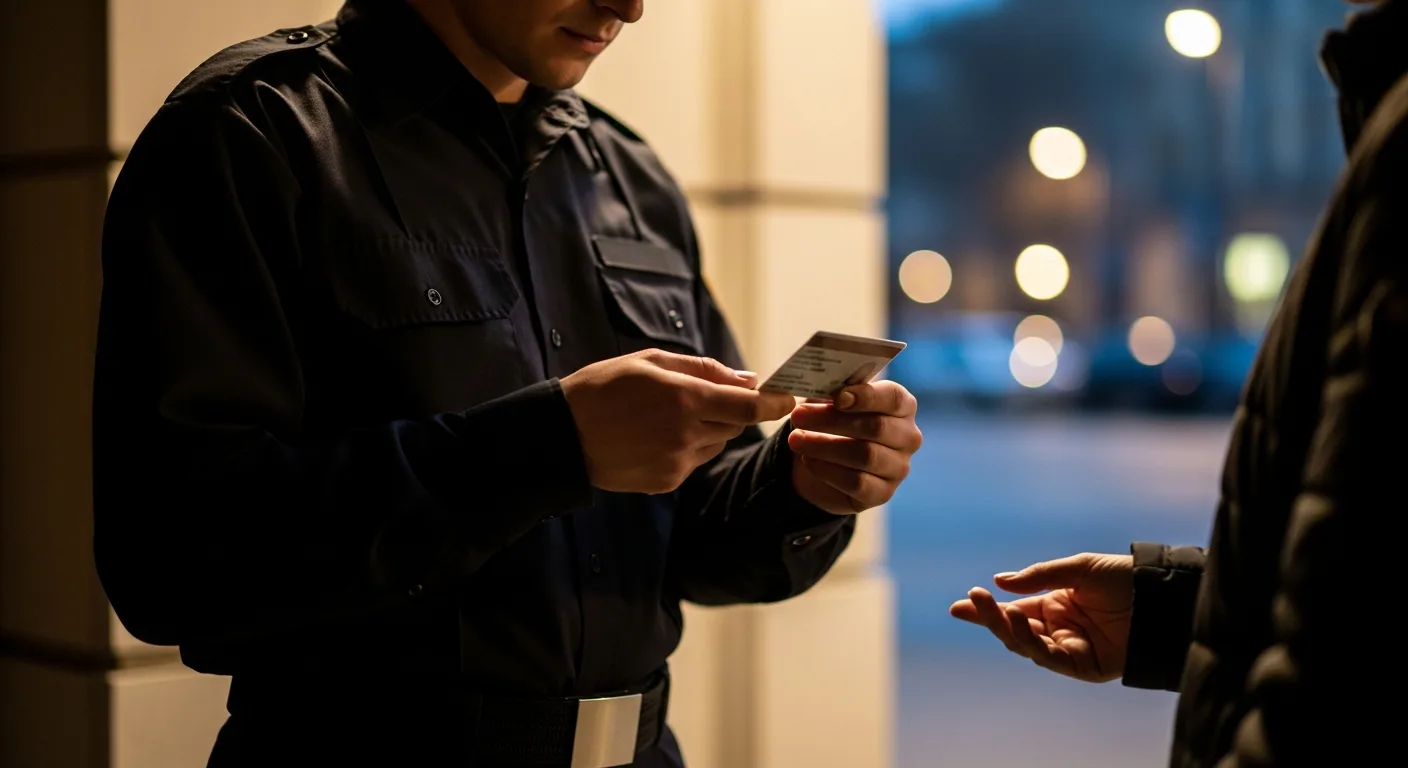
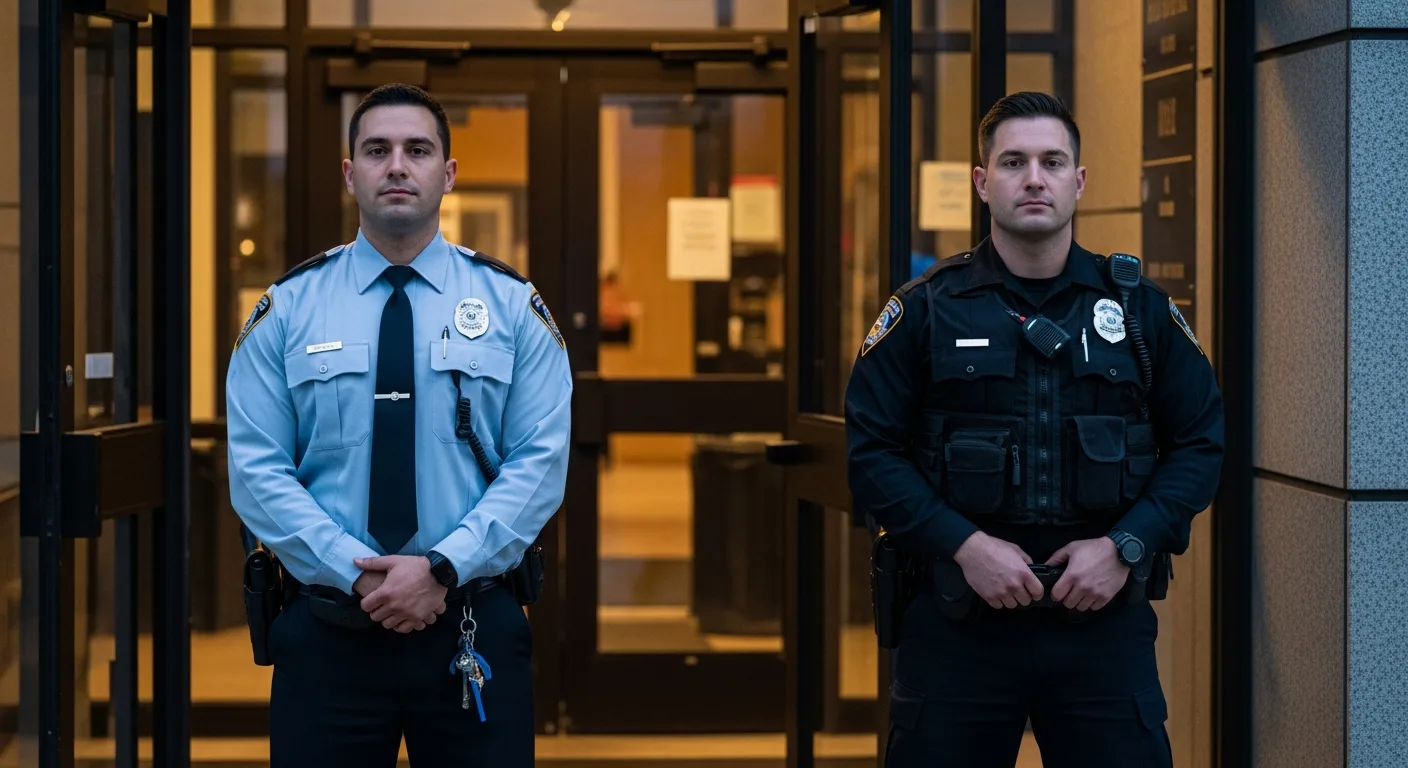
A guard is a decision-making, physically-present deterrent. Human presence discourages a far wider range of behavior than a lens does, and a guard can respond in the moment: confront trespassers, control access, de-escalate a dispute, escort staff, call and coordinate with police, and document an incident from the inside. Explore the role scope on our security guard services page, or step up to armed security for higher-threat environments.
What a guard cannot do: be in ten places at once, stay equally alert across a 12-hour shift, or provide the wide, always-on evidentiary record a camera grid delivers. One officer covers one post. Guards also carry legal weight that cameras don't — their powers to detain are limited, and their use of force is tightly regulated. More on that below.
Deterrence vs intervention: the decision that drives everything
Ask one question about your property: if something goes wrong, do you need someone to act, or do you need to know what happened? If a five-minute delay is acceptable and your real need is evidence plus casual deterrence, cameras carry most of the load. If a five-minute delay means injury, major loss, or a safety incident, you need a human who can intervene — a guard on site, or a patrol/remote-guarding response.
| Capability | Cameras | Guards |
|---|---|---|
| Passive deterrence | Moderate (visible units) | High (human presence) |
| Real-time intervention | None | Yes |
| Continuous 24/7 coverage | Yes, all angles | Per post, per shift |
| Evidence / documentation | Excellent | Good (reports, testimony) |
| Access control & escorts | No | Yes |
| Medical / emergency response | No | Yes |
| Ongoing monthly cost | Low after install | High (labor) |
The cost trade-off at a high level
The economics are the reason most buyers can't just "do both, everywhere." Labor is the dominant cost of security, and it recurs every single hour a post is staffed. As a 2026 US planning range, an unarmed guard runs about $22–$35/hr — roughly $8,000–$12,800 per month for a single staffed 12-hour post — and armed officers run about $30–$48/hr. Because no one works 24 hours, a genuine round-the-clock post needs 2–4 officers in rotation to cover shifts, days off, and relief; see how that math builds in our 24/7 guard cost breakdown. If you want a department-sanctioned uniform with real arrest authority, off-duty police typically run about $40–$100+/hr at rates the department sets.
Cameras invert that curve. An installed commercial CCTV system commonly lands around $1,000–$5,000 for roughly 4–10 cameras — a capital cost up front, then low ongoing spend for storage, maintenance, and monitoring. Between the two extremes sits mobile patrol, which spreads a human response across time and space at roughly $600–$2,500 per property per month. Treat every figure here as an estimate — the real number depends on hours, headcount, risk, and market. For the full picture and how these pieces stack, use our complete security cost guide, and don't duplicate the deep camera pricing math that lives in our security camera installation cost guide.
Liability: the part buyers underestimate
Cameras and guards don't just differ in capability — they differ in legal exposure. A guard is a person acting on your behalf, which creates duties and risks a camera never will. Guards have limited, jurisdiction-specific authority; understand it before you deploy one via whether security guards have arrest powers and the use-of-force law. Mishandled intervention can turn a loss-prevention event into a lawsuit.
Cameras carry a quieter but real liability the other way: negligent security claims often hinge on whether a property owner took reasonable measures given foreseeable risk. Footage of a preventable incident, or a documented pattern of prior events you didn't respond to, can cut against you — see negligent security liability. Whichever mix you choose, the vendor must be properly licensed and insured. Always confirm the company's state license and collect a current certificate of insurance naming your business — this is non-negotiable when a human is involved.
The hybrid that usually wins
Framing it as guards or cameras is a false choice for most commercial buyers. The strongest, most cost-efficient posture layers them so each covers the other's blind spot:
- Cameras as the always-on backbone — continuous coverage, evidence, and casual deterrence across the whole property, at low ongoing cost. See video surveillance services.
- A human layer for intervention — an on-site guard where risk and value concentrate (a lobby, a cash room, an entrance), or mobile patrol plus remote video monitoring where risk is spread thin across a large or after-hours site.
Remote guarding is the connective tissue: a monitored camera grid with a live operator who can talk down intruders over speakers and dispatch a patrol or police on verified events. It buys much of a guard's intervention value without a full-time post at every corner — the classic "cameras do the watching, humans do the acting" split, sized to your actual risk map.
Choose X when… a buyer's framework
| Your situation | Lead with |
|---|---|
| Need real-time intervention, access control, or visible on-site presence | On-site guards (armed if threat warrants) |
| Wide-area coverage, evidence, and deterrence on a budget | Cameras (monitored) |
| Large site or after-hours risk spread across many points | Cameras + mobile patrol / remote guarding |
| High-value, high-foot-traffic, or safety-critical location | Hybrid: on-site guards + camera backbone |
| Occasional, event-driven, or seasonal risk | Patrol or temporary guards + existing cameras |
Use it as a starting point, then pressure-test against your loss history, insurer requirements, and the specific hours your exposure peaks.
The buyer takeaway
Cameras and guards aren't competitors — they're a division of labor. Cameras give you coverage, evidence, and cheap deterrence; guards give you presence, judgment, and the ability to act. The security guards vs cameras decision comes down to whether your property needs to know or needs to respond — and most need some of both, layered by where the risk actually lives. Decide what a five-minute delay costs you at your highest-risk point, staff that point with people, and let cameras carry the rest.
When you're ready to price a real setup, don't guess. Read how to hire a security guard company, then get competitive quotes from licensed security companies near you so you can compare a guard plan, a camera plan, and a hybrid side by side on your actual property.
Frequently asked questions
Are security cameras cheaper than hiring guards?+
Can security cameras replace guards entirely?+
What is remote guarding, and how does it fit the guards-vs-cameras choice?+
Do I face different liability with guards versus cameras?+
When should a business use both guards and cameras?+
Share this guide
Related guides

Need to hire a security company?
Get free quotes from licensed security companies in your area.
Get free quotes