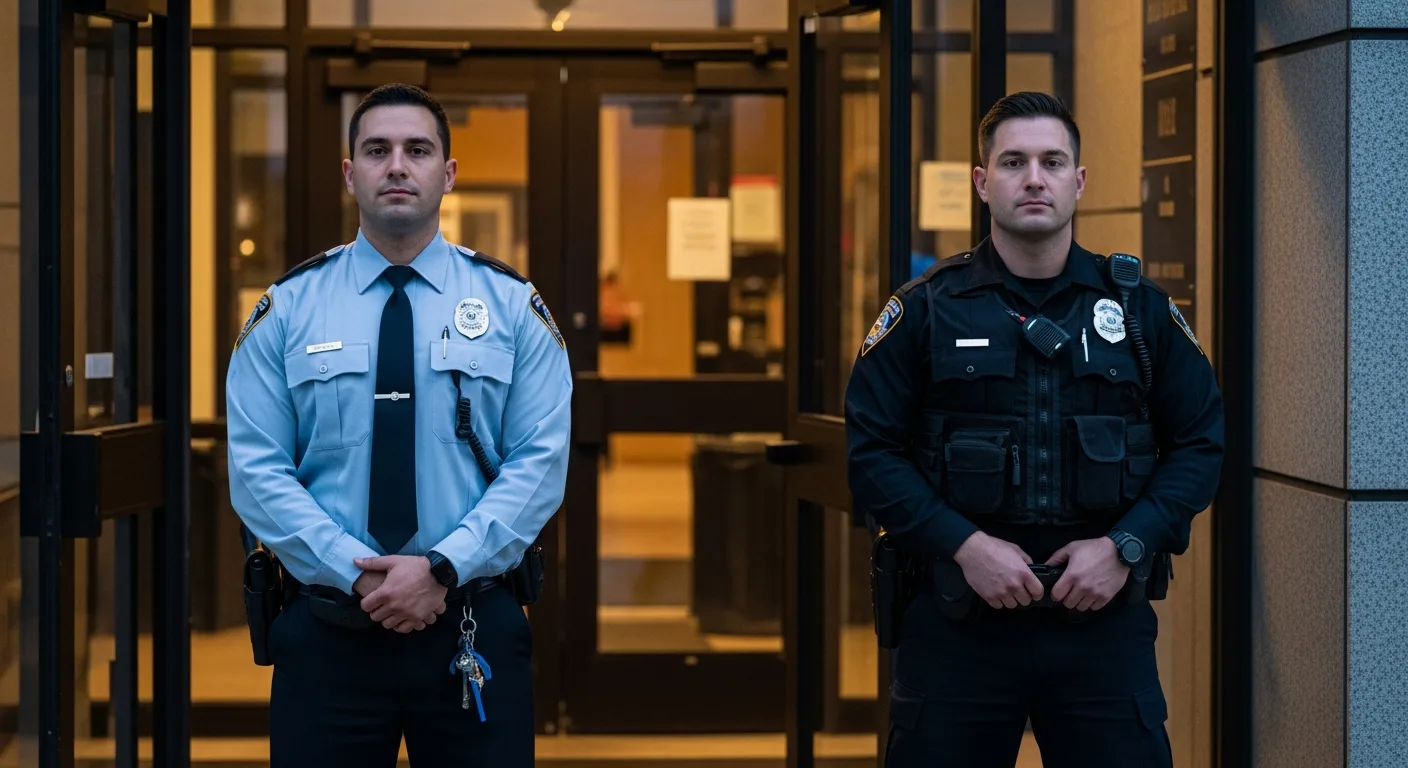
How many guards do you need? Start with the coverage window, count the posts, and apply the 24/7 math. Here's a repeatable method with worked examples.
There is no U.S. law that sets a universal guard-to-square-foot or guard-to-person ratio. You size a security team by working the problem in order: define the coverage window (which hours and days need protection), count the posts (fixed positions plus patrol routes) that must be staffed inside that window, then apply the shift math. The rule that surprises most buyers: one post covered 24/7 is not one hire — it takes roughly 4.2 to 5.4 full-time officers once shifts, relief, breaks, PTO, and turnover are covered. Everything else — site size, access points, foot traffic, incident history, asset value, break-relief law, and events — adjusts how many posts you need and whether they are staffed or roving.
"How many guards do I need?" is the wrong first question. The right one is "what am I covering, and when?" Answer that and the headcount falls out of the math. This guide gives you a repeatable method, two worked examples, a rough dollar range so the method lands on a budget, and a way to pressure-test any provider's proposal. Keep one thing in mind throughout: staffing ratios are planning guidance, not legal minimums. Almost no jurisdiction dictates how many officers a private site must deploy — but a few state labor laws, as you will see, quietly force an extra body onto your schedule whether you planned for it or not.
Start with the coverage window, not a headcount
A "coverage window" is simply the set of hours and days you actually need a security presence. Map it before you count people. A single-shift office might need coverage 7 a.m. to 7 p.m. weekdays — 60 hours a week. A distribution center running three shifts needs 168 hours a week, every week. The window drives everything downstream, because the difference between 60 and 168 hours is the difference between roughly two officers and roughly five for the same single position.
Be honest about the window. Buyers routinely under-scope the overnight and weekend hours where most loss, trespass, and vandalism actually happen, then wonder why daytime-only coverage did not stop it. If you are unsure where your real exposure sits, a quick incident-history pull (police calls for service to your address, your own prior loss reports) will show you which hours to protect. When you are ready to compare what that window costs, our security cost calculator and the breakdown in how much does security cost translate hours into a monthly figure.
Posts vs patrols — counting the positions you must cover
Once you know the window, count the posts inside it. A post is a responsibility that must be filled, and it comes in two forms:
- Fixed posts — a stationary position that has to be manned continuously: a lobby desk, a truck gate, a dock, an ER entrance, a control room. If the position going empty is a problem, it is a fixed post.
- Patrol posts — one officer covering a route or area on the move: a warehouse perimeter, a parking structure, a multi-building campus, an apartment community. Patrol trades constant presence at any one spot for broad coverage from a single body.
The distinction matters because it is the single biggest lever on headcount. A property with three doors does not automatically need three officers — one mobile patrol officer, or a fixed post at the main entrance backed by video surveillance on the others, may cover the same risk for a fraction of the cost. Extensive CCTV and access-control systems can let you convert fixed posts into patrols or eliminate them, because the camera provides the situational awareness the second officer used to. Count posts first; then decide which must be staffed bodies and which can be technology plus patrol.
- Where: Main lobby, Building A reception desk.
- When: Mon–Fri, 0700–1800.
- What they do: Badge visitors in, sign for deliveries, monitor door alarms, deny tailgating.
- Escalation: Call site supervisor first; 911 for any violence or medical emergency; log every incident in the DAR (daily activity report).
The 24/7 math: why one round-the-clock post needs about five officers
Here is the arithmetic buyers most often get wrong. A post staffed around the clock needs 168 hours of coverage a week (24 × 7). Divide by a 40-hour work week and you get 4.2 officers on paper — and that number already assumes perfect, never-absent humans, which do not exist.
The correction is the shift relief factor (SRF): the real number of full-time-equivalent officers needed to keep one post filled once you account for days off, vacation, sick time, training, and breaks. The most transparent published SRFs come from agencies that staff posts 24/7/365 and have to show their math — state departments of correction. The National Institute of Corrections Staff Analysis Workbook (2nd ed.) documents a relief factor of about 1.7 for a seven-day, single-shift post, which compounds to roughly 5.1 FTE for a post filled 24 hours a day, seven days a week. Nevada's 2014 ASCA staffing study reached the same result independently: it calculated that a 24-hour post requires 5.10 FTE whether it is staffed on 8- or 12-hour shifts. Private-sector workforce planners in adjacent fields, such as 24/7 call centers, reach for a comparable rule of thumb — roughly 5.4 FTE per continuously staffed seat once holidays, sickness, and breaks are covered. The absolute floor, if you allow zero relief cushion, is that 4.2 — but a five-officer team leaves only about 32 hours a week of slack for any absence, so it strains the first time someone takes vacation.
One honesty note on those numbers: the corrections and call-center SRFs come from higher-benefit public-sector and office settings, where generous PTO, paid training, and mandated breaks inflate the relief factor. A $16/hr unarmed contract guard typically gets far less PTO — but far higher turnover and call-out rates. The two effects roughly cancel, so private unarmed contracts still land in a similar 4.5–5.5 FTE range per 24/7 post, for different reasons. Treat ~5 as your planning anchor and press any provider who quotes less.
| Coverage window for ONE post | Weekly hours | Realistic officers (FTE) |
|---|---|---|
| Weekday day shift (e.g. 7a–7p, M–F) | ~60 | ~1.5–2 (see note) |
| Two shifts, 7 days (16 hrs/day) | 112 | ~3.5–4 |
| Around the clock (24/7) | 168 | ~4.2 floor; 5.1–5.4 practical |
Read the fractions correctly. A single officer legally covers 40 hours a week. A 55–60-hour post is more than one person can staff without either overtime or a second body — so the "0.5" in "~1.5 officers" is not one guy who stays late; it is the reliever or OT gap that covers the hours past 40, plus that officer's own days off, lunches, and sick time. Budget it as a real part-time or floating position. Read "1.5" as "one guy who stays late" and you will under-hire, run your primary into burnout, and lose them inside a quarter.
The takeaway: if a provider quotes you "one guard" for a 24/7 post, they are either running heavy overtime (which shows up as burnout and turnover) or the post will sit empty during relief. Two names on a schedule do not equal two-shift coverage once leave and sick days hit. This is also why round-the-clock protection costs what it does — see 24/7 security guard cost for the dollar impact.
Break-relief law: the driver that can force an extra body
The drivers: what pushes your post count up or down
With window and posts defined, these six drivers tell you whether you need more posts, staffed posts instead of patrols, or armed instead of unarmed officers:
- Site size and layout. Square footage, number of floors, and sprawl. One officer can only see and reach so much; multi-story or multi-building sites force additional posts or longer patrol loops.
- Access and egress points. Every door, gate, dock, and vehicle entrance is a control point. More active entrances during business hours generally means more fixed posts — unless access control and cameras consolidate them.
- Foot traffic and peak times. High visitor or employee flow demands entry control and crowd management, and peaks (retail holidays, shift changes, events) may need temporary surges rather than permanent headcount.
- Risk and incident history. Prior break-ins, assaults, and area crime rates raise the required presence. This is also where legal exposure lives (see below).
- Asset value and business type. Cash handling, pharmaceuticals, jewelry, firearms, or data raise the stakes and may justify armed security — a decision to weigh carefully using armed vs unarmed security guards, since armed officers carry different licensing and cost, per armed security guard cost.
- Events and temporary surges. One-time crowds follow their own math (below), not your standing post plan.
On the legal side, be precise about what is and is not required. OSHA does not mandate any specific number of guards. Under the General Duty Clause — Section 5(a)(1) of the OSH Act of 1970 — employers must keep the workplace "free from recognized hazards" likely to cause death or serious physical harm, but OSHA itself has stated that an employer is "always free to choose its own method of abatement." OSHA's workplace-violence guidelines are advisory, not enforceable standards, so security staffing is one option among several, not a command. The duty is triggered only when a hazard becomes recognized — for example, after prior violence or credible threats — which is why higher-risk settings like healthcare and late-night retail draw more scrutiny.
Where hard numbers do exist, they come from fire and life-safety codes, not security law. NFPA 101 (the Life Safety Code, §§12.7.6 and 13.7.6) requires at least one trained crowd manager for every assembly occupancy — defined as a gathering of more than 50 people — and additional managers at a ratio of roughly one per 250 occupants where the load exceeds 250. Two exceptions the code spells out and buyers often miss: the AHJ may reduce this ratio where an approved, supervised automatic sprinkler system is present, and the 1-per-250 requirement does not apply to occupancies used exclusively for religious worship with an occupant load of 500 or fewer. Separately, NFPA 25 (§15.5.2) requires one of several responses — evacuation, a dedicated continuous fire watch, or an approved ignition-control program — when a water-based sprinkler system is impaired for more than 10 hours in a 24-hour window. Always confirm these with your local Authority Having Jurisdiction, which can adopt a different code edition and impose stricter terms.
Turning officers into a budget: rough bill rates
The method converts hours into FTE; a budget needs a dollar figure. Providers quote a bill rate — what you pay per officer-hour, which covers the guard's wage plus the firm's overhead, insurance, supervision, and margin (always higher than the officer's take-home pay). Rates vary widely by market, shift, and risk, but the table below gives an order-of-magnitude starting point so "14 officers" becomes a monthly number. Treat these as planning ranges and confirm live figures with the security cost calculator and how much does security cost.
| Officer type | Typical bill rate ($/hr) | One 24/7 post (~168 hrs/wk) | Rough monthly spend |
|---|---|---|---|
| Unarmed | ~$20–35 | 168 hrs × rate | ~$14,500–25,500 |
| Armed | ~$30–50 | 168 hrs × rate | ~$21,800–36,400 |
Rule of thumb: multiply weekly billed hours by the bill rate, then by 4.33 for a month. A single 24/7 unarmed post at ~$27/hr runs roughly 168 × 27 × 4.33 ≈ $19,600/month. Scale that by your post count and you have a defensible budget line before you ever get a quote.
A repeatable method to estimate headcount
Run these steps in order every time — window, posts, shift math, drivers:
- 1. Define the window. List the exact hours and days that need a presence.
- 2. List the posts. Write a one-line post order (where / when / what / escalation) for each fixed position and patrol route inside that window.
- 3. Decide staffed vs technology. For each post, ask whether a camera, access control, a patrol pass, or remote monitoring covers the risk instead of a standing body.
- 4. Apply the shift math per post. Day-shift-only ≈ 1.5–2 FTE; two shifts/7 days ≈ 3.5–4; 24/7 ≈ 5. Multiply each post by its factor, and add break relief where state law (e.g. California) requires it.
- 5. Add supervision and surge. Add a site supervisor per shift once the site is large (see ratio below), and budget flex hours for peaks and events.
- 6. Pressure-test against risk and cost. Revisit the drivers — does incident history or asset value justify an extra post or armed coverage? — and convert the FTE count to a dollar figure.
Supervision: use a real span-of-control ratio
"Add a supervisor" is not a number, so here is one. Plan for one site supervisor (or shift lead) per shift on any post staffed around the clock, and apply a span-of-control benchmark of roughly one supervisor per 8–12 officers on a large site. A small office with one or two guards needs an account manager checking in, not a dedicated on-site supervisor. A campus with a dozen officers across three shifts needs a supervisor on each shift plus a site account manager over them. Supervision is not overhead you can cut to save money — it is what keeps post orders followed, DARs written, and relief actually showing up.
Remote video monitoring is a distinct fourth option
Beyond fixed post, patrol, and cameras-as-passive-awareness, virtual guarding (live remote video monitoring) is its own category. Trained operators watch your cameras in real time from an off-site center, issue live audio warnings through on-site speakers, and dispatch police or a mobile patrol when they see a real threat. The trade-off: it is far cheaper per hour than a standing body and never sleeps, but it cannot physically intervene, control access by hand, or provide the visible deterrence of a uniformed officer at a busy lobby. Used well, it replaces overnight patrol bodies on low-traffic perimeters and yards; used badly, it becomes an unwatched DVR. Weigh it as a real line item, not an afterthought.
Two worked examples
Example A — a small professional office
A single-floor, 40,000-sq-ft office, one main entrance, moderate visitor traffic, low crime area, no prior incidents. Window: weekdays 7 a.m.–6 p.m. (55 hrs/week). Posts: one fixed lobby/reception-security post; a locked, badge-controlled rear door needs no body. Math: a single daytime post at ~55 hours exceeds one person's 40-hour week, so it takes about 1.5 FTE — one primary unarmed guard for the 40 hours, plus a part-time or floating reliever for the extra 15 hours and for lunches, sick days, and vacation. The 0.5 is a real second person, not the primary working late. Verdict: roughly 1.5 FTE, no armed need, cameras on the rear and parking lot instead of a second post. At ~$27/hr unarmed, that is about 55 × 27 × 4.33 ≈ $6,400/month.
Example B — a 24/7 distribution facility
A 300,000-sq-ft warehouse, a staffed truck gate, a personnel/lobby entrance, and a perimeter, running three shifts. Window: 168 hrs/week. Posts: (1) fixed truck-gate post, (2) fixed lobby/access post during operating hours, (3) an overnight and weekend roving patrol of the perimeter and yard.
Baseline math: the truck gate at 24/7 ≈ 5 FTE; the lobby post at two shifts/7 days ≈ 4 FTE; the patrol post at 24/7 ≈ 5 FTE. That is roughly 14 officers plus a shift supervisor. Note the lobby runs only two shifts even though the plant runs three: the personnel entrance is locked overnight — production staff are already inside behind secured doors and no visitors or deliveries arrive — so there is simply no lobby traffic to staff on the graveyard shift.
Optimized math (show the work): that overnight gap is exactly where cameras and access control earn their keep. Fold the lobby's coverage into technology plus the existing patrol: put a card reader and video intercom on the personnel door so the roving officer can buzz in the occasional night or weekend arrival from their radio. That lets you drop the lobby's swing/evening shift and keep only a weekday daytime greeter post — the lobby falls from ~4 FTE to about 1.5 FTE, a saving of ~2.5, taking the total from ~14 to about 11–12. Push it all the way — the daytime lobby becomes a staffed reception only at peak hours, or the patrol absorbs visitor buzz-in entirely — and you approach the floor of ~10 (5 gate + 5 patrol, with the lobby handled by access control). Verdict: this is where the 24/7 math dominates, and where a strong surveillance package converts a 4-FTE staffed post into a card reader and a camera.
Events — a different calculation entirely
Standing-post math does not apply to one-off crowds. Event planners commonly start near 1 officer per 100 attendees and increase it for alcohol, VIPs, cash, or heightened threat, layered as fixed posts, roving officers, and supervisors. This is planning guidance, not a statutory ratio. Layer the NFPA 101 crowd-manager requirement on top — remember it triggers at 50 occupants. For anything ticketed or large, treat it as its own project — see event security.
How to pressure-test a provider's staffing proposal
A good proposal shows its work; a weak one hands you a headcount with no math. Ask:
- "Show me the coverage window and post orders." Every officer on the bill should map to a defined post and shift. If they cannot draw it, they are guessing.
- "What's your relief factor on the 24/7 posts?" If a round-the-clock post is staffed with fewer than ~4.5 FTE, ask who covers vacations and call-outs — the honest answer is usually overtime or an empty post. In break-relief states, ask specifically how meal and rest coverage is staffed.
- "Bill rate vs pay rate?" Chronic understaffing traces back to officer pay. Use bill rate vs pay rate to check whether the wage is high enough to actually retain the people they promised.
- "Is the AGENCY licensed, bonded, and insured?" Most states license the guard company itself (a PPO or private-patrol-operator license), separate from the officers. Verify that agency license is current, confirm the firm carries general liability and workers' comp, and demand a certificate of insurance (COI) that names your organization as an additional insured with a waiver of subrogation. Verify the firm with how to verify a security company license.
- "Are the individual OFFICERS licensed and trained?" Separate from the agency, confirm each officer holds a valid guard card via the state license lookup, that armed officers meet state armed requirements, and that everyone clears training minimums. Lock the liability terms down in your contract and insurance package.
- "How does the contract bill overtime, minimums, and holidays?" This is where shift-math savings quietly get eaten. Watch for minimum billing increments (e.g. 4-hour minimums on short patrol posts), holiday and OT bill-rate multipliers (often 1.5×–2×), and the gap between contracted hours and billed hours. A tight per-hour rate with a 2× holiday multiplier and 4-hour minimums can cost more than a higher flat rate. Get these in writing before you sign.
- "What can technology replace?" A provider that only ever adds bodies — and never proposes cameras, access control, or virtual guarding — is not optimizing your spend.
Understand the limits of what you are buying, too: private officers are not police — their arrest powers are limited, and if you need sworn authority you may be weighing off-duty police instead. When you are ready to compare vetted firms on the same scope, get quotes from local security companies, and use how to hire a security guard company to run a clean, apples-to-apples RFP. Whether you protect a warehouse, an apartment community, or a hotel, the method is the same: window, posts, shift math, drivers — then localize for the labor laws of the state where each post sits.
Frequently asked questions
How many security guards do I need per square foot?+
Why does one 24/7 guard post require about five officers?+
Does OSHA or any law require a specific number of security guards?+
Do meal and rest breaks change how many guards I need to hire?+
What should I verify about a guard company beyond the officers' licenses?+
Share this guide
Sources
- NIC Staff Analysis Workbook for Jails, 2nd Edition (shift relief factor methodology; ~5.1 FTE per 24/7 post at SRF ~1.7)
- Nevada Department of Corrections / ASCA 2014 Shift Relief Factor Narrative (24-hour post = 5.10 FTE; 7-day 8-hr post = 1.70 FTE)
- NFPA, 'Strategies for Crowd Management Safety' (assembly = 50+; 1 crowd manager minimum; 1 per 250; sprinkler reduction; religious-worship exemption to 500; §§12.7.6/13.7.6)
- NFPA, 'A Closer Look at Some Assembly Occupancy Requirements' (crowd manager thresholds and sprinkler/worship exceptions)
- Augustus v. ABM Security Services — California duty-free rest break ruling and AB 1512 union exception (analysis)