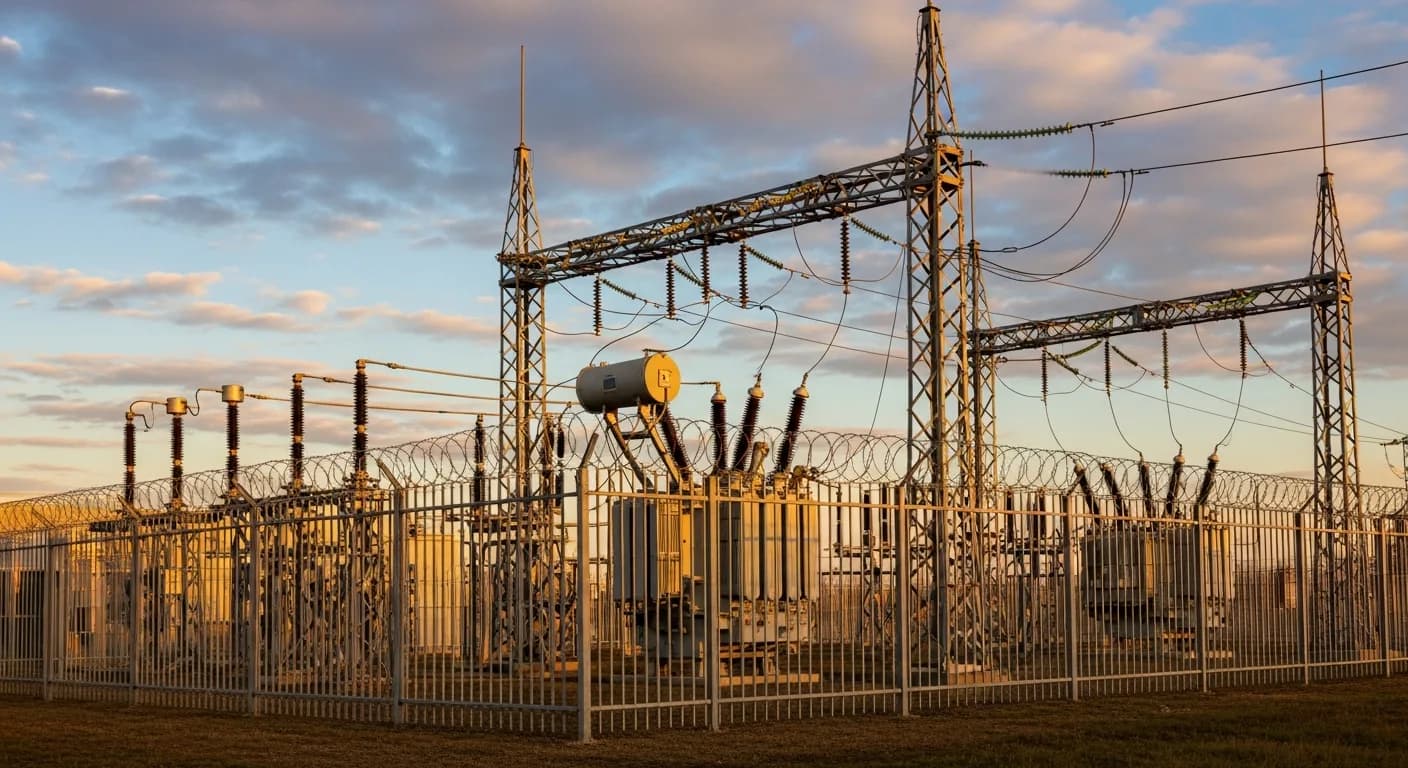
Substations, plants and pipelines face theft, vandalism and regulated physical-security duties (NERC CIP-014, TSA). Here's how critical infrastructure is protected — and what it takes.
Energy and utility assets are among the hardest targets in the security business — and the highest-stakes. A single substation knocked offline can black out a city; a breached pipeline valve station or water treatment plant is a public-safety event, not just a loss. Critical infrastructure security is the discipline of protecting these remote, high-value, regulated sites from theft, sabotage, and terrorism using a layered mix of guard force, patrol, surveillance, and hardened design. This guide is for the people who own that risk: utility operations managers, plant security directors, EPC contractors, and municipal water authorities who need to hire a qualified physical security partner and can't afford to get it wrong.
Protecting energy and utility sites means combining a screened, often armed guard force with remote video surveillance, thermal cameras, drone or vehicle patrols, and perimeter hardening — mapped to the standards that govern your sector (NERC CIP-014 for the bulk power grid, TSA guidance and directives for pipelines, EPA/AWIA for water). With U.S. utilities losing an estimated ~$920 million a year to copper theft and grid physical-security incidents rising sharply, the right vendor is one with utility/SCADA experience, armed licensing, and documented compliance support — not a generic guard company.
What critical infrastructure security actually covers
"Critical infrastructure" is a broad federal category (16 sectors under CISA), but for physical security buyers the demand concentrates in energy and utilities: electric transmission and distribution substations, generation plants, oil and gas pipelines and their compressor and metering stations, natural gas and LNG facilities, and water and wastewater treatment. What these sites share is a security profile that makes them uniquely hard to defend:
- Remote and unmanned. The U.S. grid alone has more than 55,000 substations, most of them fenced yards visited only during maintenance windows. Pipelines run for hundreds of miles through open country. There is rarely anyone on site to notice an intrusion.
- High-value, easily fenced materials. Copper grounding, bus bar, and wire can be stripped in under an hour and sold same-day. That's the theft driver.
- Catastrophic failure modes. Damage isn't proportional to what's stolen. A thief nets a few hundred dollars; the utility faces tens or hundreds of thousands in repairs plus outage liability.
- Regulated. Unlike a warehouse or storefront, what you must do is partly dictated by NERC, TSA, and the EPA — and auditors check.
That combination is why critical infrastructure security is a specialty, not a line item you hand to the cheapest bidder. It sits closer to corporate security and industrial protection than to retail loss prevention, and it usually pulls in armed officers given the sabotage and terrorism threat vectors.
The threat: copper theft, vandalism, and targeted attacks
The threat picture has gotten materially worse, and the numbers are not soft. NERC's E-ISAC reporting cited more than 3,500 physical-security breaches at grid facilities in its 2025 end-of-year data, up from about 2,800 two years earlier — with roughly 3% of incidents actually disrupting electricity service. Industry reporting has flagged a roughly tenfold rise in reported physical attacks on the grid over the past decade.
Copper theft is the volume driver, propelled by record commodity prices (copper pushed past $5.60/lb in 2025). U.S. utilities lose on the order of $920 million a year to copper theft, and the U.S. Department of Energy has estimated copper theft costs American businesses over $1 billion annually. The FBI has repeatedly flagged copper theft from electrical substations as a significant threat to critical infrastructure. The problem spans telecom too — the NCTA reported more than 15,000 destructive attacks on communication networks between June 2024 and June 2025.
Above the theft baseline sits a smaller but far more serious tier of deliberate sabotage and terrorism: gunfire attacks on substations, drone incursions, and bombings. These are the events NERC CIP-014 was written to address, and they're why a serious program plans for an adversary who wants to cause an outage, not just grab scrap.
The regulations that shape your program
You cannot buy critical infrastructure security intelligently without knowing which rules bind your sites. Three regimes dominate, and they are not equivalent — one is a mandatory reliability standard, one is a mix of voluntary guidance and mandatory (mostly cyber) directives, and one is a statutory assessment mandate.
NERC CIP-014 — the grid's physical security standard
CIP-014 is a mandatory, enforceable NERC Reliability Standard for the bulk power system. It targets the transmission stations and substations (and their primary control centers) whose loss could cause instability, uncontrolled separation, or cascading failure across an interconnection. It runs on six requirements: (R1) a periodic risk assessment to identify critical stations; (R2) third-party verification of that assessment within 90 days; (R3) notification to the operating entity; (R4) a threat and vulnerability evaluation of each identified site; (R5) development and implementation of a physical security plan including law-enforcement coordination; and (R6) an unaffiliated third-party review of the evaluation and plan. The population of truly CIP-014 "critical" substations is deliberately small, but the framework has become the de facto resiliency playbook that utilities apply to lower-tier substations too. A refinement project (CIP-014-4) tightening risk-assessment criteria and adding a proximity (½-mile) consideration has been advancing through the NERC ballot process.
TSA pipeline security — guidance plus directives
For pipelines, be precise about what's mandatory. After the 2021 Colonial Pipeline ransomware incident, TSA issued Security Directives (the Pipeline-2021-01 and 2021-02 series) for the most critical operators — but those directives are primarily cybersecurity requirements (incident reporting to CISA, a 24/7 cybersecurity coordinator, network segmentation, access control, continuous monitoring). Physical security for pipelines is addressed mainly through TSA's Pipeline Security Guidelines, which are voluntary "should" recommendations: run a criticality assessment, then a security vulnerability assessment for critical facilities, and adopt measures like access control, visitor monitoring, and periodic key inventories. If you operate pipeline facilities, your guard and patrol program should be built to those guidelines even though they aren't enforced the way CIP-014 is.
Water and wastewater
Community water systems fall under the America's Water Infrastructure Act (AWIA), which requires risk and resilience assessments and emergency response plans that explicitly include physical security. Many treatment plants layer this with local requirements and, increasingly, armed or patrolled coverage after high-profile intrusion attempts.
| Sector | Primary standard | Mandatory? | Physical-security core |
|---|---|---|---|
| Electric transmission / substations | NERC CIP-014 | Yes (enforceable) | Risk assessment, physical security plan, third-party review |
| Oil & gas pipelines / LNG | TSA SD Pipeline-2021 (cyber) + Pipeline Security Guidelines (physical) | Directives yes (cyber); physical guidance voluntary | Criticality & vulnerability assessment, access control, monitoring |
| Water / wastewater | AWIA (EPA) | Yes (assessment & plan) | Risk & resilience assessment, emergency response plan |
Building the layered program: guards, patrol, drones, and CCTV
No single measure protects a remote utility site. Effective programs layer deterrence, detection, delay, and response so that defeating one layer still triggers the next.
Guard force
Fixed-post security guards make sense at manned generation plants, control centers, and high-criticality substations — for access control, credential checks, and immediate response. Because the credible threat includes armed sabotage, many critical infrastructure posts specify armed security officers, which carries higher licensing, training, and insurance requirements you should verify before signing. Vet the officers as carefully as the company: utility posts often require background depth, drug testing, and sometimes site-specific SCADA-awareness or safety training.
Mobile and remote-site patrol
For a fleet of unmanned substations or a pipeline right-of-way, a standing guard at every point is economically impossible. That's where mobile patrol earns its keep — randomized, GPS-logged vehicle rounds across a cluster of sites, with a documented presence that both deters and creates a response capability. Patrol pairs naturally with alarm response: a monitored intrusion at 2 a.m. dispatches the nearest patrol unit.
Video surveillance, thermal, and analytics
Camera coverage is table stakes, but "we installed cameras" is not a program. What actually stops copper theft is video surveillance that is actively monitored — thermal and analytics cameras that detect a person crossing the fence line at night, a live operator who verifies the alarm and issues an audible talk-down, and a linked dispatch of patrol or police. Perimeter-hardening (anti-climb fence, locked grounding, motion-activated lighting) buys the delay that makes response matter.
Drones and autonomous patrol
Drone patrol has moved from novelty to mainstream for large or linear assets. A programmed drone can sweep a substation yard or a pipeline segment on a schedule or on alarm, covering ground no fixed camera sees and reaching a scene faster than a vehicle. Treat it as a force-multiplier layered on top of monitoring and human response, not a replacement for either.
How to hire the right critical infrastructure security vendor
Most guard companies are not equipped for utility work. Use this checklist to separate specialists from generalists before you request pricing.
| What to verify | Why it matters |
|---|---|
| State security license in good standing (guard + armed) | Baseline legality; armed work has stricter licensing you must confirm |
| Documented utility / energy / SCADA-site experience | These sites have safety and operational hazards a mall-cop vendor won't respect |
| CIP-014 / TSA / AWIA compliance support | You want a partner who can help satisfy the physical security plan requirement, not create audit gaps |
| Integrated monitoring + patrol + response capability | Copper theft is defeated by response, not recording |
| Certificate of insurance with adequate limits | Utility contracts demand high limits; verify additional-insured status |
| Officer vetting, training, retention data | High turnover on a critical post is a real vulnerability |
Two of those deserve extra rigor. Always verify the security company's license yourself rather than taking a logo on a proposal at face value, and demand a certificate of insurance naming your entity as additional insured — utility procurement will require it, and it's your first line of defense against negligent-security liability. Our full guide to hiring a security guard company walks through the RFP and vetting process step by step.
What it costs
Pricing for critical infrastructure security spans a wide range because the deployment models differ so much. A cluster of unmanned substations covered by monitored cameras plus mobile patrol runs very differently from a 24/7 armed post at a control center. As rough anchors: unarmed guard hours and armed guard hours have distinct market rates, mobile patrol is priced per-visit or per-route, and continuous armed coverage is the most expensive line by far. For real numbers, see our breakdowns on unarmed guard hourly rates, armed guard cost, 24/7 coverage cost, mobile patrol cost, and security camera installation cost, plus the overview at how much security costs. To model your own site mix, run the numbers in our security cost calculator.
The right frame isn't "cheapest guard hour." It's cost of coverage versus the cost of a single outage or a copper-theft repair that can run into six figures — plus the regulatory and reputational exposure of a documented security failure at a critical asset.
Buyer takeaway
Critical infrastructure security is a specialist discipline defined by remote, high-value, regulated assets and a threat environment that keeps escalating. The winning approach is layered — monitored thermal video and analytics for detection, mobile patrol and drones for reach, and screened (often armed) guards at your most critical manned sites — built explicitly around the standard that governs your sector, whether that's NERC CIP-014, TSA pipeline guidance, or AWIA. Above all, hire a vendor with real energy/utility experience, verified armed licensing, and the compliance support to keep you audit-ready.
Ready to protect your substations, plants, pipelines, or water facilities? Get quotes from licensed critical infrastructure security specialists, or browse vetted providers in our directory of security companies to start building your shortlist today.
Frequently asked questions
What is critical infrastructure security?+
Is NERC CIP-014 mandatory, and does it apply to my substation?+
Do TSA pipeline security directives require physical security guards?+
How do you stop copper theft at a remote substation?+
Should critical infrastructure guards be armed?+
Share this guide
Sources
- NERC CIP-014-3 — Physical Security Reliability Standard (official)
- NERC Project 2023-06 — CIP-014 Risk Assessment Refinement (CIP-014-4)
- TSA Pipeline Security Guidelines (physical security guidance)
- TSA Security Directive Pipeline-2021-02F (cybersecurity directive)
- IEEE Spectrum — Power Grid Attacks Push Utilities to Increase Security (NERC E-ISAC breach data, ~10x increase)
- CNN Business — Copper prices are rising, thieves are taking notice (copper theft costs, AT&T incidents)
- Security Industry Association — The Future of Utilities Security (55,000+ substations, threat trends)
Related guides



Need to hire a security company?
Get free quotes from licensed security companies in your area.
Get free quotes