Government buildings mix open public access with real threats. Here's how courthouses, city halls and agencies secure the front counter — screening, officers and procurement basics.
Government building security is a distinct discipline. A courthouse, city hall, permit counter, or DMV is a public building by law — it must stay open and accessible while also screening for weapons, managing angry or distressed visitors, protecting elected officials and clerks, and controlling access to sensitive back-office areas. You cannot simply lock the doors the way a corporate campus can. That tension — open to the public, hardened against threats — is what makes securing public facilities harder than almost any other environment a private security company will bid on. This guide explains how the model works, what the federal government uses as its blueprint, and how a city, county, or agency buyer should scope, price, and vet a contract.
Government building security combines armed or unarmed contract officers, visitor screening (magnetometers and X-ray at higher-risk sites), access control, and camera coverage, scoped to a documented risk level. The federal model is the standard to copy: the DHS Interagency Security Committee (ISC) assigns each facility a Facility Security Level (I–V), then applies a matching set of countermeasures. Most public buildings are guarded by private contract officers, not sworn police — the Federal Protective Service alone oversees more than 13,000 contract Protective Security Officers across roughly 8,500 federal facilities. Buyers should scope to a risk assessment, decide armed vs. unarmed by post, and buy through a formal procurement with license, insurance, and performance standards written into the contract.
Why government building security is its own problem
Public buildings carry a risk profile you don't see anywhere else. They are, by design, open to walk-in traffic — often people who are frustrated, in crisis, or there specifically because of an adverse decision (an eviction, a custody ruling, a denied claim, a tax lien). The threat is rarely theft; it's targeted violence, disruption, and the occasional coordinated protest. Layered on top: elected officials and public-facing staff are named, findable, and sometimes threatened, and the buildings themselves are symbolic targets.
That changes the job. A guard at a private warehouse or construction site is mostly deterring trespass and theft. An officer at a public counter is doing de-escalation, weapons screening, and workplace-violence prevention in front of a live crowd, dozens of times a day. The skill set overlaps with corporate security and hospital security — both also manage public access and volatile visitors — but the legal and procurement overhead is heavier because taxpayer money and public accountability are involved.
The federal blueprint: the ISC Risk Management Process
You don't have to invent a framework. The federal government already built one, it's public, and it scales down to a single county building. The DHS Interagency Security Committee (ISC) publishes The Risk Management Process for Federal Facilities (2024 Edition), the mandatory standard for all nonmilitary federal facilities. Even if you're a municipal buyer with zero federal obligation, it's the cleanest way to justify — and defend — what you spend.
The process runs in a fixed order:
- Assign a Facility Security Level (FSL I–V). Based on mission criticality, symbolism, population, and threat, each facility gets a level from I (low) to V (highest, like a critical national-security site). A small rural clerk's office is not a downtown federal courthouse, and the standard says so explicitly.
- Set the Level of Protection (LOP). The FSL maps to a baseline set of countermeasures — screening, barriers, access control, guard force, cameras. You either apply the baseline or a documented, customized level for facility-specific conditions.
- Test against the Design-Basis Threat. The ISC maintains a Design-Basis Threat report (some appendices are restricted/FOUO) describing the undesirable events countermeasures must address — active shooter, vehicle ramming, insider threat, and so on.
- Govern through a Facility Security Committee (FSC). Tenants, the security organization, and the owning agency jointly approve and fund measures.
For a buyer, the takeaway is simple: scope your guard contract to a written risk assessment, not to a gut feeling. An FSL-style determination tells you whether a post needs an armed officer, whether you need a magnetometer, and how many hours you're actually buying — and it gives your council or board a defensible paper trail.
The contract-guard model (and who actually stands the posts)
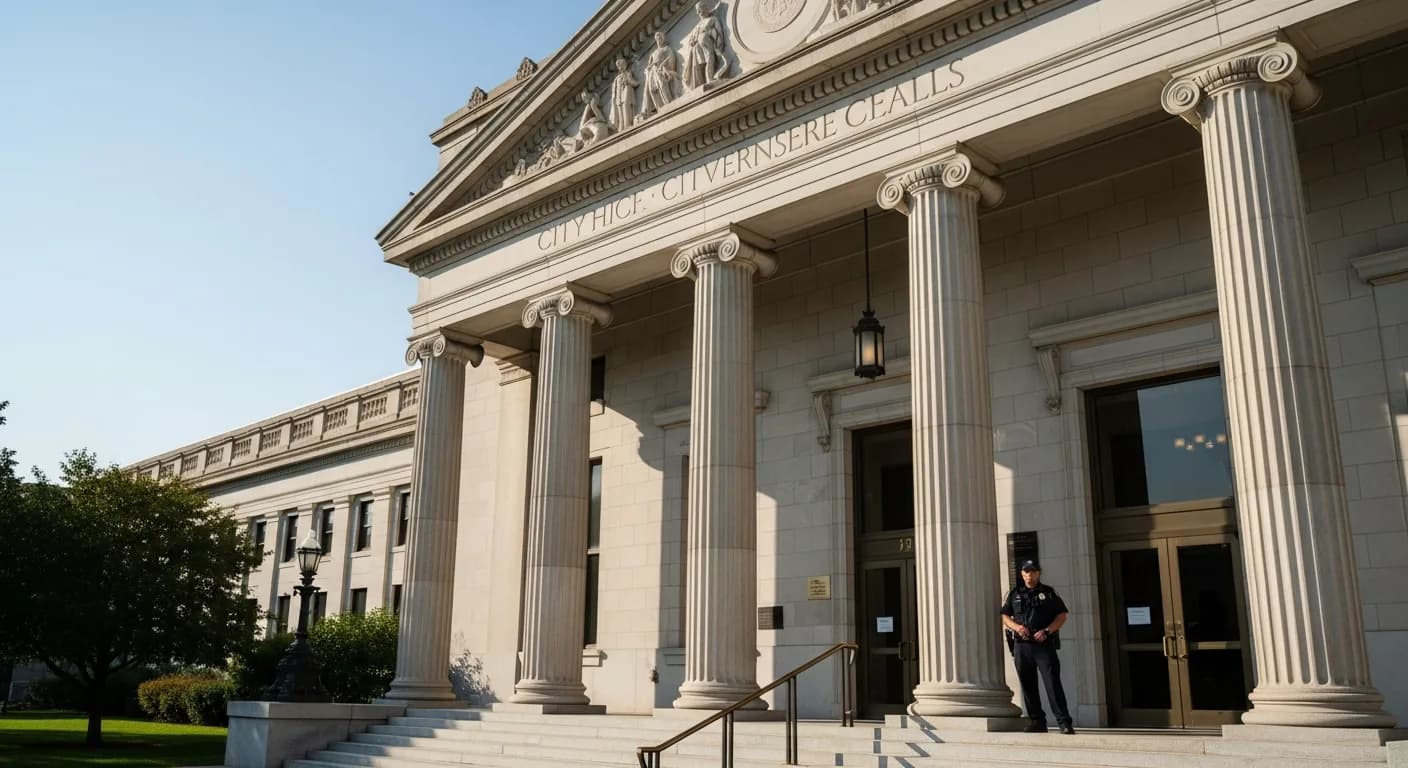
Here's the fact that surprises most first-time buyers: the officers at the door of a government building are usually not government employees. They are private security guards under contract. The Federal Protective Service (FPS), the DHS agency that secures federal buildings, employs roughly 900–1,300 sworn federal law enforcement officers — but it oversees more than 13,000 contract Protective Security Officers (PSOs) who do the day-to-day access control and screening. Per GAO, FPS used contract guards at about 2,500 federal facilities at a cost of nearly $1.7 billion in FY2024. FPS protects roughly 8,500 federal facilities and the ~1.4 million people who work in or visit them.
State, county, and municipal governments run the same play at their own scale: they contract with licensed private firms for uniformed security guards rather than pulling sworn police off the street for static posts, because it costs less and frees law enforcement for actual policing. The PSO or contract officer handles the routine — screening, access, incident reporting, escorts, first response — and calls in police for anything that escalates to a crime or an arrest.
Armed vs. unarmed: decide it post by post
This is the single biggest cost and liability lever in a government security contract, and it should be decided per post, not per building. A screening station where visitors could bring in a weapon, a courthouse handling criminal or family matters, or a benefits office with a history of threats generally warrants armed officers. A quiet administrative lobby, a records annex, or an after-hours access-control desk is often fine with unarmed officers plus cameras and a duress alarm.
| Factor | Lean unarmed | Lean armed |
|---|---|---|
| Public contact | Low / by appointment | High-volume walk-in counter |
| Nature of business | Records, admin, licensing | Courts, benefits denials, evictions |
| Threat history | No documented threats | Prior threats or incidents |
| Screening role | Access control only | Weapons screening at entry |
| Cash / evidence / firearms on site | None | Present |
| Relative cost | Lower | Higher (training, insurance, wage) |
Armed posts cost more for good reasons: higher wages, more training, more insurance, and more liability exposure. Expect the fully-loaded bill rate for an armed officer to run meaningfully above unarmed — see our breakdowns on unarmed guard hourly rates and armed guard cost for current ranges. If a post runs around the clock, model it with the 24/7 coverage math before you commit — three shifts a day, seven days a week, is roughly 336 hours a week per post.
Visitor screening: magnetometers, X-ray, and public access
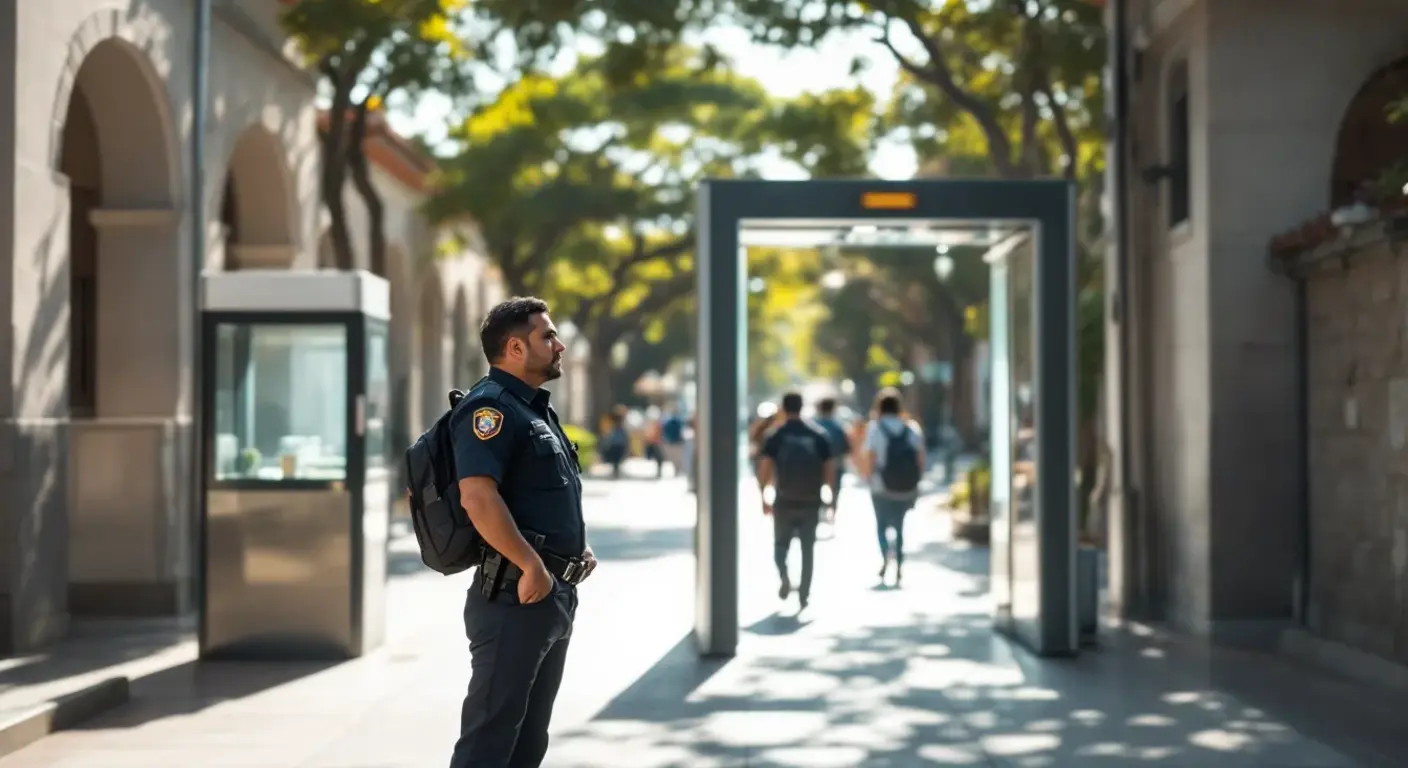
At higher-FSL buildings — courthouses especially — entry screening is the core countermeasure. That means a walk-through magnetometer, hand-held wands, an X-ray belt for bags, and trained officers who know how to run the line fast enough that the public isn't backed out the door. Screening is where public-access risk and security collide most directly: you're processing everyone, you can't profile, and the choke point itself becomes the thing an attacker studies. Good screening design keeps the queue outside the secured perimeter, controls the standoff distance, and has an armed officer positioned to cover the checkpoint.
Screening posts are labor-intensive — a single lane typically needs two to three officers to run properly (wand, X-ray monitor, response). Scope the officer count to throughput, not just to "one guard at the door," or you'll create a line so slow that people prop doors and bypass it. Cameras feed the whole operation: entry, queue, counters, back corridors, and parking should all be on video surveillance with retention long enough to support investigations and public-records or litigation requests.
Workplace violence: the counter is the front line
Public-facing government staff — clerks, caseworkers, benefits examiners, code inspectors — absorb a lot of hostility, and workplace-violence prevention is a legitimate part of the security scope, not an afterthought. Under OSHA, employers have a general duty to provide a workplace free of recognized hazards, and while OSHA has no dedicated workplace-violence standard, it enforces prevention through the General Duty Clause. Practically, that means panic/duress buttons at counters, ballistic or barrier glazing where warranted, clear sightlines, an officer who can reach a counter quickly, and a documented response protocol staff are actually trained on.
It also means the officer's job description leans heavily on de-escalation and behavioral awareness — spotting the agitated visitor before it becomes an incident. When you evaluate firms, ask specifically about de-escalation and workplace-violence training, not just guard-card minimums. Neglecting this isn't only a safety failure; it's a negligent security liability exposure for the agency.
Layered coverage: guards plus patrol plus cameras
A serious program doesn't rely on a static post alone. The strongest, most cost-efficient designs layer:
- Fixed officers at screening and access-control points during business hours.
- Roving/interior patrol covering corridors, garages, and multi-building campuses.
- After-hours mobile patrol for perimeter checks when the building is closed — far cheaper than a full overnight standing post, and often adequate for lower-FSL sites. Compare against the mobile patrol cost versus a dedicated overnight guard.
- Cameras and access control as the connective tissue, with monitored alarms and remote verification.
The right mix depends on your risk level. A small city hall might run one unarmed day post plus after-hours patrol and cameras. A county courthouse might run armed screening, roving patrol, and 24/7 camera monitoring. Model the options before you write the RFP — our security cost calculator gives a fast ballpark, and the full cost guide explains what drives the bill rate.
Procurement: how public buyers actually buy this
Government security is bought through formal procurement, and the contract is where you win or lose. Whether it's an RFP, an IFB, or a cooperative purchasing vehicle, build these into the solicitation and the awarded contract:
| Contract element | What to require |
|---|---|
| Licensing | Firm and every officer licensed in your state; armed officers separately permitted. Verify the license — don't take it on faith. |
| Insurance | General liability, and where officers are armed, adequate limits; you named as additional insured. Get a certificate of insurance. |
| Post orders | Written, site-specific duties, escalation, and use-of-force policy attached to the contract. |
| Training | De-escalation, workplace violence, screening equipment, active-threat response — documented per officer. |
| Staffing & QA | Minimum experience, background checks, supervisor ratios, and measurable performance standards (post coverage, incident reporting, response time). GAO has repeatedly flagged weak guard oversight — build audits in. |
| Wage compliance | Prevailing/Service Contract Act wages where applicable; a livable officer wage reduces turnover. |
One practical warning that shows up in federal audits: the cheapest bid is often the one with the highest turnover and the weakest oversight. Write measurable performance standards and the right to audit into the contract, and weight your evaluation toward quality, training, and supervision — not just the lowest hourly rate. For the full vendor-vetting workflow, see how to hire a security guard company.
Buyer takeaway
Government building security is a balance between mandated public access and real, targeted-violence risk — and the way to get it right is to copy the federal model at your own scale. Start with a written risk assessment in the spirit of the ISC's Facility Security Level process. Let that determine armed versus unarmed post by post, your screening design, and your officer count. Buy it through a formal procurement with license, insurance, training, and performance standards written in, and weight your award toward quality rather than the lowest bid. Layer fixed posts, patrol, and cameras so you're not paying for standing guards where a patrol and a camera would do.
Ready to scope a contract? Get competitive quotes from licensed firms, or browse security companies that serve government and municipal facilities in your area.
Frequently asked questions
Are government buildings guarded by police or private security companies?+
Do government facility security officers need to be armed?+
What standard should a city or county use to decide how much security a building needs?+
How is government building security bought — can we just hire a firm?+
What does government building security cost?+
Share this guide
Sources
- DHS Federal Protective Service — Operations (facilities, contract PSOs, population protected)
- GAO — Federal Facility Security: Challenges in Guard Performance and Oversight (contract guards at ~2,500 facilities, ~$1.7B FY2024)
- CRS — The Federal Protective Service and Contract Security Guards: A Statutory History and Current Status
- CISA — ISC Standard: The Risk Management Process for Federal Facilities (Facility Security Levels, Levels of Protection, Design-Basis Threat)
- CISA — Interagency Security Committee (mandate, Facility Security Committees, 2024 Edition)
- Federal Register — Protection of Federal Property (2025) (FPS authority, ~8,500 properties, ~1.4M people)