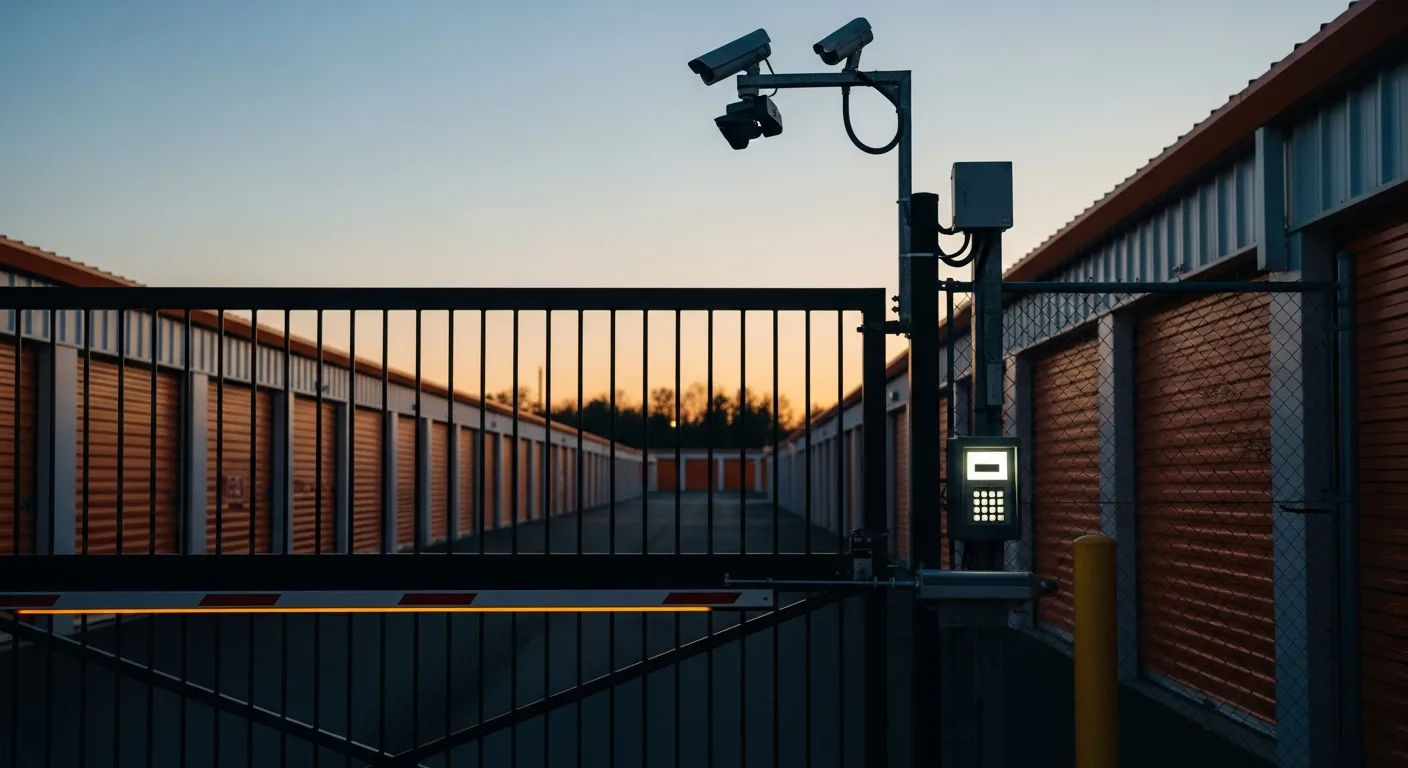
Self-storage runs on a low-staff model — gate access, cameras, and remote or virtual guarding. Here's how to secure a facility and deter break-ins without a full-time post.
Self storage is one of the leanest-staffed commercial real estate assets in America. A single manager often oversees a 60,000-square-foot property with hundreds of units, and many sites run unstaffed on nights and weekends entirely. That model keeps operating costs low and margins high, but it also creates a security gap that thieves have learned to exploit systematically. Break-ins, lock-cutting, wall-breaching, and fraudulent online rentals have made self storage security a board-level concern for owners and REITs, not just a line item. This guide breaks down how facilities actually get hit, what layered protection looks like, and why remote video guarding paired with mobile patrol has become the cost-effective backbone of a modern self storage security program.
Effective self storage security is a layered system, not a single guard. The core stack is: perimeter and gate access control with unique keypad PINs, per-unit door alarms, full CCTV coverage of drive aisles and interior corridors, and — most importantly for the low-staff economics — remote video monitoring with live audio talk-down backed by scheduled mobile patrol. This combination delivers 24/7 human-verified deterrence at roughly 40–70% less than an on-site overnight guard, which typically costs $4,000–$10,000 per month per post.
Why self storage is a soft target
The self-storage sector is enormous. The U.S. has well over 50,000 facilities by conservative counts (some industry trackers put the number above 67,000 once management contracts and small operators are included), spanning more than 2.1 billion rentable square feet and generating roughly $45 billion in annual revenue. The SSA's 2025 Self Storage Demand Study found that 12.6% of U.S. households used self storage in 2024, up from under 9% two decades ago. That growth has attracted organized theft crews alongside legitimate tenants.
Three structural factors make these properties attractive to criminals. First, low staffing: most facilities have one on-site person during business hours and nobody overnight, exactly when break-ins occur. Second, location: many sites sit in industrial parks or on the edge of town where a crew can work undisturbed. Third, valuable, portable, untraceable contents — tools, electronics, collectibles, and inventory sit behind a $15 padlock. Nearby verticals face the same profile; the tactics overlap heavily with the risks covered in our guides to warehouse and industrial security and construction site security, where low-density, high-value sites are similarly exposed after hours.
How break-ins actually happen
Understanding the attack patterns is the prerequisite to defending against them. The dominant methods reported by operators and manufacturers are:
- Lock cutting. The single most common method — a thief walks up with bolt cutters and a disc lock is gone in seconds. Cheap padlocks are the number-one vulnerability.
- Tenant infiltration and wall breaching. A criminal rents a legitimate unit, then cuts through drywall/partition panels or climbs over the top of the corridor walls to clear out every unit in the row from the inside — often invisible to aisle cameras.
- Reconnaissance rentals. Crews rent a unit purely to map camera blind spots, lighting gaps, and response times, then return to hit the weaknesses hard. This is why an estimated 57% of burglarized facilities report multiple break-ins.
- Fraudulent e-rentals. Online, contactless rental — great for conversion — lets theft crews obtain gate codes and building access with a stolen identity and no face-to-face contact. Investigators have flagged e-rentals as a leading enabler of the recent surge.
The scale is genuinely underreported. Self-storage burglaries frequently fall under the FBI Uniform Crime Reporting "hotel rule," which scores multiple units burglarized under one manager as a single offense. So when a crew hits 20 units and the manager files one police report, the national data records one burglary. A 2025 case in Memphis illustrates the real exposure: police reported one facility was struck at least 23 times in a single year, with burglars cutting locks, sawing latches, and entering through the roof — aided by inoperative exterior cameras and poor interior lighting.
The layered self storage security stack
No single control stops all four attack methods. A defensible program stacks physical, electronic, and human layers so that defeating one still leaves the others in play.
1. Perimeter and gate access control
The property line is your first filter. Perimeter fencing (and electric perimeter fencing for large outdoor RV/boat lots), a controlled vehicle gate, and — critically — unique keypad PINs per tenant are the baseline. Unique codes turn the access system into an audit log: every entry and exit is timestamped to an individual, which both deters insiders and gives investigators a suspect list. Anti-tailgating rules and gate cameras that read license plates close the "one code lets a caravan in" loophole.
2. Per-unit door alarms
Individual door alarms are what defeat the tenant-infiltration and lock-cutting attacks that aisle cameras miss. When a unit is opened without the corresponding PIN entry, the system flags an "unauthorized open" in real time. Tie those alarms to your monitoring center so an event triggers a live look-in rather than a next-morning discovery.
3. CCTV coverage that actually covers
The Memphis case is the cautionary tale: cameras that exist but don't work, or don't cover interior climate-controlled corridors, are worse than useless because they create false confidence. Effective coverage means the gate, every drive aisle, all building entrances, elevators, and — for multi-story and climate-controlled sites — interior hallways, with no dark corners and maintained lighting. Cameras are only a deterrent when they're monitored; unmonitored footage is a forensic tool used after the loss, not a prevention layer. Our breakdown of video surveillance systems and the real-world security camera installation cost covers spec'ing this properly.
4. Remote video guarding — the staffing model that fits
This is where self storage economics and security finally align. Remote (virtual) video guarding puts trained operators watching your cameras from an off-site monitoring center. AI analytics flag a person on the property after hours; a human operator verifies the threat and issues a live audio talk-down over on-site speakers — "You are on camera at unit 214, police have been notified" — before any lock is cut. Providers report deterrence in the 90%+ range the moment an operator speaks, because most storage thieves are opportunists who flee when they realize they're being watched in real time.
The cost case is decisive for a lean asset. An on-site guard runs roughly $20–$45 per hour, so a single overnight post lands at $4,000–$10,000 per month — often more than a small facility's security budget can bear. Remote monitoring for a self-storage site typically runs $200–$500 per month depending on camera count and hours, and one operator can watch multiple properties at once, covering every zone simultaneously instead of one guard walking one aisle. If you're weighing on-site coverage anyway, compare against our 24/7 security guard cost breakdown before committing.
5. Mobile patrol as the physical backstop
Remote guarding handles detection and talk-down; mobile patrol supplies the physical presence and response that cameras can't. Scheduled and randomized patrol visits — a marked vehicle, an officer checking gates, testing locks, and clearing corridors — add a visible deterrent, catch maintenance and lighting failures, and provide on-scene response when the monitoring center escalates. For most facilities the winning formula is a hybrid: remote monitoring covering the high-risk, high-cost overnight window, plus mobile patrol sweeps at randomized intervals. You get 24/7 human oversight and boots on the ground for a fraction of a standing guard post. See mobile patrol security cost for typical per-visit pricing.
Staffing models compared
| Model | Typical monthly cost | Coverage | Real-time deterrence | Best fit |
|---|---|---|---|---|
| Unmonitored cameras only | Hardware + ~$0 monitoring | Records everything, prevents nothing | None (forensic only) | Never sufficient alone |
| On-site overnight guard | $4,000–$10,000 per post | One zone at a time | Visible presence, physical response | High-value urban / regulatory need |
| Remote video guarding | $200–$500 per site | All zones simultaneously | Live talk-down, 90%+ deterrence | Indoor / corridor / multi-site |
| Mobile patrol only | Per-visit (varies) | Point-in-time, between visits gaps | Visible sweeps, gap between rounds | Small budgets, low-risk sites |
| Hybrid: remote + patrol | Monitoring + patrol visits | Continuous + physical response | Detection, talk-down, and boots on ground | Most facilities |
Buyer's due-diligence checklist
Whether you self-manage or hire a vendor, run every self storage security proposal against this list:
- Licensing. Confirm the guard/patrol company holds the correct state security license and that patrol officers are licensed — see how to verify a security company license.
- Insurance. Require a current certificate of insurance naming you as additional insured; our certificate of insurance for a security vendor guide lists the coverages and limits to demand.
- Negligent-security exposure. Understand your own liability if a tenant is harmed on a poorly secured property — the stakes are covered in negligent security liability.
- Monitoring specifics. Human-verified alarms, live audio capability, camera health monitoring, and documented incident reports for every alert.
- Access-control hygiene. Unique tenant PINs, e-rental identity verification, and immediate code deactivation on move-out or default.
- Vendor vetting. Follow a structured process — our guide on how to hire a security guard company walks through references, insurance, and contract terms.
What about armed guards and corporate portfolios?
The vast majority of self storage sites do not need armed security; the threat is property theft, not violent confrontation, and an armed post multiplies both cost and liability. Reserve armed or on-site security guards for high-crime urban locations, cash-handling offices, or where a specific documented threat exists. Multi-facility owners and REITs should treat this as a portfolio program under corporate security governance — standardized camera specs, one monitoring vendor across sites for scale pricing, and centralized incident data so you can spot the reconnaissance-rental pattern across locations before a crew works down the row.
Buyer takeaway
Self storage security is won by layering, not by hiring a single guard the P&L can't sustain. Lock down the perimeter with unique-PIN access control, alarm every door, cover every aisle and corridor with maintained CCTV, and put a trained human behind those cameras through remote video guarding with live talk-down — then back it with scheduled mobile patrol for physical presence and response. That hybrid delivers genuine 24/7 deterrence at a fraction of an on-site post, which is exactly why it has become the default for lean-staffed facilities.
Ready to price it for your property? Estimate your program with our security cost calculator, or get free quotes from licensed remote-monitoring and mobile-patrol companies that serve self storage in your area.
Frequently asked questions
How much does security cost for a self-storage facility?+
Do self-storage units really get broken into that often?+
Are cameras enough to stop storage theft on their own?+
What's the difference between remote video guarding and an on-site guard?+
How do I stop tenants and online renters from becoming the thieves?+
Share this guide
Sources
- SpareFoot — U.S. Self-Storage Industry Statistics (facilities, revenue, sq ft)
- StorTrack — Self-Storage Industry Statistics for 2025 (occupancy, rates, length of stay, SSA demand study)
- Janus International — The Most Common Types of Burglary in Self-Storage
- Janus International — Top 5 Vulnerabilities in Self-Storage
- Modern Storage Media — Operators and Tenants Fight Self-Storage Theft (57% multiple break-ins; UCR hotel rule; hot-spot states)
- Local Memphis — Self-storage facility burglarized at least 23 times in 2025
- SpareFoot — Are Storage Facilities Safe? The Truth About Self Storage Crime
- Guardian Integrated Security — Security Guard vs Remote Monitoring cost comparison
- F5 Hiring Solutions — Best Remote Video Monitoring for Self-Storage 2026 (talk-down deterrence, per-site pricing)