Production security protects locations, talent, expensive gear and the script itself. Here's how sets are secured — from basecamp watch to talent protection and crowd control.
Film and television sets are high-value, high-visibility, and temporary — the exact profile criminals and opportunists look for. A single production truck can hold six figures of cameras, lenses, and lighting; a marquee cast draws paparazzi and crowds; and a script leak can wipe out a marketing plan. Film production security is the discipline of protecting people, gear, locations, and information across the compressed, mobile lifecycle of a shoot — prep, principal photography, and wrap — usually under a permit that names security as a condition of filming. This guide is written for line producers, UPMs, production coordinators, and studio risk managers who need to scope, budget, and hire the right coverage in the major US hubs.
Most productions need a licensed guard company that can staff three roles at once: access control at set and basecamp, overnight watch for equipment left on location, and — for named talent — close protection. Budget roughly $30–$60/hour per unarmed guard and more for armed or off-duty officers, and confirm the vendor holds the correct state license (California PPO, Georgia GBPDSA, New York DOS) plus a $1M+ general liability policy that lists your production and the film office as additional insured. In LA, private guards are separate from the off-duty police (MPOs) your FilmLA permit may require.
What film production security actually covers
Unlike a fixed corporate campus, a production moves. The security scope shifts daily with the shooting schedule, so a good film production security plan is built around the callsheet, not a static post order. Five threat categories drive almost every deployment:
- Equipment theft. Cameras, lenses, DIT carts, generators, and lighting packages are portable, resellable, and frequently staged on public sidewalks or open lots. Theft peaks in the gap between crew wrap and the next call time.
- Location and basecamp access control. Curious pedestrians, fans, and trespassers will walk onto an unguarded set. Basecamp — the trailers, catering, and cast holding away from the shooting location — needs its own perimeter.
- Talent and VIP protection. Named cast attract crowds and, occasionally, fixated individuals. This is close-protection work, not gate-watching (more on that below).
- Script and IP leaks. Watermarked sides, sealed sets, phone-check policies, and controlled access to writers' rooms and editorial bays.
- Paparazzi and crowd control. Managing sightlines, tenting, and pedestrian flow so a public location doesn't become an unmanaged event.
The core roles on a production security detail
Set and basecamp access control
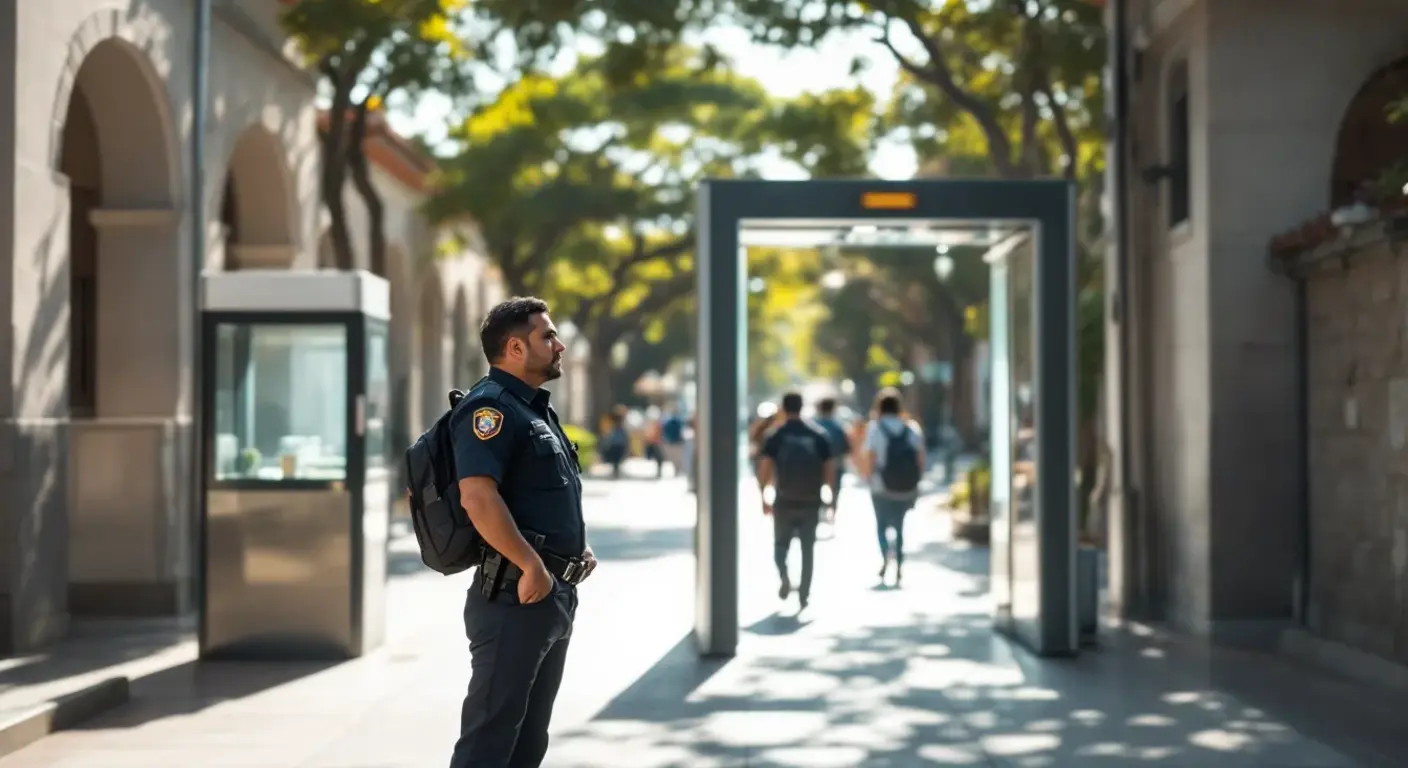
The backbone of any detail is unarmed officers managing entry points, checking crew credentials, keeping the public out, and watching gear during the day. This is standard contract security guard work, but on a set it demands people who understand production etiquette — quiet on a rolling take, invisible in the frame, and calm with a curious public. Basecamp usually gets its own posts covering trailers, catering, and vehicle staging, functioning much like construction site security around a temporary, high-value equipment yard.
Overnight equipment watch
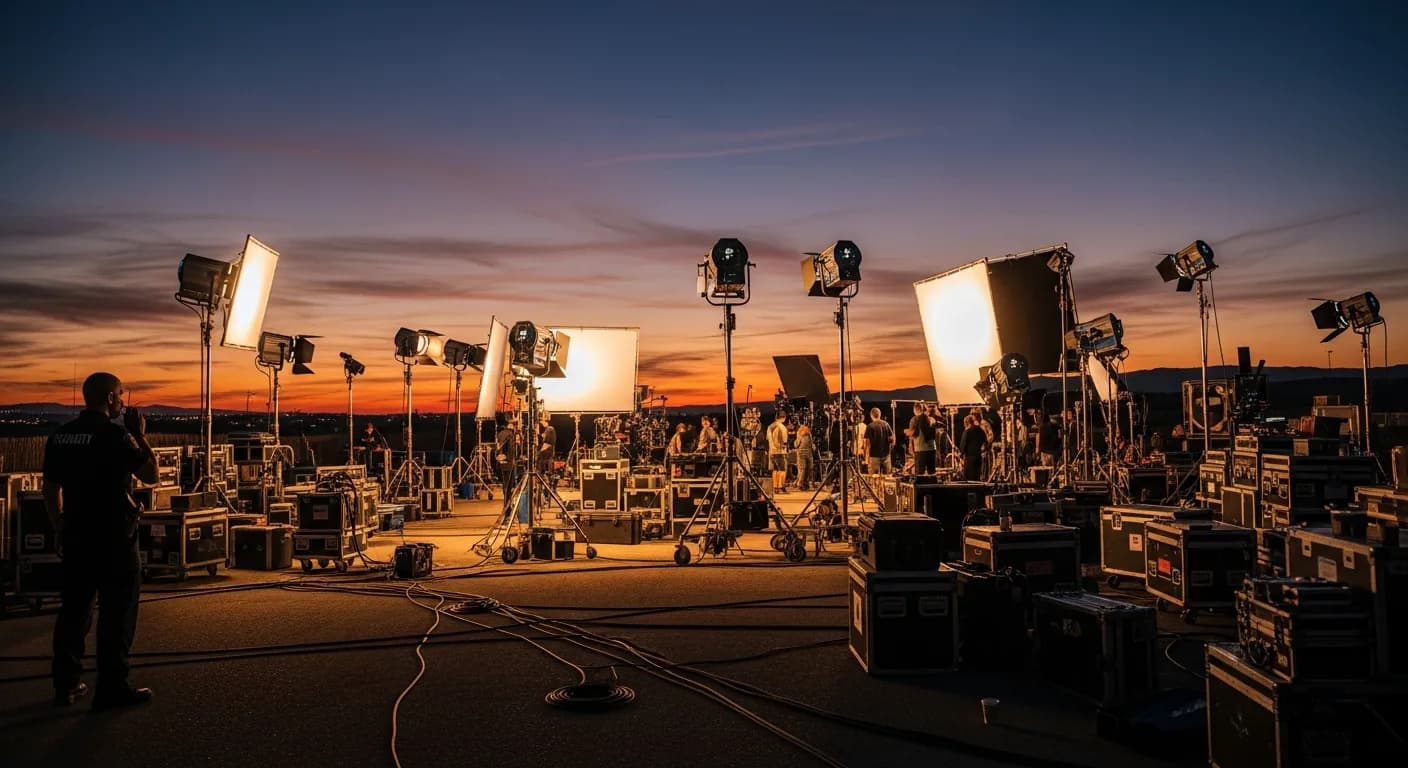
When a location holds gear overnight — trucks, generators, base-lit sets — you need dedicated mobile patrol or a stationary overnight watch. Off-duty officers and MPOs leave when their shift ends; your equipment does not. Pairing a posted guard with a documented patrol loop and, where practical, temporary video surveillance closes the after-wrap window when most on-location theft and vandalism happen. The economics mirror warehouse and industrial security: concentrated value, minimal after-hours foot traffic, and a clear cost of a single loss.
Talent and VIP protection
Protecting a named actor is a different profession from watching a gate. It involves advance work, route and arrival planning, crowd and paparazzi management, and travel between the hotel, basecamp, and set. This is executive-protection work — treat it as such and staff it from a dedicated executive protection team rather than pulling a post guard off the perimeter. Access control and close protection are complementary but distinct disciplines; blending them leaves both gaps. For the corporate side of a studio or production office, ongoing corporate security handles the fixed-facility layer that a per-project detail does not.
Armed coverage and off-duty police
Armed armed security is warranted for high-value equipment moves, cash payroll, elevated threats against talent, or productions in higher-crime areas. Separately — and this trips up first-time producers — many jurisdictions require sworn off-duty or retired police for specific activities. In Los Angeles, FilmLA permits frequently mandate Motion Picture Officers (MPOs) for street or lane closures, any scene with firearms or simulated gunfire, and stunts or precision driving. MPOs handle traffic and public-safety compliance; they do not watch your gear or run your access points. You will typically need both MPOs and private guards, budgeted as separate line items.
Licensing and permits in CA, GA, and NY hubs
Every production hub regulates who may provide contract security, and the rules differ enough to matter when you vet a vendor. Verify licensing yourself — our guide on how to verify a security company license walks through the state lookups.
| Hub | Regulator | Company license | Guard requirement |
|---|---|---|---|
| California (LA) | Bureau of Security & Investigative Services (BSIS) | Private Patrol Operator (PPO); $1M general liability required | BSIS "guard card" (Power to Arrest + 40 hrs training); armed adds firearm permit |
| Georgia (Atlanta) | Board of Private Detective & Security Agencies (GBPDSA) | Agency license + insurance | Unarmed: 24 hrs Board-approved training (no individual license); armed: registered + weapons permit + 15 hrs added training |
| New York (NYC) | Dept. of State (registration) + DCJS (training) | DOS company registration | 8-hr pre-assignment + 16-hr OJT + 8-hr annual; armed: NY pistol license + 47-hr firearms course |
California: A contracted film-set security vendor must hold a Private Patrol Operator (PPO) license, and every guard must carry a valid BSIS registration. All PPOs are required to carry commercial general liability insurance of at least $1,000,000 per occurrence. There is no special "film" license category — production security falls under the same Private Security Services Act as all other contract work.
Georgia: Atlanta's production boom runs on the same rules statewide. Unarmed guards are not individually licensed but must complete 24 hours of Board-approved training; armed guards must be registered through their licensed employer, pass a fingerprint background check, and obtain a Board-issued weapons permit (a personal concealed-carry permit does not qualify a guard to work armed).
New York: Guards register with the Department of State after an 8-hour pre-assignment course, then complete 16 hours of on-the-job training within 90 days and an 8-hour in-service course annually. Armed guards need a valid NY pistol license plus a 47-hour firearms course.
Permits name security as a condition of filming
The permit itself often forces the security conversation. FilmLA — the official film office for the City and County of Los Angeles — requires proof of liability insurance (standard $1,000,000 general liability, with the jurisdiction and FilmLA named as additional insured) and California workers' compensation before it releases a permit, and it cannot waive the comp requirement even for single-employee or 1099 crews. High-impact activity such as closures, firearms, or stunts triggers added lead time and the MPO requirement noted above. New York productions permit through the Mayor's Office of Media and Entertainment; Georgia works through local film offices and the state's Camera Ready county program. In all three, your security vendor's certificate of insurance has to satisfy the permit — see our checklist on the certificate of insurance for a security vendor so a missing additional-insured line doesn't stall your permit release.
What it costs
Production security is billed hourly per officer, with rates driven by role, armament, market, and shift. Use these as planning ranges and confirm against live quotes:
| Role | Typical range (per hour) | Notes |
|---|---|---|
| Unarmed set/basecamp guard | $30–$50 | See unarmed guard hourly rates |
| Armed guard | $45–$75+ | See armed guard cost |
| Overnight equipment watch (24/7) | Premium for nights/holidays | See 24/7 coverage cost |
| Talent close protection | Quoted per detail | Advance work + travel billed separately |
| Off-duty police / MPOs | Set by jurisdiction | Separate from private guards; permit-driven |
Watch for overtime multipliers on the long days productions are famous for, night and holiday differentials, minimum call lengths (often 4–8 hours), and travel/per-diem on distant locations. Our broader breakdowns on how much security costs and mobile patrol cost explain the line items, and you can model a specific shoot with the security cost calculator.
Hiring checklist for a production detail
- Correct state license, verified. Confirm the PPO/agency/DOS credential in the state registry, not just a claim on a proposal.
- Insurance that satisfies the permit. $1M+ general liability, workers' comp, and — critically — the jurisdiction and film office listed as additional insured on the certificate.
- Production experience. Guards who know set etiquette, rolling takes, and how to stay out of frame. Ask for recent film/TV references.
- Flexible, callsheet-driven staffing. The ability to scale up for a night exterior and down for a stage day.
- Clear division of labor with MPOs. Written scope so private security and off-duty police aren't assumed to cover each other's gaps.
- Incident reporting and use-of-force clarity. Understand what arrest powers guards actually have, use-of-force law, and your negligent-security liability exposure before an incident, not after.
Run the process the same way you would any critical vendor — our step-by-step on how to hire a security guard company applies directly. Productions in hospitality-heavy or mixed-use footprints can also borrow tactics from hotel and hospitality security for cast holding and from corporate security playbooks for the production office.
Buyer takeaway
Film production security is a coordinated, callsheet-driven package — access control, overnight equipment watch, and dedicated close protection for talent — delivered by a properly licensed vendor whose insurance actually satisfies your permit. Don't conflate private guards with the off-duty police your jurisdiction mandates, and don't ask a gate guard to protect a lead actor. Scope it early, verify the license and the certificate of insurance, and build the detail around your shooting schedule.
Ready to staff a shoot? Get quotes from vetted, production-experienced providers, or browse licensed security companies in your filming hub.
Frequently asked questions
Do I need private security if my film permit already requires off-duty police officers?+
How much does film set security cost?+
What license does a film production security company need in California, Georgia, or New York?+
Who protects the lead actors — the same guards watching the set?+
How do I protect expensive camera and lighting gear left on location overnight?+
Share this guide
Sources
- California BSIS — Security Guard Registration Fact Sheet
- California BSIS — Private Patrol Operator (PPO) Fact Sheet
- FilmLA — Get a Film Permit
- FilmLA — Area Requirements (City of Los Angeles)
- Georgia Secretary of State — Board of Private Detective and Security Agencies
- Georgia Code §43-38-7 — Licensing of armed employees
- New York Department of State — Security Guard Training Requirements
- New York DCJS — Security Guard Training